ATI's latest GPU targets the mainstream first

By Scott M. Fulton, III | Published November 16, 2007, 11:45 AM

The latest holiday graphics card line from the company in red has a distinctively green feeling to it, maybe for the first time.

When AMD acquired graphics card producer ATI in July 2006, the executives who brought the two titans together told a two-part message: First the fusion would benefit both brands; second, the ATI identity won't be going away.

But former ATI CEO Dave Orton did leave AMD last July after all, giving the post-merger state of the company a certain Daimler Chrysler feel to it. And yesterday, AMD's rollout of ATI's new Radeon 3800 series GPUs had a definitive AMD flavor to it. Unlike typical rollouts from ATI and nVidia in the past, in which the best features premiere at the enthusiast price level and mainstream buyers get to wait six to eight months, this time some of ATI's most important new technology components are being geared for the mainstream buyer first, at less-than-premium price points.

It's a gamble with some sensible-sounding logic behind it, especially given the warnings economists are making about this holiday season's outlook. With consumer spending likely to take a dip over last year, manufacturers should be adjusting their target markets for more moderate spending.

So the fact that the high-end model in ATI's line-up, the Radeon HD 3870 with 512 MB of the fastest GDDR4 memory on board, will sell for a suggested $219 in the States, is something of a surprise. Three years ago, the $200+ price tier represented the high-end of the GPU market, until nVidia started exploiting higher ground, introducing its highest-end performers in glitzy, premium packages that eventually cracked the $1,000 barrier.

Usually the smarter buyers wait until time for the next product cycle, when the once-premium tier GPU gets repackaged as a more mainstream model, and gets a very heavy discount. Recently, $200 has been the "sweet spot" for buyers seeking the best performance for the dollar.

Now, ATI is actively courting that buyer directly, and not with a second-hand or discounted model. With Microsoft's version 10.1 upgrade (some call it "correction") to DirectX 10 due to arrive with Windows Vista SP1, the ability for cards to take advantage of its improved use of memory and its enhanced shading capabilities is a much-desired feature.

ATI opted to premiere its DX 10.1 support with the 3800 series first, as well as boost its feature set with support for dual monitors at varying resolutions, so that the second monitor can run as a dedicated HD display. These are real-world features that everyday consumers can understand, especially if small OEMs equip their custom-made systems with 3800 cards for mainstream buyers.

The latest benchmark tests from TG Daily's Darren Polkowski show the 3800 series ever-so-slightly outperforming nVidia's GeForce 8800 GT - the latest of its premium tier to slide down into the sweet spot - in the more general tests. Average prices for 8800 GT-based cards (OEMs build their own cards using nVidia's chips) hover today around the $230 mark, ever-so-slightly more expensive than ATI's 3800 price points.

To help ATI make its case to mainstream consumers, AMD presented yesterday some screen shots of a demo of its current support for the future DirectX 10.1 - what customers will see from their cards tomorrow if they buy today. They appear in a new white paper (PDF available here) featuring technical explanations of Microsoft's visual innovations - including some items that were actually planned for DX 10.0 but which weren't actually finished in time.

Among the most convincing of these demonstrations is the one involving global illumination. As rendering engineers know all too well, while ray tracing would be the optimum way to determine the proper light and shade to apply to all points in a scene (following the paths photons take as they bounce off surfaces with different textures), that process is still too detailed for even today's GPUs to attempt. Up to this point, the general shade applied to objects in a room has been determined by ambient lighting, with a few features tacked on to fudge for less-than-believable results.

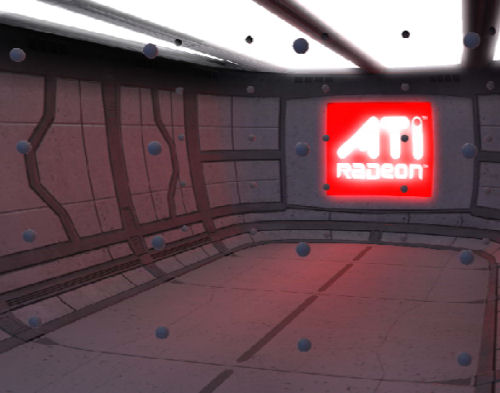
From a demo of Microsoft DirectX 10.1 'global illumination' provided by ATI (plate 1 of 2)
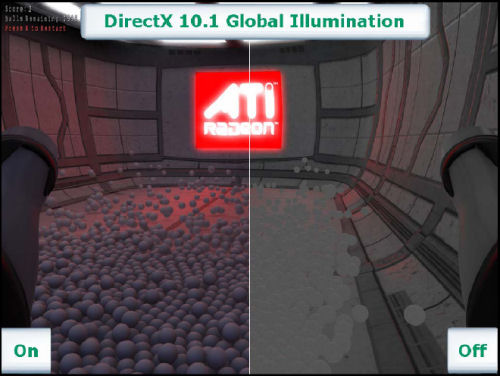
In a very convincing demo of DirectX 10.1 provided by an AMD white paper, we see white balls in a white room with varying trim and colored light. In the lower plate on the right side, you see how current ambient lighting techniques make the balls disappear against the background. By understanding the nature of bounce light, DX 10.1's adjustments make these white balls seem like tangible objects to the human eye.
From a demo of Microsoft DirectX 10.1 'global illumination' provided by ATI (plate 2 of 2)

An ATI demo of global illumination in DX 10.1 shows how Microsoft chose to mask this problem without fudging it too much: The new scheme actually creates rendered scenes in memory, at less than display resolutions, for multiple points in space. Those scenes are used only as samples to determine the predominant colors and shades, for what engineers call "light probes."

Assuming then those chosen points in space are represented by invisible cubes, the probes can estimate a reasonable light color value for any vector one needs to check, for light that passes through those cubes. Thus, without sampling every point in space like ray tracing would, the viewer gets a respectable approximation of bounce light.

The results are very dramatic. White balls in a white room have a multitude of colors in reality that can be completely missed by ordinary renderers. Those colors are provided by bounce light, and those shades are sufficiently represented by global illumination.

With marketing phrases like "performance per watt" providing the icing on the cake - green icing, not red - the entire ATI Radeon 3800 series rollout has a distinctively AMD flavor to it. If this works, ATI could set up a market position for itself against nVidia analogous to the one AMD had (and would like to rekindle) with Intel.

Comments

The illumination technique is a mix of ambient occlusion and irradiance mapping, very easily achievable with any shader model 3 card (including PS3 & Xbox 360). DX10 not required.

Score: 0

|

Good stuff but my once favorite company is dead in my eyes. ATI is dead. They don't even have a f*cking card that goes toe-2-toe with Nvidias overpriced high-end monster. I have 2 ATI cards left in a drawer inside some antistatic baggies. Once those are sold off, I am never going back unless I see 2 things:

A massive comeback like Intel (ugh) did to Whip AMD's butt.

Getting rid of disgusting sickening CrapNET "technology" from all of their control centers and subsequently, from their employees' memories (they can use the Haitian for that).

Furthermore, let me use ATI's cards to perform password-cracking operations like my shiny new 8800 can with the help of their SDK. with 512bit interface and GDDR4, its a damn shame they don't let programmers write software that can utilize the power of their chips (at least in that department) for cracking.

Score: 0

|

Bad timing on AMD/ATIs part... another "mainstream" card is not what the market needs right now with the release of Crysis. Hopefully NVIDIA will address this with their next GPU release scheduled sometime in early 2008. Until then its medium setting with low resolution.... ahhh

Score: 0

|

Whoa did no one catch this part "Radeon HD 3870 with 512 GB of the fastest GDDR4 memory on board"
I mean 512 Gigs!!! hehe, that really would make it a good deal. I mean I wouldnt need a hard drive just put it all on the cards 512 GB of ram. Okay so I would still need a hard drive but its funny no one caught that yet. Anyways the card still sounds pretty good, plus I'm tired of Nvidia always being in your face in the beginning of every game.

Score: 0

|

I always did like ATI better than nVidia. This just gives me another reason. I don't really see myself buying desktops anymore, as I've switched to notebooks and to the Mac side, but hopefully we'll see some of this technology migrate over to ATI's next series of mobile chips.

Score: 0

|

I like that. I may even buy this 3800. ATM i have x1950 for almost a year and i expected it to work at least a year more until i'll have to replace it with something more powerful. Now i'm not sure.

As for this light-probing technology, it sounds reasonable. Though i do like full ray tracing a lot more...With today's powerful GPUs we could have got a reasonable FPS with hardware-accelerated ray tracing.

Score: 0

|

"As rendering engineers know all too well, while ray tracing would be the optimum way to determine the proper light and shade to apply to all points in a scene (following the paths photons take as they bounce off surfaces with different textures), that process is still too detailed for even today's GPUs to attempt."

Score: 0

|

3D Studio MAX and other high-def rendering and modeling tools use full ray tracing and sometimes provide quite fast rendering speed using CPU only. With GPUs being somewhat more powerful and with better parallel rendering support (suites well for ray tracing) and additional optimizations (not as radical as those mentioned in this article, yet useful and with noticeable effects) real-time ray-tracing may be real. IMHO.
Remember that today's most FPS-reducing features are advanced lighting and shadows (especially self-shadowing). Ray tracing includes these by default: normal tracing pass to render actual object's surface is mostly identical to the same tracing used to calculate lighness of this surface. I am not sure about anti-aliasing, but i guess something might be done with that as well.
But i doubt someone will try to create consumer-grade ray tracing library and hardware support for it. Market is ruled by projective graphics, and it will be so for many years to come...

Score: 0

|

You sir, are obviously not a rendering engineer.

Score: 0

|

I am not. They are. Yet they are interested party. There's a whole industry built around projection rendering. They can't (won't) abandon it. I do not beleive them. If you could provide me with third party publications with exact numbers (and math behind them) indicating that it is not possible indeed to build such thing - i'll take my words back. Until then - i'll stick with My own Humble Opinion.

Score: 0

|

Before it can tackle Windows, Chrome must leave Safari in the dust

It's a little browser with dreams of becoming a bigger operating system some day. But while it's chasing Microsoft's dreams, Chrome's tail is being chased by Apple.

Silverlight 3 goes live on Microsoft's servers

Microsoft's answer to Adobe's Flash is (unofficially) here, with prospects of higher-speed, higher-resolution video and for the first time, 3D.

Best Buy-brand TVs to get TiVo

A new alliance will place the retailer's own brand alongide the manufacturers, and could also lead to future partnerships on services.

Three Android phones on the way from T-Mobile in 2009

T-Mobile's myTouch 3G, launched Wednesday, will be followed by two more Android phones later this year, but neither of them will be HTC's Hero.

LTE still lacks a voice

The 4G Wireless standard that Verizon hopes to show off before this year is out is still at a loss for (spoken) words.

T-Mobile's strategy to combat Apple's iPhone with Android

With a trio of Android phones now in the pipeline for 2009, T-Mobile hopes to break the iPhone's emerging stranglehold.

EC's Reding: Government should act as broker for media downloads

If Internet media services don't step up and build an attractive way for users to start paying for downloads, a commissioner says, government may do the job instead.

Sony TVs get Netflix, still no PS3

Though it's coming in behind LG, Samsung, and Microsoft, Sony will begin to offer Netflix streaming, too.

Google Chrome OS: Too little, too early

Carmi Levy: Wide Angle Zoom Don't start the revolution just yet, says Carmi, who isn't so certain Chrome OS will be the "Windows Killer."

GAO pen test brings the hammer down on federal rent-a-cops

But are the computers to blame for the contract-guard fiasco at FPS?

What's Next: Chrome OS will have at least some friends in high places

Also: South Korea takes another round of DDoS abuse, and Neelie Kroes and Steve Ballmer may shake hands before she exits stage left.

Data sharing among online advertisers: Is sanity in sight?

Lockdown with Angela Gunn In the middle of a 15-page plea not to get regulated, a spark of smart thinking.

PST Recovery Software 12.0

July 9 - 11:34 PM ET

Unistal Data Recovery 12.08.06

July 9 - 11:09 PM ET

BKF Repair 3.0

July 9 - 10:54 PM ET

Vuze for Windows 4.2.0.4

July 9 - 6:26 PM ET

UltraVNC 1.0.6.4

July 9 - 6:05 PM ET

WildBit Viewer 5.5 Beta 3.0

July 9 - 5:44 PM ET