Congress: Should cell phone exclusivity contracts be illegal?
By Scott M. Fulton, III | Published June 22, 2009, 5:21 PM
Exclusive cell phone sales and distribution contracts, such as the one between AT&T and Apple Inc. for all models of iPhone, are solely responsible for the quickening pace of innovation in the American handset market, or solely responsible for its imminent demise -- solely. That's the black-and-white nature of the arguments raised before the Senate Commerce Committee last Wednesday, as executives from the nation's second largest carrier and two smaller ones joined industry advocates in debating whether locking out carriers' access to popular phones is good for competition and good for the consumer.
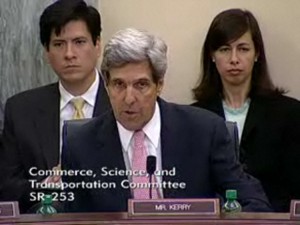
"Today, when you sit down at a computer and you access a broadband connection, you're not told by your broadband provider that you have to have a Dell or an HP or an Apple in order to access the network," stated Sen. John Kerry (D - Mass.), the former presidential candidate who chaired a portion of Wednesday's hearing. "And when you purchase a wireless phone in Asia or Europe, you typically don't buy it through a wireless carrier. You purchase it separately from the manufacturer or from an outlet."
Regardless of the fact that many broadband subscribers rent their cable modems through their carrier, this state of affairs -- where every device is available to everyone everywhere -- seems to Sen. Kerry like an ideal state of affairs. But on the other side of the bench was Paul Roth, President of AT&T Retail Sales and Services, who is one of the principal architects and defenders of his company's contract with Apple (the exact terms of which senators last week were unsuccessful at prying loose). Roth's principal argument was difficult to rebut: If you level the playing field nationwide, you end up driving handset prices up and the incentive to make better handsets down.
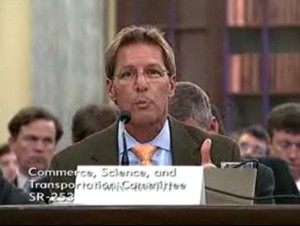
"Exclusive device deals lead to lower prices. Consumers pay well under what AT&T pays Apple for the iPhone. It's a standard US industry practice for the device [to be] sold below its cost, in return for a two-year agreement where the subsidy that made the initial price possible is recovered over the term of the agreement," Roth testified. "In the past two years that the iPhone has been exclusive to AT&T, the price of the iPhone has gone from $399 to $199, and just last week to $99, all while exclusive to AT&T. And with the iPhone at $99, prices of other devices, including other exclusive devices, have dropped and will continue to drop in response to that."
Along with innovation comes the risk of lack of success -- a risk that handset manufacturers in this economy are unwilling to assume completely on their own, Roth pointed out. So AT&T and the other competitors in the "Big Four" -- Verizon Wireless, Sprint, and T-Mobile -- offer exclusivity deals to manufacturers, he said, knowing it will drive them to produce handsets with features that competitors' models may lack.
Roth also went so far as to argue this: If AT&T and other carriers did not seek exclusivity by demanding features such as touchscreens, with the sole exception being Apple (which all agreed to have initiated the iPhone deal), manufacturers would not have offered or even created these features on their own.
As Roth went on, "We often ask for innovative features or design which requires a manufacturer to create an entirely new product, and our requirements are often the catalyst for innovation. To build really new and innovative devices creates risks for manufacturers, and the manufacturers are seeking a partner to share that risk with them. They ask us to commit both technical and financial resources, and make volume commitments, all without the assurance that the device will be a success. AT&T competes with foreign carriers like Deutsche Telekom and Vodafone for the attention of these manufacturers, to bring innovative devices first to consumers in the United States. It's not an accident that the iPhone...launched first in the United States. We took a risk with Apple on the iPhone, that it would be a big success for consumers. And consumers were the ones who benefitted from that."
But beside Roth on the witness table were executives from two other carriers serving mainly rural areas, including US Cellular President and CEO Jack Rooney. Claiming that the Big Four carriers were doing no less than hijacking the industry, Rooney argued, "Exclusive arrangements are especially damaging to rural citizens because oftentimes the biggest carriers don't offer any service at all, and so the product is unavailable to that consumer. When rural consumers buy an exclusive phone from one of the bigger carriers, they frequently must accept an inferior network as a tradeoff -- a tradeoff no consumer should be compelled to make.
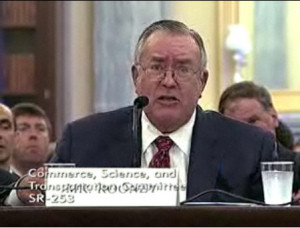
"There is harm in urban areas as well. Consumers who desire an iPhone or a BlackBerry Storm smartphone cannot use it on our network, even if they prefer our service," Rooney continued. "We do not understand how the public can possibly be served by such a practice. If you take away nothing else from this meeting, I want you to understand a central goal of policy makers should be to enable consumers to buy the handset they want, and choose the service that best suits their needs."
Roth later countered by arguing that AT&T also serves rural areas as well, blanketing 90% of the nation, and soon 95% after it acquires some Alltel assets from VZW. But Rooney agreed that the US market was vast, which should be catalyst enough, he said, for handset manufacturers to pursue this market without exclusivity as an incentive.
"I've heard that exclusive arrangements drive innovation. This is counter-intuitive. Every manufacturer desires to sell its product to the widest possible audience," testified Rooney. "If handset exclusivity did not exist, would any manufacturer refuse to invest in great devices knowing that there was currently a handset market of nearly 300 [million] users in the United States? Any handset maker that invents a great device receives intellectual property protection, and that confers a tremendous financial incentive to build a winning product."
Supporting Rooney's claims was Penn State Professor of Telecommunications and Law Robert M. Frieden, who pointed out that one of today's common tenets of exclusivity agreements consists of arrangements between a carrier and manufacturer to limit functionality, as evidenced by the growing list of functions you cannot do on an iPhone.
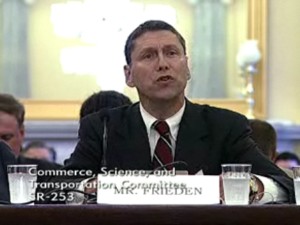
"Near-exclusive reliance by wireless carriers and their agents on a single business model, which combines wireless service and handsets used to access the service, strongly influences what kinds of services the handset can perform, and what kind of software the subscriber can download," said Prof. Frieden. "This combination of handset and service also creates incentive for carriers to secure exclusive distribution rights for choice devices such as the Apple iPhone. It motivates carriers to favor ways to recoup their handset subsidies rather than to concentrate on offering unconditional access to the features within the handset, or services available by downloading software and content to the handset."
Frieden cited the FCC's 1968 Carterfone decision, which enabled customers for the first time to purchase telephones other than those produced by Western Electric -- at the time, AT&T's sole manufacturer. The principle of that decision, the professor said, was that utilities that provide a service should have no monopoly on the device that produces that service.
"Television broadcasters have no right to restrict consumers from watching cable and DVDs. Likewise, no personal computer manufacturer or software vendor can regulate what consumers see on their monitors, and what services they can access. Applying the Carterfone policy to wireless would stimulate innovation in handset design, promote competition, and motivate carriers to make their networks more accessible," stated Frieden.
The argument against Frieden is that the wireless industry, unlike the wireline phone industry in 1968, does not need the FCC's intervention in order to create competition. That argument was presented by Progress & Freedom Foundation Senior Fellow Barbara Esbin, with a tone that at times indicated she seemed annoyed at Frieden's and Rooney's arguments, and at times that she just had a headache and would like to have gone home.
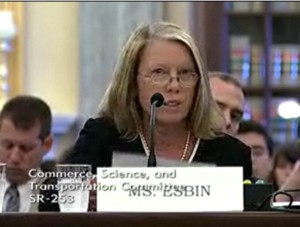
"Consumers will remain protected from demonstrable anti-competitive activity or unfair and deceptive practices in this sector by our antitrust and consumer protection authorities. The FCC has repeatedly found the wireless marketplace to be effectively competitive -- not perfectly competitive, but effectively competitive," Esbin testified. "Carriers are willing to pay for exclusive arrangements because offering subscribers a hot new handset is a way to differentiate their services. The FCC has acknowledged that product differentiation is a natural competitive response by carriers to customer churn. Churn itself is a sign of competition, and the exclusive arrangements are simply a feature in an intensely competitive market. And handset manufacturers benefit from the exclusives by being able to develop the initial version of a device for one type of network, ensuring both speed to market and some control over the user experience. Guaranteed minimum order from the manufacturer, another common feature, can remove some of the risks associated with a new product offering, thus permitting riskier and more innovative designs."
Next: Could exclusivity bleed into the computer realm?
I for one wanted a I Phone but no serivce in the area code 39476. Ported my number to Altell and AT&T cut of my high speed 6.0 internet off. They spend Billions trying to get you to bundel but when it comes to a quick call that your ported number disconnects you from the internet Not A Word. Then it took 2 days to get back up running. they only work from 9-7 if you can get through in 10 t0 20 minutes . They say heavy call volume then connected to a computer answering machine that will tell you everything but what you need,so another 5 minutes to get to a live operator. Ha not enough people working Was talking with the regular phone service to straighten this out at about 7 oclock he just sends me back to DSL internet people and goes HOME. Then they finally get the message that am down only had this for 3 1/2 years they give me another number and here comes the new installation kit with CD and everything I don't even need> More lost expense on there part, Oh yes I have CDMA from Altell and it work get Celluar South also has service at 39476 CDMA but none of the big carriers. Oh yes I would have perfered the GMS type phone but to no avalibilityat 39476.
Score: 0
|I'm sick to death of people buying phones for hundreds of dollars, and [it's a great phone] but you can't use it anywhere else but with Tmobile, ATT or Verizon... it's stupid. Phones could be made to handle all these formats and communications, but yet they don't. They want to lock you in...
Point of fact, if you go with iPhone and ATT and you think you're getting crappy service, you cancel [you get termination fee] and you can't use your phone anywhere else... where is this fair?
Phone companies need to be put on a level playing field saying this is THE standard; this is what a phone must be able to do..
Where's the option to advise you your going over your planned budget? Where's the customer relationship? Acting in the customers best interest? Nah- they'll just charge you out the wazzoo...
They suck.
Thanks for reading!
www.lehsys.com
Score: 0
|I kinda like the anti-competitive laws in Australia and the 4 Pillar Bank system (Top 4 banks can not merge. Should be upgraded to Top 5 to be honest). If you want a law to stop "too big to fail institution from forming" and force competition this is a way to do it
Score: 0
|But where would you even begin to institute something like that in the US?
The "too big to fail" companies are already....too big to fail.
I still think we should have just offloaded the customers of AIG to other companies, covered whatever losses remained and let AIG fail. Still wouldn't have cost anywhere near as much as these continuous bail-outs are...
FTM, let the car companies declare bankruptcy, dissolve, reform and come back without 90% of their legacy costs. That's what we have medicare for, right? It's not like GM and Chrysler would just disappear. They'd restructure, lose the majority of their debt and actually be able to *compete* with Toyota, Honda, and such.
I keep telling myself I'm missing something...that it couldn't be that obvious, but frankly, the more I think about it, the more I can't help but think all these bail-outs and stimulus packages are designed to do something completely *other* than "help" the "people"...
Score: 0
|Actually though I agree with you on most part the idea that "too big to fail" companies can never fail is probably slowly fading awy. I agree US has probably not seen such a thing but Europe is already seeing this and the trend is a bad one. Probably one of the biggest examples are branches of Siemens like siemens Communications, semiconductors . They are all dead or look at the wireline market, the once big is dead.
Exclusivity in a way hurts competition a lot I would probably agree with Sen. John Kerry on this point. Price is only a very small part of the bigger picture. Taking example of iPhone itself (not saying that it is a bad phone), wouldn't you agree iPhone could have seen much better innovations/featuresets if it did not enjoy the exclusivity?
Score: -1
|.....wouldn't you agree iPhone could have seen much better innovations/featuresets if it did not enjoy the exclusivity?
Errrrr no not all. That's a complete load of rubbish mate.
Score: 0
|Exclusivity seems bad for competition, to me. It can run the risk of being about which network has the money to secure the most popular phone. Exclusivity also doesn't provide any incentive for the phone manufacturer to drop the price, nor the network to push to get customers a better deal. Competition is a good thing, exclusivity never is.
Dell with only Intel Processors, ie? Other people make computers, so by everyone's logic of "no-one makes you sign to that carrier and get that phone" the Dell situation should never have been a big deal either and allowed to continue.
Score: 0
|"the Dell situation...."
...is completely different.
Intel told Dell they'd get a special deal if they promised not to sell AMD cpus.
Apple said nothing of the kind to AT&T. AT&T's network still supports *any* GSM-capable phone and their website offers a rather wide variety.
Score: 0
|Carriers have the right to exclusivity and if you think that sucks - don't buy the phone and stop whingeing. Simple as.
Score: -1
|Crap. I agree with you. Stop that. :p
Score: 0
|lol :)
Score: 0
|Two points of BS:
"And when you purchase a wireless phone in Asia or Europe, you typically don't buy it through a wireless carrier" - Nonsense. You typically buy subsidized from the carrier in the EU (don't know Asia)
"If you level the playing field nationwide, you end up driving handset prices up and the incentive to make better handsets down." - Nonsense. We are talking about exclusivity. Carriers can still subsidize as much as they want, which will effectively introduce transparent competition and drive DOWN prices.
This is fairly trivial stuff. Tired of the BS spawned by corps and politicians - clearly fabricated lies on both ends to support their arguments.
Score: 0
|Already illegal in Australia. Competition law prevented Apple from tying in the iPhone 3G with any carrier - so we ended up with all but one carrier supporting it (the last didn't get it because they didn't have decent 3G coverage).
I think most consumers would prefer choice.
Score: 0
|You have a choice, don't buy an iPhone. As they said, this created mor eiPhone like phones. Its not like there are carriers without cell phones available. This whiole thing is nonsense, its not worthy of a debate on Capital Hill. LIBERAL WASTE IN FULL FORM!!!
Score: 1
|Sure, we all know Republicans would never do anything like this. *rolls eyes*
Score: -1
|@Tenoq:
What price are we talking with these phone in AU now? Still $99 without the carrier lock-in?
Score: 0
|Thats not the issue at all..
The issue is not so much "omg i am contracted to verizon, and have no choice but to break said contract to get an iphone since its only on ATT" (obviously if your contract is not up you are gonna break it to get a new phone even if it is offrered by your current carrier)
The concern is the sweetheart licensing/exclusivity deals, and the tying of phones in general to carriers..
IE not ONLY the fact that you can only get an iPhone on ATT, but that you can only USE the iPhone you just bought on that carrier's network.
The Corp line is "we are paying for the phone its our right to restrict you from using it on another carrier.." the senator/FTC are more saying.. no my signing a contract for 2 years with you to get a discount on the phone, is the extent of what you should legally be able to do as far as carrier locking..
And this was largely prompted by the fact that any phone (the iPhone is just the most recent example) that is carrier exclusive cannot be used in certain geographical areas because we do not have 100% coverage in the US of all carriers..
Because ATT for example chooses NOT to build out in my area I am being barred from using the iPhone..
Personally I wish they would look more at the contract terms and laughable pricing but meh
Score: 0
|"Because ATT for example chooses NOT to build out in my area I am being barred from using the iPhone.."
It should work just fine on any GSM network. Unfortunately, in the US, that's AT&T and T-Mobile. The rest, I believe, use CDMA.
Unless they make the device dual-band or CDMA, your options are limited more by the hardware than the contract.
There's nothing stopping you from buying the iPhone, breaking the contract and signing up with T-Mobile, though. ;)
Score: 0
|Considering Apple has whined in the past about other companies "monopolies", it's quite laughable that they are doing the same thing with their phones.
Score: 0
|quite evident you have no idea what a monopoly is
Score: -1
|"Churn itself is a sign of competition"
Could also be a sign of unhappiness.
Score: 0
|Its very simple... pay full price for the phone with no contract, or get the free or discounted phone with a contract. Some companies already do that option.
Score: 0
|Most do. I got my Voyager for $50. Touchscreen, qwerty keyboard, net, music, video....
..and yet people want *more* for *less*.
It's crazy.
Score: 0
|US Senators are a JOKE!!!! Vote them out already!!!! The US East coast needs to get a CLUE!!!
Score: 0
|What like our West Coast has a clue.. i.e. California, Bankrupt...
Score: 0
|Agreed, but if you want these losers to actually do their job instead of protecting it, we need term limits. This way we wont be subjected to retards that let their dates drown in a car because they were too drunk to care, or didn't want the DUI charge, and what's one life anyway, right.
Score: 0
|I agree with the House only having term limits. The way the framers wanted it the house was for common people (hence the two year terms). The senate is for career politicians (hence the six year terms).
Score: 0
|Our society demands cheap phones but doesn't want to be locked into long terms contracts. Unfortunately we don't seem to realize that the rest of the world has expensive phones but no long term contracts.
you get one ... not both.
Score: 0
|Agreed. This is a waste of time. The manufacturers subsidize the high cost of developing phone after phone (most manufacturers come out with a new one every month it seems) with carrier tie-ins. The cost of R&D alone on these things has got to be enormous.
Our "society" has been notorious lately for wanting "everything" for "nothing". No-one seems to realize (or care) what it costs.
Score: 1
|I really think your warping this entire argument for your own agenda. No one is asking for handouts here. We just want to choose what we want for our money. If ATT can subsidize an iPhone, why can't they do the same for a Palm Pre? Or an android phone? Apple and Palm both do their own R&D, they aren't subsidized by Sprint or ATT. They make money on the phones. (and in Apple's case, the App Store.)
Of course phone companies have a right to recoup there expenses on subsidized phones. That's why we sign CONTRACTS. If I leave ATT for Verizon, I still have to buy out of the contract no matter what phone I have. Their costs are covered, so why do they care what I do with the phone?
Score: 0
|"Apple and Palm both do their own R&D, they aren't subsidized by Sprint or ATT"
???
How is the iPhone *not* subsidized? You are locked to AT&T and get a discount on the phone because of it. Do you honestly think the phone would be the same price unlocked? Seriously?
The contracts aren't what matters. Contracts are relatively easy and not overburdening to break. Any carrier can offer a contract, and while they do offer "$50 off" or whatever when you sign a 2 year contract, that's not even close to they will subsidize for *exclusivity*. Especially on phones like the iPhone, Palm or Blackberry.
Score: 0
|BIG GOVERNMENT, PLAIN AND SIMPLE!!!
Let consumers handle this, another waste of taxpayer's money on frivolous debates. Just like having baseball players on the hill, this is stupid, this is NOT a matter for the government. The US is still called a free-market economy but not for long. EVEN having this debate is WRONG! This is debating the little things that may give some votes yet we are in a recession CAUSED by the liberals who have been in control of congress for YEARS, and the same ones wasting our tax money on crap like this!
What has the 1 trillion dollars you nit-wits spent done for the economy? Our economy would be best served if all these people up there were replaced in the next election, and stupid debates like this cease to happen in the future. STOP the WASTE!
Score: 0
|oh shut up. you might have had a valid point in there somewhere but then you had to start railing on the government and the liberals and the economy. just shut up if you're not going to talk about the actual article.
Score: 0
|The-One: Amen to that. Now with the national health insurance plan, they plan to spend at least another $1 tril, but we all know it is going to end up costing the citizes $3 tril. Guess how they are going to pay for all that spending? Higher taxes. They can only get an extra $160 bil or so for raising taxes on the rich. We are next in line for the massive tax hike. Perfect example of why we need the FairTax.
Also, you forgot to mention the Congressional Hearings into College Football and the BCS.
Score: 0
|BETANEWS ... say it with me ... this isn't the drudge report.
Score: 0
|You're right, I should shutup and let the government continue this ludicrous destruction of our free market economy with YOUR tax dollars. Thank you for pointing me in the correct direction.
Score: 2
|Well actually, The-One has a few good points. Big government + Big bulls*** = tax payers money. Damn government constantly interfering in everything. It's just nuts.
Score: 1
|Calm down sweetheart, I'm sure you've never rambled on incoherently about a righty.....
Score: 0
|ROFL. "free market economy"...i sure hope you are not talking about the USA as the USA does not have a "free market economy". You probably also think the USA is a Democracy.
Score: -1
|The-One: I guess you forgot about the first stimulus package that was passed by Bush. Not to mention the Iraq war, which reasons to go there were fabricated by the Bush Administration and Tony Blaire. Just to let you know, you can't just blame one side for all the problems. Blame falls on everyone.
Score: 0
|vikampion - old excuse, Republicans aren't in power now, and cannot waste our tax money. Dems have been in control of congress FOR MANY YEARS!!! The current congress is no better, and there was a vote that 98% of congress agreed to the Iraq war (thats both republicans and democrats, bush, blair, etc..) Hindsight blaming Bush is stupid and old. Even Kerry said we should do it(look on youtube). When it was popular, every politician agreed.
Anyways, I'm only blaming those who are on power now and have the ability to CHANGE, but will NOT do so. This telecom forum is another example of WASTE!
Score: 2
|Again...you need to check your facts.
Dems only have been in control of congress for the past 2 years. Repubs had control of it from 2003-2007
Also, I agree w/ you that everyone was in support of the Iraq war going in. The problem is that you are ONLY blaming dems, when teh blame ALSO falls on Repubs (which is why in my original post, I said the blame falls on everyone).
Also, the statement saying to only blame the people in charge now is ludicrious. You can't blame someone who just got into power for problems that have been caused by the last 15-20 years.
Score: -2
|"Repubs had control of it from 2003-2007"
Not hardly. No-one had control. The margins were so close that *nothing* could get through unless one side gave in.
Talk about your perfect system. ;) Moved only by rhetoric and emotional response; the only things they could accomplish were zero substance "looks like we're doing something" BS and overblown, "no time to think about it", "emergency" decisions.
Now, if we could get that system without the "emergency" decisions, I wouldn't mind so much...other than billions spent on BS "makes 'em look good" legislature. Stack both idiot sides equally and let *nothing* get done. At least then they aren't spending us into 30+ years of debt, waging "military actions", or taking our freedoms away.
Score: 3
|vikampion - so, because republicans "were" in control, and dems just recently spent 1 trillion dollars on nothing, and dems are wasting their time with this BS instead of something important like...ummm... nuclear N.Korea, republicans should be blamed too? Your logic is mystifying :)
Score: 0
|