EC silent thus far over Microsoft's Windows 7 E tactics shift

When Microsoft originally presented its proposal to the European Commission last July 24 to offer Windows 7 to European customers without Internet Explorer 8 pre-installed as a requirement, it showed the EC a picture of how it could present customers with a choice of Web browsers, including IE8 but also Firefox 3, Safari 4, Google Chrome, and Opera. (The order of appearance may have been according to estimated usage share.)
As the company's proposal (DOC file available here) read, "Nothing in the design and implementation of the Ballot Screen and the presentation of competing web browsers will express a bias for a Microsoft web browser or any other web browser or discourage the user from downloading and installing additional web browsers via the Ballot Screen and making a web browser competing with a Microsoft web browser the default."
The picture accompanying that description was presented separately, and is reproduced here: It happens to show the Web browser ballot screen appearing in IE8, the way existing European Windows XP and Vista users with IE8 might see it if it were presented to them. At the time, it seemed that the prominent "Internet Explorer" label on the title bar was merely indicative of the fact that a Web browser would be displaying the ballot, and not of some bias as described by the proposal itself.
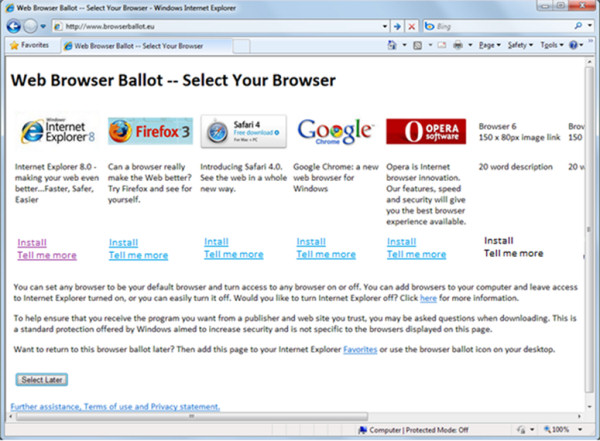
But it did clearly indicate the need for a Web browser of some sort to display the ballot. Though the proposal states that users of all three modern versions of Windows, where IE is the default browser, would be presented with the ballot screen, the proposal did not say a Web browser was required to display it. Rather, it said that the ballot would be offered as an "Important" or "High Priority" item via Windows Update.
So it appeared at that time that Microsoft had already worked out a solution to the problem of how to present new Windows 7 users with a browser choice, using the browser-less Windows 7 E edition it had planned to introduce last June 11. However, last Friday's unusual announcement by Microsoft Deputy General Counsel Dave Heiner suggests that if it thought it had a solution, it might not actually have been a working one. Heiner cites "continuing feedback...from computer manufacturers and other business partners" as its reason for changing course, and distributing Windows 7 in Europe on October 22 with Internet Explorer 8, unless the European Commission accepts the company's proposal.
"One reason we decided not to ship Windows 7 E is concerns raised by computer manufacturers and partners," Heiner wrote. "Several worried about the complexity of changing the version of Windows that we ship in Europe if our ballot screen proposal is ultimately accepted by the Commission and we stop selling Windows 7 E. Computer manufacturers and our partners also warned that introducing Windows 7 E, only to later replace it with a version of Windows 7 that includes IE, could confuse consumers about what version of Windows to buy with their PCs."
But just one week earlier, Heiner's superior, Brad Smith, stated in a formal press release that the reason Microsoft would ship a browser-less Windows 7 E first was not to reduce consumer confusion, but rather to comply with European law.
"As we said June 11th, we currently are providing PC manufacturers in Europe with E versions of Windows 7, which we believe are fully compliant with European law," Smith wrote at the time. "PCs manufacturers building machines for the European market will continue to be required to ship E versions of Windows 7 until such time that the Commission fully reviews our proposals and determines whether they satisfy our obligations under European law."
The implication from Heiner's later statement announcing the course change is that Microsoft knows that by selling Windows 7 unaltered to European customers, it may be violating European law. As of Monday afternoon, both Microsoft and the European Commission's Antitrust Division have been silent on this issue, in communications with Betanews.