PDC 2008: More details on the new Windows 7 Taskbar

By Nate Mook | Published October 29, 2008, 7:05 PM

At PDC 2008, Microsoft took the wraps off Windows 7 and showcased its new dock-like Taskbar. But the revamped Taskbar isn't in the pre-beta build distributed to attendees, so we went hunting for more details on Windows 7's most prominent new feature.

First up, Quick Launch is officially dead. Microsoft will be leaving the Quick Launch folder in Windows 7 for backwards compatibility, but any shortcuts stored there will never show up. Deskbands (like an address bar in the Taskbar) still exist in Windows 7, but must also support rendering on the transparent Glass UI.

The new Taskbar essentially has Quick Launch integrated into it. Applications can be pinned to the Taskbar so the icon never moves. Opened applications have a square around the icon to differentiate them from those that have not been launched.

Applications not pinned to the Taskbar will appear on the right side when opened, and disappear from the Taskbar when closed. Like the taskbar grouping introduced in Windows XP, each application only has one icon. Hovering over the application in the Taskbar pops up a display that shows thumbnails of the app's opened windows.
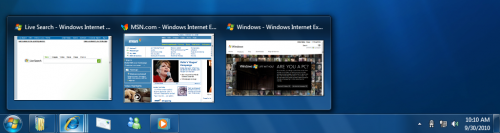
Windows 7 Taskbar

Those who have used the Mac OS X Dock or ObjectDock from Stardock will find the Windows 7 Taskbar very familiar. But Microsoft has introduced some unique features to its own take on the dock. The most notable of these is "Jump Lists," which add a mini Start Menu to an application and surface key options.

Formerly known as Destination Lists, Jump Lists are accessed by right-clicking an application's Taskbar icon or via dragging. Jump Lists are broken into two areas: destinations and tasks, and are fully customizable by the developer.
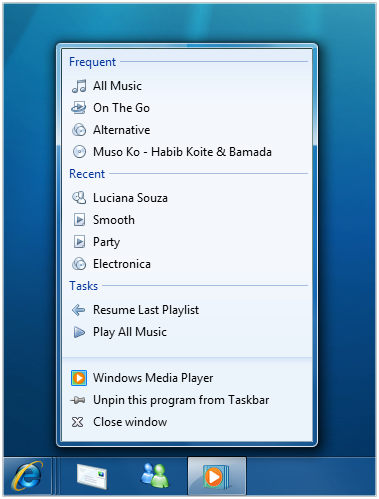
Jump List

Destinations are nouns, such as "Notes" or "TPS Reports." Pinned destinations are located at the top, with categories provided by Windows 7 below. Recent is enabled by default, although developers can choose to display Frequent. Below the known categories are custom categories, such as "Important."

Tasks reside below destinations and contain verbs such as "Close window." Tasks specifically related to frequent actions a user would take in the application are at the top, while Taskbar tasks such as "Unpin this program" are at the bottom.
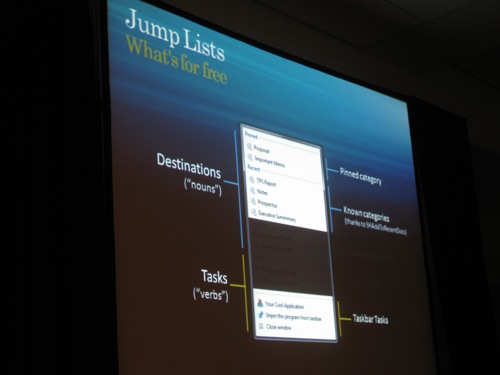
Jump List

Another major new feature in the Windows 7 Taskbar is the "Thumbnail Toolbar" -- a remote-control for a window. It appears on the Taskbar thumbnail user interface and like the Jump List, surfaces key commands with up to 7 buttons. Unlike Jump Lists, however, Thumbnail Toolbar buttons are window-specific and pertain to common window tasks. They can also change depending on an application's state.
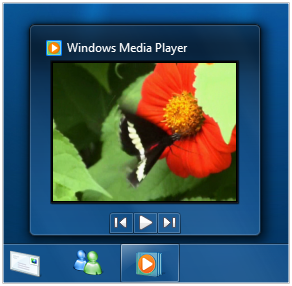
Windows Media Player Thumb

Windows 7 will additionally allow images to be overlaid on an application's Taskbar icon. This could be used to indicate a new IM or e-mail, or even display a progress bar that shows the status of a task. The Mac OS X Dock also has these abilities.

Lastly, the Windows 7 Taskbar includes a task switcher that exposes thumbnails of documents for switching between windows. The thumbnail is provided by the Desktop Window Manager (DWM), although developers can override the image with a bitmap of their own.

Show Desktop will still exist in the Windows 7 Taskbar, but the button has been moved to a small space on the very right side of the screen that is not labeled. When you hover over the small button, opened windows disappear and only the outlines remain. When you click the button, it works just like Show Desktop always has.
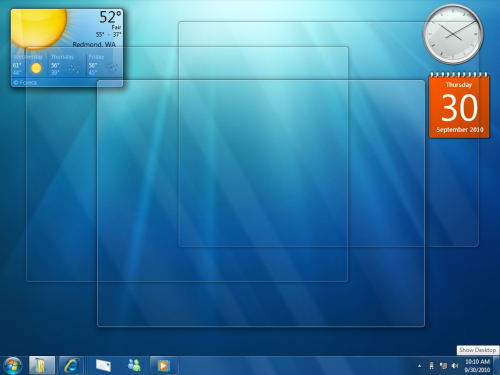
Show Desktop

Unfortunately for developers, the new Taskbar was not included in the M3 pre-beta build of Windows 7 distributed at PDC 2008. The first time consumers and developers will gain access to the new UI is early 2009, when Windows 7 Beta 1 ships.

A major caveat for developers, however, is the new Taskbar APIs won't ship with .NET Framework 3.5 SP1 in Windows 7, but come with .NET Framework 4.0 that will arrive later. Because of this, developers will need to use WPF wrappers in Windows 7 to enable the Taskbar features.

For those hoping to see multi-monitor support with the new Taskbar, don't hold your breath. Microsoft says that this could conceivably happen in Windows 8, but it won't be added to Windows 7.
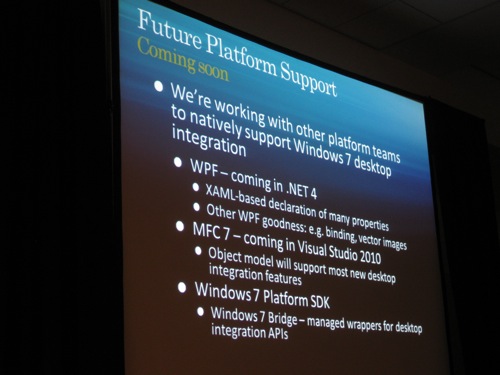
Taskbar Roadmap

Comments

View comments by with a score of at least

Enabled the Superbar in my install...a few things;

Active/inactive: Active windows show on the taskbar as "raised" with a frame around them.

Number of open instances: On the Right of the icon, there appears a partial frame for each task above the initial one.

Hovering to see the windows in the group takes under a second. each item in the preview has an "X" to close them without opening the actual window (It would be nice if you had a maximize or minimize in case the window was buried...one click instead of two?)

It looks pretty functional, all said. A lot of the comments in here regarding it's usability (or lack thereof) seem to be misplaced. It's very easy to tell if it's active or not, how many tasks of it are active, and quite simple and quick to switch between tasks.

Score: 0

|

"First up, Quick Launch is officially dead. Microsoft will be leaving the Quick Launch folder in Windows 7 for backwards compatibility, but any shortcuts stored there will never show up."

Nooooo!

"Applications can be pinned to the Taskbar so the icon never moves. Opened applications have a square around the icon to differentiate them from those that have not been launched."

Noooooo!

"Like the taskbar grouping introduced in Windows XP, each application only has one icon. Hovering over the application in the Taskbar pops up a display that shows thumbnails of the app's opened windows."

NOOOOOOO!!!!!!

For god's sake, it's like they custom designed this new UI to piss me off.

I like Quick Launch, and I think it's better than having all or even some of your apps "pinned" to the taskbar. Being able to use smaller icons and thus take up less taskbar real-estate is reason enough. Collapsability at a user-set point is another. And quite frankly I think it's just asking for confusion for people to have to tell just by a little square around the icon that their app is already open. I can't tell you how many times I've seen OS X users seem uncertain about whether a particular app is open. Of course on a Mac this is exacerbated by the retarded "all application windows are closed and you can see the desktop, but the program isn't closed because you haven't quit it yet, and the only way you can tell is by the application menu above" thing. I've never understood the value of that.

And now mandatory task bar grouping? Another one of my most hated features from XP and Vista. I just turn it off first thing. Is it really going to be required? Hell I may have to stick with XP for *decades* at this rate. Or maybe just find a totally alternate shell. In fact I predict these changes may make a boom for the alternate shell developers.

Ironically 90% of the "innovations" here seem to be old news. Just this time around they're making it "standard" or "required". Take "Jump Lists". It sounds like these work almost exactly like they do already in XP and Vista. Look at Winamp or UltraVNC for prime examples - the OS restore, move, close, minimize, etc. is in one part of the menu, and Winamp or VNC or whatever's custom functions in another. Which in the case of UVNC is actually about 20 options, all separated by menu dividers. You can even have sub-menus (see Winamp). It's just that a lot of devs don't take advantage of these possibilities. But... do they need/want to? That's maybe a better question. The functionality is already there, regardless.

How about being able to have images overlaid on the toolbar for "New mail" or status bars"? OK, maybe I haven't exactly seen this, but there are definitely apps that do fancier things with their taskbar icons, including scrolling text, animation, and changes to indicate status (new mail, etc.). So again not much news there except perhaps now it's an "image" that can be overlaid (not sure of the difference really).

I could swear I've seen apps doing the "thumbnail toolbar" thing before too.

Maybe what's going on here is that all of these things have been available, but required a lot more coding and cleverness on the part of the app developers to get them working. If that's the case I applaud MS for making it easier and/or standardized, but let's not pretend they're innovations. Far from being stolen from OS X, they're stealing from themselves. :p

Score: 0

|

I for one love the new task bar and can't wait to use it. Not to mention... if you want more taskbar real estate.. use the small icons instead of the large ones... you can fit more of them on the task bar... I, for one, have loved the program grouping and collapse since they unveiled it...

Score: 0

|

If I use small icons (or icons at all, instead of text), how can I tell with just a glance at the task bar what song is playing, what web page my browser is on, or what Explorer folder I have open? All these things are possible with the current task bar, and all make things faster and easier. The only reason I can see liking the new taskbar is for aesthetic preference, but I don't think that should ever get in the way of functionality and productivity. At the very least it should be an option - stupid, no text, collapsing-all-app-instances-into-one-icon mode for eyecandy wh***s, and sensible, text-friendly, just-like-it-already-is mode for people who actually like to work on their damn computers.

Score: 0

|

At just a glance? You cannot.

However, with a momentary hover (or even a click, for instant pop-up) you can.

If you still want the old behavior, right-click the taksbar, choose properties, and select "Never Group". This will bring the text labels back and stop the grouping behaviour.

:)

Score: 0

|

Win7 was made for portable handheld computers and pocket computers with multi touch in mind...
I really don't like if I can't change the theme because it looks so bulky and some basic stuff have been removed whats awful from them... , and they seem slow with developments or how can Mac start everything from scratch for every new OS ?

Win7 should need different editions with different looks !! Or how can Desktop users use it? Hope do get more news or why so few info so far , PDC ticket per person is very expensive and they should give much more for the people...

Score: 0

|

You are WRONG...
- Windows 7 is made for Desktop computers, workstations, laptops, netbooks, and embedded.
- You can shrink the taskbar to half height if you want the extra screen real estate.
- What basic stuff has been removed that you so desperately need, and can't find another way of doing with the new taskbar paradigm?
-Mac start everything from scratch for every new OS? Mac has been improving on the same codebase since 2000/2001 when Mac OS X first came out... they're on version 10.5 now (leopard) and 10.6 (snow leopard) will be coming out next... they don't start from scratch... that would take forever!
- Win7 has different looks.. they're called windows basic (a non GPU accelerated theme).. and windows standard (looking like Win 2000 and prior)
- You want more to read? here are some links...
http://www.winsupersite.com/win7/win7_preview.asp
http://www.istartedsomething.com/
http://channel9.msdn.com/
http://www.microsoft.com.../events/pdc/videos.mspx (watch the Day 2 videos)

Score: 0

|

-Mac start everything from scratch for every new OS? Mac has been improving on the same codebase since 2000/2001 when Mac OS X first came out... they're on version 10.5 now (leopard) and 10.6 (snow leopard) will be coming out next... they don't start from scratch... that would take forever!
- Win7 has different looks..


...even that wasn't from scratch, but a BSD/NeXT/Mach Frankenstein.

Score: 0

|

Sentences cannot start with "But". I know that is being petty, but it is a pet peeve I hate seeing. :)

Score: 0

|

Of course they can. Go buy a copy of the Wall Street Journal, New York Times, or any newspaper. Sentences start with "But" all the time.

Score: 0

|

But for the fact that I love responding to silly comments, I would have ignored your sentence.

Score: 0

|

But the language isn't decided upon those sitting in State at Universities. It is decided by those who speak it and write it.

Score: 0

|

It's sad to see they are dropping Quick Launch.

I use Quick Launch exclusively to launch applications that I use frequently (e.g., Excel, Word, IrfanView, WMP, PowerDVD, etc.) and instead of having a small area next to the Taskbar where most shorcuts are hidden and competing for screen space with the Taskbar, I have expanded it on top of the Taskbar so the latter becomes a double decked Taskbar - very efficient in launching those programs, and with Vista, I can add any additional shortcuts quickly (excuse the pun) to Quick Launch by right-clicking the icon and select "Add to Quick Launch" on the Context Menu (on Windows XP, one can only pin shortcuts to Start Menu).

The new Taskbar may be more efficient than previous versions, but docking the icons to the Taskbar still takes up space - what if I have over 30 icons that I want to dock? Would there be any space left for other running applications? Or does it permit the creation of custom toolbars and dock to it as we please, as with previous Windows versions?

P.S. I also don't group Taskbar buttons of the same program together as I also find this to be less efficient and slower as most multi-tiers menus are.

Score: 0

|

Agree. I use the Quick launch almost exclusively and almost the same way for launching programs. I too thought that with the addition of "add to quick launch," in Vista that it was going to be around to stay.

Score: 0

|

Agreed. I have 37 quick launch icons on my task bar. Also moving the task bar to the top of the screen is a lot more efficient (all application menus are already at the top anyway).

I've tried docks before and they seem very inefficient to me. I can't stand it when my apps are grouped in windows. One way to get around this might be to start having tabs in more application windows.

Score: 0

|

what makes the taskbar "dock-like"? The fact that it doesn't have words anymore?

Score: 0

|

Both sit at the bottom of the screen, have user-defined icons of the user's favorite programs, and have an indicator which appears to show that that program is running. Clicking on that icon focuses that application, or runs it if the application isn't running. Application not part of the user's favorite apps list will appear to the right of the list.

Also they both have transparency effects (THAT isn't surprising though).

That's pretty much the core feature of Apple's Dock.

I'm not complaining though, I think it will work nice.

Score: 0

|

In addition to the fact that you can "pin" icons there and that both non-running and (with some sort of indicator) running application appear there, the icons also support overlays for things like showing the number of new e-mails or a new IM. Additionally, "jump lists" are somewhat similar to the context menu you can find on OS X dock icons, particularly with applications like iTunes where this kind of thing makes sense.

Score: 0

|

I always thought the OSX dock was inspired by the windows task bar.

Score: 0

|

I personaly am bumbed that Windows 7 will not ship with .NET 4.0 (or at least teh article makes it sound like that when mentioning that Taskbar APIs will ont ship with the OS in 3.5 SP1, unless they just mean for that beta that was distributed). As a developer that is incredibly important to me, I hate going through wrappers when I can go straight to the source (in most cases)

Score: 0

|

Am sure it will, just like .NET Framework 3 came installed in Vista so will .NET 4 in Windows 7...am sure

Score: 0

|

"For those hoping to see multi-monitor support with the new Taskbar, don't hold your breath. Microsoft says that this could conceivably happen in Windows 8, but it won't be added to Windows 7."

Crap.

Also, is there going to now be no "Show Desktop" functionality at all then?

I like the concept of this new taskbar (and can deal with no longer having a quicklaunch, as the pinned items cover that), but both the aforementioned points need to be in place before it is fully useful to me.

Score: 0

|

There will be Show Desktop "space" in the Taskbar. When you hover over the space, it removes the windows and leaves an outline of them. I should have mention that in the article; I will add it.

Score: 0

|

So you can see the desktop, but can you access it?

Once you hover off the space, is there a time delay? Can you click while in this 'space' and it'll stay on the desktop?

*Edit* Thanks thought for finding out/writing something about it.

Score: 0

|

"For those hoping to see multi-monitor support with the new Taskbar, don't hold your breath. Microsoft says that this could conceivably happen in Windows 8, but it won't be added to Windows 7."

Why is that?

Score: 0

|

Once you hover off the space, the windows reappear near immediately.

Good question, I'll find out about clicking in the desktop space and get back to you.

Score: 0

|

That sucks - what good is showing the desktop if you can't access anything on it!

Score: 0

|

You can hit "Windows + D" and that will show your desktop (I usually find that faster anyway).

Score: 0

|

UPDATE: When you CLICK the button it works just like Show Desktop used to.

Score: 0

|

At least you'll be able to look at the wallpaper and if you have the Ultimate edition, you can watch a video. :/

Score: 0

|

A real beta process at work: Mozilla fires up Firefox 3.6 Beta 2

In the clearest sign yet that public input really does help the development process, a flurry of bug detections provoked Mozilla to release Beta 2 of the next Firefox.

Snow Leopard and Windows 7 still can't crack the netbook problem

Apple has killed Atom support in OS X 10.6.2 and Windows 7 Starter Edition is stripped of "basic" functionality.

Microsoft's Top 3 advances in Exchange Server 2010

The latest round of changes launched today will impact how admins deliver services to e-mail recipients, and how much companies will pay along the way.

Firefox turns five: Thanks for giving us a choice

Carmi Levy | Wide Angle Zoom: No longer the phoenix rising from the ashes, Mozilla has carried on more than just Netscape's legacy.

The Samsung Intrepid: A nice phone, if you can accept Windows Mobile

Samsung appears to have built solid enough hardware, but it's the software that seems uncomfortable and unintuitive.

Kindle for PC opens in beta, underwhelms

Amazon has opened the beta of Kindle for PC, a companion to the Kindle, but little else.

European ministers approve watered-down 'neutral net' language

The latest provision in the EU's telecoms regulatory framework would let businesses cancel individuals' Internet access, if they go to court first.

It's the US vs. the EU over Oracle+Sun and the meaning of 'open source'

Now that the EU is a virtual country, the US Justice Dept. is taking a stand in favor of its view -- and against the EC's -- that MySQL will survive under Oracle.

Qualcomm: $1.3 billion Samsung licensing deal unrelated to fair trade violations

Samsung has come to a 15-year licensing deal with Qualcomm over 3G and 4G wireless technology.

Nokia's 'limited number' of recalled chargers exceeds 14 million

Today, the Finnish phone maker has begun a recall of mobile phone chargers that are a shock hazard.

Ubuntu 9.10 upgraders report frustration

For those Wine aficionados out there, beware of the remote possibility that your Linux system could be infected by Windows-seeking malware.