Why Steve Ballmer's CES keynote was boring: Microsoft is looking back, not forward
By Joe Wilcox | Published January 7, 2010, 1:00 PM
Three things were missing from Microsoft's Consumer Electronics Show 2010 opening keynote: Vision. Vision. Vision. OK, that's one thing times three, but o-o-oh was it missing. What wasn't missing: Microsoft's investment in the past.
The keynote, featuring CEO Steve Ballmer and accompanied by Entertainment & Devices president Robbie Bach, trumpeted what Microsoft long ago called "better together" -- a term that may be as much relic at the company as the strategy should be. Who knows what term Microsoft now uses for the strategy, which is about making Product A better by connecting it to Product B, or C. Better together is a sensible marketing strategy, but from a product development perspective worked -- ah, better -- for Microsoft when it was a growth company.
Today's mature Microsoft, lumbering up the Information Superhighway in its 18-wheeler, can't move as fast as young Web companies. It's long past time Microsoft lightened the load. Better together is a good strategy for growth companies, which tend to move new products to market faster and can pick up new customers through integration of features among existing products. Mature companies can hold back innovation by tying too much new product development to existing, successful products. For Microsoft, better together is a burden.
The Mediaroom 2.0 Metaphor
Microsoft's keynote got off to a bad start because of a power failure. It was bad luck or perhaps jab or joke from the universe or deity -- that the keynote would lack power. Ballmer finally took the keynote stage more than a half-hour late, wearing a red sweater, which I liked, by the way. The sweater suits Ballmer. But the sweater was the only thing loud coming from the the Big B last night. In this case, B also meant boring in a keynote that just never hit its stride.
By far, Mediaroom 2.0 was the best Microsoft CES keynote announcement, and it's not even a direct consumer product. Mediaroom also is metaphor for the kind of sluggish product development that drives better together all too slowly.
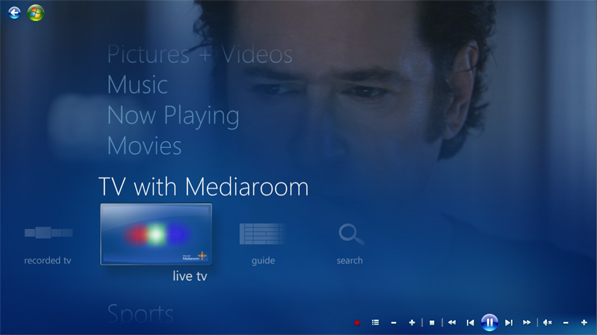
Mediaroom 2.0 is a vital better together component for Microsoft's living room strategy, providing IPTV providers like AT&T capability to deliver programming directly to Xbox 360 or Windows 7 Media Center. The unifying approach was truly innovative back in 2003, when I first heard about it. Microsoft hadn't yet released Mediaroom, but offered predecessor TV Foundation for cable operators. Ed Graczyk, then marketing director for Microsoft TV, and I spoke about the company's living room strategy, which I wrote about for JupiterResearch's now defunct Microsoft Monitor blog in a post simply titled: "Microsoft's 'Better Together' Strategy." Excerpt:
There's also a big win for Microsoft, and one that is part of the company's long-term vision for unifying PCs in the den with televisions and consumer electronics devices in the living room. I asked Mr. Graczyk about how Microsoft TV Foundation might benefit users of other Microsoft products. After all, Windows XP Media Center also serves up a program guide.
He then went on to describe Microsoft's 'better together' strategy, where the company does plan some synergy around cable content, Microsoft TV Foundation and products like Windows Media Center or the Xbox game console. So in one scenario, a Windows Media Center PC might use the cable box's program guide to schedule shows for digital video recording. In another, games could be delivered by the cable operator through the digital box to Microsoft's game console.
That kind of distribution potentially would open up new revenue opportunities for games publishers, cable operators and Microsoft, whether games run permanently on Xbox or for a limited time in a games-on-demand type service. Mr. Graczyk also discussed other content delivery or sharing options, at least in networked homes, on handhelds and other devices running Microsoft software.
Future Past isn't a Good Strategy
For anyone watching last night's CES opening keynote, Microsoft promises to deliver in Mediaroom 2.0 much of what Graczyk spoke about six-and-a-half years ago. However, there are several problems:
- Entertainment and video consumption is shifting to Internet services, such as Hulu and YouTube. Visionary in 2003 isn't visionary for the 2010s.
- New Mediaroom capabilities require people to have a Windows PC or Xbox 360 console; media consumption is shifting to browser and phone.
- In the United States, only AT&T's U-verse service, which is available in 22 states, can really utilize Mediaroom 2.0's full capabilities.
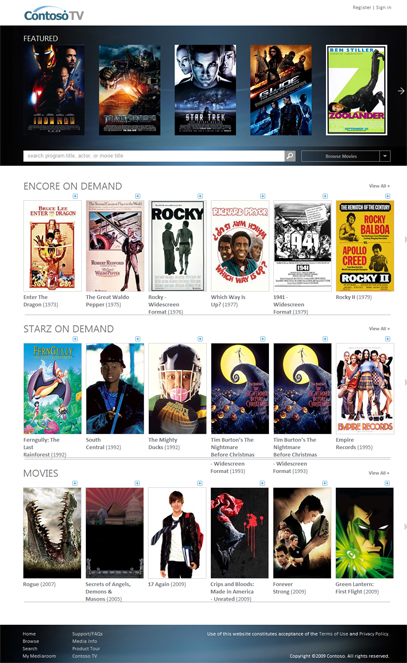
Video consumption is no longer just about television sets or being bound to the living room. Consumers increasingly want to get their video content anytime, anywhere and on anything. Big screens are big, but the living room is but one context for consuming video. According to ComScore, U.S. Internet users watched a record 30.9 billion videos online in November, 12.2 billion at Google sites, with YouTube accounting for 99 percent. U.S. Internet users watched 924 million videos at second-ranked Hulu, or average 21.1 videos -- that's 2.1 hours average per person. Nearly 85 percent of the total U.S. Internet audience watched videos online in November, or 12.2 hours average.
By the way, I am a U-verse customer (since February 2008) who simply loves the service. AT&T and Microsoft have done great work. The program guide is simple and usable. U-verse can record up to four TV shows simultaneously -- two in HD. No other TV service I've used -- Cox, Verizon or Warner -- compares. My buddies using satellite services coo when they see U-verse in my home and one by one switch when it becomes available in their areas. Mediaroom actually is a visionary product -- one of the best things to come out of Microsoft in years. But it's too slowly advancing -- and for that cable and telco operators bear some of the blame. That said, video consumption is changing, and Microsoft isn't keeping pace. The vision Microsoft articulated in 2003 is the one largely executed on in Mediaroom 2.0. The market changed, but not Microsoft's strategy.
Like many other consumers, as a U-verse customer, I'm more interested in content on the go rather than content plopping me on the couch. U-verse for my smartphone -- and not just one running Windows Mobile -- would be exciting. How Microsoft's Mediaroom 2.0 cloud services meet mobile needs could be visionary. For example, Mediaroom 2.0's in-Web browser video-on-demand services look really promising and could help cable operators and telcos better compete with services like Hulu. It's innovation, but not if it takes another 7 years to come to market. That said, Amazon and Netflix, among other services providers, offer VoD in a browser today. Microsoft still chases the future.
Microsoft is moving too slowly. Better together is a major reason. It's long past time that Microsoft developed new and exciting consumer products free of Office's or Windows' weight -- or that of its other products or services. Microsoft should innovate new products for which Office and Windows must connect, not the other way around. Better together should be about the innovative future pulling the innovative past.

Last year too they announced nothing new and excitng at all. All the Windows 7 info was out at PDC before CES. Only 2007 saw unveiling of Windows Home Server.
Score: 0
|Yeah yeah, Microsoft isn't a visionary... That's why they designed an amazing mobile OS which was TOO SLOW ON BACK-THEN mobile CPUs. This got them much flame throughout the years, but the INTELLIGENT techie community always saw 5 or 10 years into the future, and said: "wow, this is the best OS that can be in 5 or 10 years, because it will TAKE 5 or 10 years to GRADUALLY ENHANCE THIS EXCELLENT FOUNDATION OS -- and by then CPUs and battery will be more than enough to handle the complexity". iPhone's OS and Android are pure kaka. They CANNOT become much better than today in 5-10 years. Linux on desktop has been stuck in neutral for God-knows-how-long, and so was MacOS. The only one stuck in neutral that WANTS to be stuck in neutral gear is the top dog which does mostly everything the right way, as judged by the numbers that don't lie -- maintaining dominance on desktop/biz and will REGAIN dominance in the mobile platform. Gay eye candy alone and a few cloud services isn't gonna let Google or Apple prosper. It'll be massively complex OS with massive effort for compatibility with desktop OS, massive amount of drivers/peripherals/etc. It's basically the desktop OS reborn for handheld devices. Apple and Goolge have ALREADY proven FAIL.
Only a moron will say Microsoft isn't forward thinking. They, unlike Apple, talk less but do more. They will surely continue to rule the computing world in the next 10 years. Nobody even comes close.
Score: 2
|@ extremely wrong
Microsoft is a dying brand thanks to Google & Apple. Wake up son, living in denial is worse than embracing the truth. 10 years from now Microsoft will be the next Netscape.
Score: 1
|Bookmark this page and come back in 10 years and ask me to start a new cult and be your prophet... Clearly your guru Steve Jobs and his company will be long gone/sold-off... Either way they will be IRRELEVANT in desktop AND mobile markets.
Google will, too, be very weak (or totally dead) in the mobile market due to INABILITY TO INVEST COMPETITIVELY IN THE PLATFORM. ChromeOS on netbooks, mobiles, etc will be utter crap that after a generation or two of suckers will be deemed UNSELLABLE IN THE REAL WORLD (to make one cent profit). Anything Google does Microsoft can do better -- it'll just take them a couple years (as usual). The converse? Google desktop? Server OS? Dev tools? Gaming platform? Infinite software/hardware support? Ha..ha..ha...
Score: 2
|Google will be dead because MS will eat its lunch in the search and ad business. Google's monopoly is shaky because it has a low barrier to entry - some servers, databases, scalable operating systems, some web developemt - all of these technologies are cheap commoditties, and any worty opponent to Google can replicate them.
Instead of protecting their core monopoly, Google went on to roll everything themselves - operating systems, browsers, now even hardware. They will become mired in the low-margin consumer front, while neglecting the high-margin monopoly search/ad front. Microsoft is attacking the latter with success.
Score: 0
|LOL, what were you expecting? An exciting keynote like Steve Jobs delivers? The only time Steve Ballmer is exciting is when he is sweating profusely from his fat greasy body and shouting like a gorilla: "Developers, developers, developers..."
But to be quite honest with you many Mac users hope Steve B. stays at the helm of Microsoft and continue to drive this company underwater.
Score: -3
|Some years ago, the Department of Justice was about to divide Microsoft into 2 companies, and let the 2 halves compete separately. Then the Bush administration came in, and gave Microsoft a stay of execution. You know, I sometimes wonder whether Microsoft may have actually been better off long-term if it had been split into smaller pieces. Four 6-wheelers would be more competitive than one 18-wheeler, to use Joe's analogy.
In the future, media viewing will move to Slate devices. Unlike a desktop Mac or PC, which are for content creation, the slates are for content consumption. They must be multi-touch devices. Microsoft made the incredibly inept decision to bring multi-touch to the desktop Windows 7, which doesn't need it, and abandoned Windows Mobile, which incredibly is still designed for use with a PDA Stylus Pen, just like it was in 1994.
Microsoft needs a mobile OS to run on both phones and slates. But it failed. Windows Mobile 7 is now DOA. The world has given up on it.
Score: 0
|Joe Wilcox
Are you just a microsoft hater or what all I ever read from you is how (in your eyes)microsoft is always screwing up.
Joe seeing you have ALL the answers why not go run Microsoft who knows you may be better at that than you are reporting.
I always thought a reporter was suppose to be unbiased your just a flamer and not a very good writter.
Score: -1
|@KSzostek They say you're toughest on the one's you love most. I've written many posts over the years -- and plenty at Betanews -- praising Microsoft. Zune HD and Windows 7 are among the recent ones.
Microsoft has got to get with it. The mobile-to-cloud platform is moving relevance away from the Windows computer. Microsoft is moving too slowly.
Should Microsoft's board of directors call and ask me to run the company, sure I would consider their offer. :)
Score: -1
|Sorry Joe you wouldn't last a day.
Score: 0
|"not a very good writter." For that matter neither are youu. :-)
Score: -1
|looking back is not always a bad idea.
sometimes ideas of the past need to wait for time to pass by before they can become reality.
i'm sure that many innovators have looked at old star trek shows and inspired them to plan for the future.
for example smart phones might be considered to resemble the star trek communicators.
and stun guns are just one step of many towards making phasers.
touch screens that are now made only need to become transparent to make them futuristic communication panels.
there are many other examples of looking back in order to plan for the future.
Score: 3
|Let's face it: Microsoft has become the General Motors of the computer industry. They have zero sense for what the market wants, and -even when they have a hint- they're too slow to react. Microsoft is quickly becoming irrelevant. They don't have much of a clue, and cannot execute in a timely fashion. General Motors all over again !
Score: -4
|Good, I'd like to see m$ disappear into nothing.
Score: -5
|They really missed a big opportunity here. One more reason why I think Ballmer needs to go. I still think they can pull things together this year. But if they don't my confidence in Ballmer's ability to execute on a solid vision wanes significantly. Others have already given up hope.
They should have talked about increasing/expanding Zune integration, WM7, Windows Live Wave 4. Seems like Windows mobile is what is really holding their strategy back right now. Once they fill that piece in, I think we will see the whole 3 screens and cloud come together. Zune will finally go global, XBOX can really come to the phone, and Microsoft can finally execute on sync.
Score: -1
|Be nice if you can post something that's going on in the CES. If your not at the CES, then don't post garbage that you read off the net.
I had to goto CNN to find REAL NEWS on the CES.
http://www.cnn.com/SPECIALS/2010/ces/
Grow up Joe. I think I speak for majority of the users who comes here and want to read what's happening at the CES. We really don't care about your narrow minded, 1D vision about "Microsoft vs Apple".
Score: 3
|@sudbury Betanews has LOTS of live CES coverage. You shouldn't need to go elsewhere. Examples: http://www.betanews.com/...ES+2010&x=0&y=0
Score: 0
|Hi Joe. Ed Graczyk here. I’m now with Ceton Corp (www.cetoncorp.com), which was actually the other TV demo in Steve's keynote -- the one showing the Media Center PC recording 4 live channels of HDTV via digital cable and CableCARD. A world’s first for any TV distribution platform I have to point out!
My comments in 2003 might today seem premature (I prefer “prescient” personally J) but it’s important to understand that, back then even more so than today, the world of TV was much different. It was a world of only proprietary distribution networks, running proprietary technology, and managed by a handful of service providers who ultimately controlled what got deployed and when. Microsoft provided the enabling technology but service providers determined roll out schedules.
I am admittedly biased, as I worked on the first generation of Mediaroom and its predecessor products like Foundation, but I have to agree Mediaroom 2.0 is a phenomenal product. What other software platform lets service providers deliver their pay-TV services, not only to set-top boxes, but also to the Xbox, the PC or the mobile phone? Mediaroom 2.0 blends the best of IPTV delivered over “managed networks” with “over-the-top” video services. It’s a stepping stone from today’s world of television, delivered on managed networks by service providers to subscribers who live in their network footprint, to the world of television of tomorrow, where anyone can get just about anything, using any device, from anyplace where they have an Internet connection.
But even more so, with Windows 7, Microsoft has delivered the ultimate home entertainment platform for television in Windows Media Center. Whether you’re a cable subscriber using the Ceton quad-tuner card to turn your PC into the world’s first (and only) 4-tuner DVR, or a customer of a Mediaroom service provider like U-verse, WMC brings the best in pay TV, as well as the world of over-the-top TV, into a kick-ass device with a TV user experience that puts the rest to shame. You can’t find that on Apple, you can’t find that on TiVo, you can’t find that on the cable or satellite STB you get from your local provider.
Vision takes a bit of time to come to fruition, even in the world of technology.
Ed
Score: 0
|I'm not very familiar with all the TV tech in Windows 7, but it's just another thing that proves why Microsoft will FOREVER SUCCEED -- they invest in COMPLEX technologies and integrate them into their cashcows (Office/Windows). That means that whichever tech/trend starts taking off (servers in the home, etc) Microsoft will ALREADY BE IN POSITION to give something to people who didn't really think they needed it.
Windows 7 is indeed close to perfect OS which can easily last 5+ years (just like the much beloved XP). The only thing it's missing, in my eyes, is WinFS (SQL-based file system) to make it THE PERFECT OS.
Score: 0
|