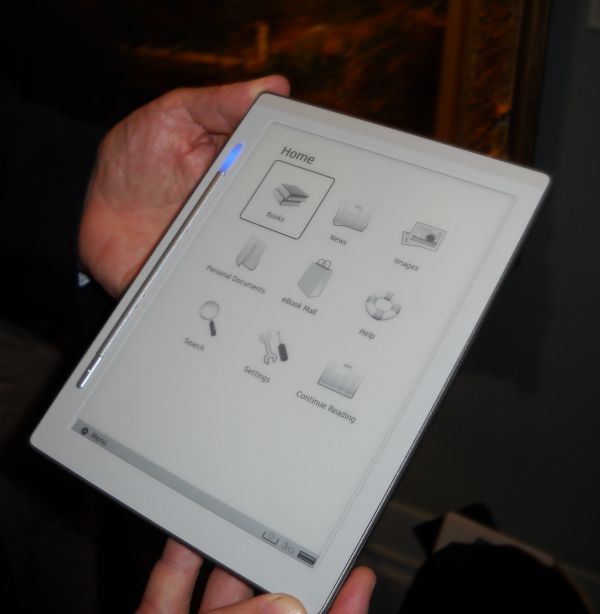
3G wireless eReader from Irex aims to tackle Amazon's Kindle

By Jacqueline Emigh | Published September 23, 2009, 8:56 PM

Irex Technologies' first eReader to be sold in the US.

Through new partnerships with Verizon Wireless, Barnes & Noble, Best Buy, and other major US firms, the European-based Philips spin-off hopes to at least hobble the Amazon giant in North America. Set for release next month, Irex's 8.1-inch touch screen eReader will be better than the Kindle in almost countless ways, officials contended during a press conference today in New York City.

Unlike the Kindle, which is dedicated to sales from Amazon.com, the Irex DR800SG will support Barnes & Noble's eBookstore and ultimately other e-comm sites, magazines, and newspapers, too, said Hans Brons, CEO and founder of Irex. Based in the Netherlands, Irex has been carefully eying the US e-reader marketplace for more than a year now, according to Brons.

Best Buy will be making the eReader available soon for $399. By comparison, Amazon's 10-inch Kindle DX runs $489, while Sony's upcoming 7-inch Reader Daily Edition will also be priced at $399.

Kevin Hamilton, North American CEO, Irex Technologies, presenting the Irex eReaderIn contrast to the "proprietary" Kindle, the eReader will support multiple document formats and DRM schemes, according to Kevin Hamilton, North American CEO of Irex, speaking at his company's press conference today. Supported formats will include the increasingly ubiquitous Adobe PDF (for "flowing text") and the international e-book standard EPUB.

Although the handheld reader will connect to Windows PCs through the USB port, its underlying platform will be built on Linux for "open development," he said.

Beyond helping to power the reader's custom battery, the USB connection will come into play when users want to send their own documents to the reader for viewing. For the moment, at least, documents saved in formats such as Microsoft Word .DOC or .DOCX will need to converted to PDF first. You can also power up the battery -- which is replaceable -- through an electrical connection to a wall outlet.

Irex Technologies' first eReader to be sold in the US.

Currently, electronic pages appear on the Irex reader in black-and-gray, and a stylus is needed for carrying out tasks like turning pages, changing font sizes, and looking up word definitions. But Irex plans to add finger-touch capabilities in 2010 and "true color" in 2011, according to Hamilton. A notetaking feature is coming soon, as well.

A Linux-based software development kit is also in the cards for the Irex e-reader, to let third-party developers build new vertical market as well as mainstream applications.

Andrew Frank, research VP at the Gartner Group, told Betanews that he thinks Irex's "more open" approach will help to hold down costs on the device.

Irex, though, faces big competition, not only from the Kindle and other e-readers but also from tablets from PC vendors, including the long-rumored Apple and the recently rumored Microsoft "Courier."

In his presentation today, Brons pointed to Irex' reflective screen technology, which consumes relatively little power, as one plus the Irex eReader holds over PC tablets.

Price, of course, seems like another. Brons said that two newspapers in Europe -- where Irex has distributed its eReaders for several years already -- are now helping to subsidize the devices.

Hamilton told Betanews that his company is now in talks with The New York Times about possible electronic distribution.

Comments

View comments by with a score of at least

Looks like bigger iphone to me!

Score: -1

|

Interesting, the background on that screen looks a lot whiter than the Kindle's (and, for that matter, anybody else's). Is it still eInk? I'm assuming it must be if they don't have color yet...

Score: 0

|

Happy with my 1gen Kindle for now, I wont change until they come up with color and multitouch screens (Apple tablet maybe?)

Score: -1

|

It will be great, when these devices include browsers that support HTML5, etc. That will allow users to read their web mail, etc. while offline.

Someone should run an Acid3 test on the browsers of these devices, to see how standards-compliant they are. The Acid3 test is here:

http://acid3.acidtests.org/

These are the results you can expect, from the major desktop browsers:

Chrome 2.0 - 100/100
Safari 4.0 - 100/100
Opera 10 - 100/100
Firefox 3.5.3 - 93/100
IE 8 - 20/100

An even more interesting comparison:
iPhone 3GS - 100/100
Zune HD - 5/100

Hopefully, eReader vendors have had enough foresight, to include a modern, standards-compliant browser.

Score: -2

|

Why the hell does one need a browser in everything ? Isn't it enough to a Desktop,laptop and phone to browse the net.

I just want a decent reader which does one job good..ability to read ebooks. And why in the hell is it important to have a browser that can do 100/100 in Acid3. How many websites do you think have the capability to use all the javascript used in Acid3...

Score: 0

|

A couple of examples where a browser might be useful on an eReader:
1. Google's Fast Flip, to quickly scan through the news.
2. Web email. HTML5 local store even allows you to read them offline.
3. Internet or intranet sites used to disseminate documents (PDFs, etc.).
...

I would much rather read this stuff, in a comfortable place, with an eReader that has an e-Ink-quality display.

Score: -1

|

I'd rather keep things the same and just improve the performance of ultraportable laptops. It is the most versatile tool I use. Having to keep a reader, a phone, a desktop, etc around is annoying.

Score: -1

|

This stuff is interesting, but my thesis is that whereas Kindle, Sony and iRex seem to be predicated on the construct of the book as less than the current experience (i.e., mostly text), the industry is headed for a full-blown re-boot that takes advantage of interactivity, touch/tilt, social engagement, movies, pictures, animation and sound, a topic that I expound upon in:

Rebooting the Book (One Apple iPad Tablet at a Time)
http://bit.ly/zOoEu

Check it out, if interested.

Mark

Score: -1

|

Knowledge and access to knowledge should be free
I totally repsect rights of authors but there are so many
books and titles that could be spreaded to readers.
And remember Africa is totally uneducated.
What effect digital reading will bring to these people ?
I think profits and benefits will come not only directly from the distribution of
a device and the content but from the results these may trigger to people or if you prefer to consumers.

Moreover Amazon's and others devices are very "selfish" since they
lock the reader to have one access to books that they decide to make available to the specific format.

Buying a digital reader device is meaningfull when someone can also do and read whatever he/she likes from wherever is available.
Else Amazon and the rest of companies should provide their own proprietary readers for free and the reader can accept their proprietary policy.
From the moment I pay and own a device it is my right to use it as I want.
For example if we go back in time, TV broadcasting companies could lock TV sets to broadcast only their programs and asking from us to pay for the TV set as well as the broadcasted content. Is it rational ?

Score: -1

|

first thing to do, compile pam and ssh to run on the irex. or figure out how to redirect a console through the usb port.

Score: -1

|

I have the Kindle 1 and I too will keep it for now. What I want in a new book reader is the ability to replace the battery (score one for Irex), removable media like and SD card, security security security and wireless.
I use the flip stype sd cards and can transfer doc without needing a cord...very handy when on the go.
I want security!! When ANYONE turns on my device they can read all of my stuff, delete it or make changes...at least give the option to password protect when turned on or idle for x time. Not much code work required for this one.

Score: -1

|

I have a Kindle 2. And I will keep it for now until that one comes out. I got the kindle 2 from here: http://www.computersncs....-skindle&gift=27619

Score: 0

|

PDC 2009: What have we learned this week?

There was the freebie that no one will forget, the heebie-jeebies courtesy of Scott Guthrie, and a teensy bit clearer picture of how this cloud thingie should work.

Live report: Will Google Chrome OS change Linux?

The mysteries of just what Chrome OS is, and how much of an operating system it truly is, may be resolved today.

PDC 2009: Microsoft cares about Web browser performance

The effort to give users of the world's dominant Web browser the impression of quality, is a personal one for the man who leads that battle.

Nokia re-affirms its commitment to Symbian, sort of

Maemo won't necessarily be replacing Symbian in the Nokia N-Series, but that's definitely a place where it will be found.

E-book readers will be in short supply this holiday season

E-readers are hot this year, and a lot of compelling new products have been released, but are there enough electrophoretic displays to go around?

Sony looks to finally open a single storefront for downloads

Sony has had many different download portals for movies, music, e-books, and games, and now it's looking to make a single shop for all of it.

Tuning out the tablet: Time to give the endless speculation a rest

Wide Angle Zoom: Wishing and hoping and thinking and praying....won't put an iTablet on the market.

Five improvements for IT managers in 2010

If businesses are to improve their efficiency for next year, they need to stop and reassess the basic tenets of their job.

AOL's spinoff from Time Warner to shed 2,500 jobs

As AOL moves toward become an independent company again, it will cut nearly a third of its workforce.

Gartner: SMS-based money transfer will be bigger than mobile browsing, search

Gartner issues its predictions for the 10 things our phones will be doing in 2012.

Don't forget to upgrade to Firefox 3.6 beta 3 today

Mozilla has released the latest beta its Firefox 3.6 browser software, just over one week after beta 2.