A look at Eeebuntu Base 3.0

By Tim Conneally | Published May 28, 2009, 8:51 AM


Download Eeebuntu Base Edition 3.0 from Fileforum now.

Eeebuntu is a custom Ubuntu distro optimized for use on Asus' Eee PC line of netbooks. By incorporating Ubuntu with the Array Kernel and EeeConfigure, Eeebuntu eliminates much of the massaging Ubuntu would require to fully work on Asus' popular netbook.

To accommodate the various capabilities of the vast Eee product line, Eeebuntu comes in three different ISOs: Eeebuntu Standard, Netbook Remix, and Base. A week and a half ago, Eeebuntu released version 3.0 of its Base edition, the lightest and tightest of the three ISOs.

To test this barebones Ubuntu distro, we loaded it on the most barebones Eee available, the 2g Surf 700. With a 900 MHz Intel Celeron M, 256 MB of RAM, and a miniscule 2 GB Flash drive, it proved an ideal candidate for upgrade. To add to the unit's need for an overhaul, it is equipped with a 4-cell battery at only 2% capacity, completely decimated after two years of being used on the road.

Since Base 3.0 was released, a number of users complained of an installation that freezes at 5%. In Betanews tests, we too experienced this problem, not only in installation, but also during creation of a bootable image in Unetbootin. Fortunately, a simple "brute force" approach eventually created the bootable SD card (4 attempts), and also eventually made the installation work (6 attempts). Both processes took no more than 5 minutes to reach 5%, so it is a hassle, but not a long wait for failure.
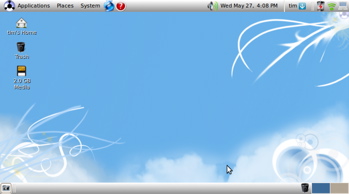
Eeebuntu desktop

After installation, startup takes 72 seconds and puts the system immediately online if it is in range of a familiar wireless signal. The desktop and architecture are identical to Ubuntu 8.10 (Intrepid Ibex), but the Base distro lacks almost all additional software and plug-ins. It includes Firefox, remote desktop, a text editor, a BitTorrent client, terminal, Synaptic, and a few other tiny applications. Everything else can be added at the user's will.

Because things like Compiz and Java are not installed by default, the system consumes fewer CPU cycles and therefore less battery power, a definite bonus on a system with a battery 98% dead. When the power supply is disconnected, Eeebuntu intelligently switches to reduced performance mode and dims the screen by 25%.

So even with a battery with only 2% of its capacity, our system ran for 82 minutes at a low/moderate CPU load (averaging 34%, hooked up to external monitor, Wi-Fi connected, running IBam and system monitor.) Using the computer casually (that is, downloading and installing software and using Firefox) drained the battery in 66 minutes.

For Eee users familiar with Ubuntu who know the open source programs they frequently use, Eeebuntu Base is worth checking out. It is stripped down not to the absolute basics, but to the point where very little elbow grease is needed to get the system running efficiently.

Comments

View comments by with a score of at least

Agreeing with the previous statement about battery life. Using the numbers above, you could casually browse for 66 * 50 minutes ... 3300 minutes?! You'd be hard pressed to make be believe this laptop would work for 2.3 days straight. That said, it might really help the battery, yes, but I can't believe that this number is accurate.

I'd love to see someone with a fresh Asus EEE laptop try this out and see what battery life they get.

Score: -1

|

For a "base" edition, the CD image is very big at 562MB.

Score: -1

|

"So even with a battery with only 2% of its capacity, our system ran for 82 minutes at a low CPU load (averaging 34%, hooked up to external monitor, Wi-Fi connected, and system monitor running.)"

OooohKaaay..... And your assessment is not that the battery gage function might be defective but that Linux is almost as good as a perpetuum mobile?

Score: 0

|

I updated that passage because I was also running IBam, which is pretty trustworthy.

http://packages.ubuntu.com/en/intrepid/ibam

Score: 0

|

Interesting. But still unlikely. Prob the bat itself is reporting the wrong value then (not sure how these things work tho).

Score: 0

|

I'm a big Ubuntu fan, but there's no way you can get that much performance out of any OS with only 2% battery life remaining.

At the risk of sounding like Scotty, "there just isnae the power!"

I think the battery was misreporting it's charge level from the sound of it.

That aside, this looks like a nice little OS to run on a netbook. I will continue to monitor it's performance in the future.

Score: 0

|

Google Chrome 4: Yes, it's fast, but is it usable?

As Betanews readers have responded to our stories about Chrome's JavaScript superiority...Does that mean we'd actually use this browser? Well...

Video: Netflix on PlayStation 3

Netflix has come to the PlayStation 3 via Blu-ray and BD-Live.

Verizon Wireless launches new Android, Chocolate, and ruggedized phones

The lower-priced Eris joins the Droid, while the Chocolate gets a touchscreen and more music playback.

Early sales figures for Windows 7 nicely high, but do we know why?

Fans of triple-digit surges in figures quoted by Betanews will love this one, as it appears Microsoft rediscovered how to pull off a software launch.

Myka announces its latest Linux-based 'net top box'

Myka's ION brings Boxee, XMBC, and much more to HDTVs.

What hath Mac wrought? A remembrance after a quarter-century

The reason there's a Macintosh today is not because of some brilliant flash of engineering genius, but because Apple had the audacity to learn from its mistakes.

Early build of Moblin 2.1 improves connectivity, but not device support

The Linux Foundation's Atom-centric OS yesterday received a major overhaul with the project release of Moblin 2.1 for netbooks and nettops.

The iPhone's China syndrome: Sales of 5,000 and climbing

There's actually a country where Apple's device is not a godsend, where sales can be measured in the dozens.

New European counterpart to FCC will ensure 'a more neutral net'

Late Thursday night, the ruling telecom administrators of the EU's member nations signed away their final authority to a new entity overseen by the EC.

Sophos study suggests Windows 7 UAC's default setting is self-defeating

Without any anti-virus installed, a Sophos test showed, User Account Control was only capable of thwarting just one malware package out of ten samples chosen.

Indiscreet tweet trips awareness of Web SSL vulnerability

A group of high-level security engineers had been making progress on thwarting a low-level threat to the Web, until somebody blurted it all out on Twitter.