Login:
Password:

AMD Downplays Performance Factor During Tech Analyst Day

By Scott M. Fulton, III, BetaNews

July 26, 2007, 12:07 PM

At the start of AMD's semi-annual technology analyst day conference, president Dirk Meyer and VP of marketing Henri Richard set the tone for the day-long session by toning down even further the relative importance of performance, including among consumers.

"No longer do we hear that it's all about performance," said Meyer during his opening remarks. Instead, the three pillars of the company, as he perceives them, are power efficiency, providing the optimum visual experience to customers, and thirdly, something of a surprise: affordable Internet access, including to emerging markets. This may come as a shock to customers and investors alike who never considered AMD an ISP.

Richard picked up that theme later, adding that he felt the second pillar - "Ultimate Visual Experience" - is critical to the new AMD. This is true for business as well, he explained, where videoconferencing is becoming a more critical application. "We're not just doing slides and calculating spreadsheets," he said.


Update ribbon (small)

1:33 pm July 26, 2007 - Performance is an element that cannot be played down in the server space. Since the first news of AMD's forthcoming Barcelona quad-core architecture has been released, there's been considerable controversy over its performance claims, particularly whether the company is cherry-picking some performance numbers and either glossing over or selectively omitting others.
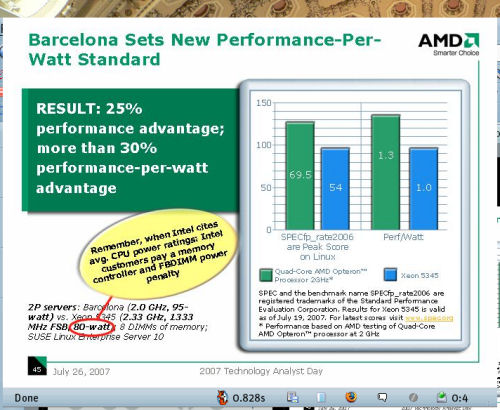
The sole performance claim AMD was willing to make against Intel during its semi-annual Technology Day on July 26, 2007.

So there will be considerable examination and re-examination of AMD's current comparison of choice: In this case, the company chose a measurement of floating point operations peak throughput (as opposed to raw speed) for a 2P Barcelona 2.0 GHz quad-core based system (eight cores total). In this case, AMD yielded a relative score of 69.5. AMD then compared this figure against a SPEC report for an unnamed Intel Xeon E5345-based, 2.33 GHz quad-core based system, with a peak score of 54. BetaNews located one such system in SPEC's database this afternoon: a Bull SAS NovaScale R460. So this figure does appear to be current.

Had AMD chosen to cite the score for the R460 running at 2.0 GHz ??" the same speed as the Barcelona ??" that Intel-based system's peak score would have been 42.4. So the margin in AMD's test is narrower, though the company does get the opportunity to say its 2.0 GHz system outperforms a faster-clocked Intel-based system.

Much better performing Intel-based systems do exist; however, they're clocked at much higher speeds. However, they're four-processor dual-core systems rather than two-processor quad-core systems. For instance, SPEC reports a Bull SAS NovaScale R480, using four Xeon 7140M processors at 95 watts, clocked at 3.4 GHz, with a peak SPECfp_rate score of 72.5. In terms of raw performance per watt, the 7140M-based system would score 3% better at 95 W than the Barcelona system at 95 W...provided you're willing to overlook the fact that you're running four processors instead of two. The Bull SAS quad-core system AMD chose to compare against uses 80 W.

At the time of its introduction last year, the 7140M posted a record business operations performance score on the SPECjbb 2005 benchmark, and a record performance score on the TPC-H database benchmark.

But AMD's Randy Allen again reminds customers that Intel-based systems may still consume more power, by virtue of using more "power hungry" memory, and by using a separate memory controller that also uses its own power. While 65nm Budapest architecture quad-core processors will be available for workstations and servers in the second half of this year, Meyer confirmed today, clock speed is not being mentioned, although he did say a Barcelona-based server was on display for analysts to witness for themselves, at an overclocked speed of 3.0 GHz.

This brings up an important problem going forward: If AMD stays safe in the 2.0-2.66 GHz range for Opterons going forward, it may be able to compete point-for-point against Intel at that level, though it could get outperformed at higher clock speeds.

UPDATE 5:00 pm ET July 16, 2007 - An AMD spokesperson contacted BetaNews this afternoon to offer clarification on what AMD's Dirk Meyer called his company's third "vector" - the drive to affordable Internet access.

"This was not meant to imply AMD is going the route of an ISP," the spokesperson told us. "Rather AMD is continuing to focus efforts around developing and promoting affordable, power efficient solutions for emerging markets. This effort is called 50x15, a global initiative founded by AMD, which aims to enable affordable, accessible Internet connectivity and computing capabilities for 50% of the world's population by the year 2015. Among the programs under 50x15 is AMD's involvement in the One Laptop Per Child program out of MIT that you are likely familiar with."


Update ribbon (small)
5:05 pm ET September 11, 2007 - In a statement to BetaNews this afternoon, a representative of SPEC told us that an estimate of 69.5 for AMD's SPEC performance that appeared in this story, was not properly labeled as an estimate and was cited as actual SPEC results.

"According to the SPEC CPU2006 license, if numbers are actual results," said SPEC media relations director Bob Cramblitt, "then whoever provides the numbers must be able to provide a full-disclosure for the results; otherwise, the results must be labeled as estimates."

Add a Comment (12 Comments)

BetaNews reserves the right to remove any comment at any time for any reason. Please keep your responses appropriate and on topic. Foul language and personal attacks will not be tolerated.

Name (required):

E-mail (required):

Enter Your Comment:

By deminicus

posted Jul 28, 2007 - 12:03 PM

i just hope they can still compete with intel. I would be best to still have a choice(a real choice).

Score: 0

By maniakmx3

posted Jul 26, 2007 - 5:56 PM

I think AMD Will surpise us like they always do. With the ATi Merger, I'm sure the two brilliant companies are cooking somthing up.

Fans of AMD will just need to continue supporting their beloved processor to help the company continue to grow (AMD can only manufacter about 40% of what Intel can manufacter due to how small the company is) But with Toshiba Giving in, Acer's AMD Platforms blowing away the competition. AMD has ALOT of fight left in them, We the consumer just needs to continue supporting them.

Score: 0

By Eeyan

posted Jul 29, 2007 - 3:14 AM

AMD - We the consumer just needs to continue supporting them.
Most definitely........ indubitably!

Score: 0

By runningfool

posted Jul 26, 2007 - 4:13 PM

*sigh*...and AMD was once at the pinnacle of the processor world. i love them to death but theyre slowly floundering. its even harder to side with AMD when intel is making such leaps and bounds, and not doing anything wrong in the process.

Score: 0

By Tenoq

posted Jul 26, 2007 - 8:36 PM

Anti-trust and anti-competitive behaviour don't count as "doing anything wrong in the process"?

*chuckles*

I'll buy an AMD system next, methinks. Much better for a HTPC. While it is a shame AMD is slightly slower with the current gen of chips, Intel was slow for years and people kept buying them. :P

Score: 0

By Ramhound

posted Jul 26, 2007 - 1:01 PM

PC_Tool it worked for Nintendo :lol:

Score: 0

By PC_Tool

posted Jul 26, 2007 - 2:38 PM

Betanews has this nifty thing called a "Post a Reply" button which allows you to post replies in a properly threaded manner.

You should really try it sometime. ;)

Score: 0

By PC_Tool

posted Jul 26, 2007 - 12:53 PM

Corporate VP Randy Allen is expected to provide some overview of the Barcelona quad-core roadmap soon, which he promises will be "game-changing."

*laughs*

I love AMD, but this is too rich.

When one is losing, getting shredded, beaten up one side and down the other?

No problem. Just pretend you're playing a different game.

Score: 0

By LRN

edited Jul 26, 2007 - 4:08 PM

Well, Intel did this a few times. When you're not the leading one - just turn 90 degrees left or right to become a leader. Change where 'forward' is . I swear, i heard that about Intel long time ago...Can't remember exactly though.
Also, TFT monitor industry knows this trick very well too. Awful view angles on this matrix? Not a problem, just change angle measuring method from 10:1 to 5:1, this will fix the results!
Now, with so much 'mobility' etc, maybe it IS important to have better performance/powerconsumption ratio. Though it does not matters for me.
And, to tell the truth, i don't see much performance increasement anyway. When we switched from Pentium to Pentium II or to the same Pentium with higher frequency - THAT was real (obvious) performace boost. Nowadays i just don't see processors working THAT faster. Besides, system overral performance now depends heavily on memory and HDD too, raising raw cpu power just won't make you happy, unless you encoding something, or performing any other CPU-hungry process.

Score: 0

By JonathanD

edited Jul 30, 2007 - 1:31 AM

"When we switched from Pentium to Pentium II or to the same Pentium with higher frequency - THAT was real (obvious) performace boost."

Yeah Pentium II was pretty much a Pentium I on a SEC cart and I think they might have added some L2 cache or something hmmm I think maybe MMX (new MMX instructions ?) as added too but its been so long I cant remember lol Yeah MMX is/was awesome just when it first hit the software just wasnt there for it so nobody noticed any sort of speed increase.

Edit: well I was close lol
http://www.answers.com/t...ntium-ii?cat=technology

Score: 0

By Tenoq

posted Jul 26, 2007 - 8:40 PM

"Nowadays i just don't see processors working THAT faster."

They're a LOT faster - but their power is being wasted on crappy software design. Vista is obviously the case in point at the moment, but it was the same with the release of XP. Efficient software (particularly OS software) was throw out the 'Window' decades ago.

But you're right - the bottlenecks now are HDD and to a much lesser extent, RAM. Those technologies progress a lot slower than CPUs. :(

Score: 0

By JonathanD

posted Jul 30, 2007 - 1:24 AM

If I could pick one part on my PC to make faster right now I think the HD would be the first thing :) I have dual channel DDR2 and it feeds my CPU just fine. My HD cant keep up with the GB's per second that the rest of my system can handle :( The thing outside my PC I would like to see faster is my net connection !!! *Brighthouse just started doing that packet shapeing thing....* doesnt hurt too much but I think some of my traffic is being shaped unfairly... (BT and eMule ok I understand, but come on youtube ?) 15Mbps isnt enough for me :) I feel the need for something like 80Mbps or something lol

PS. Faster optical drives with more capacity would be nice too but 20$ for a blank disk would make me poor.... (I have burned TB's of stuff on DVD's !!!)

Oh and what this all has to do with AMD is the fact that CPU's are fast enough ! I have 5 comps in my house 2 of them are AMD 3500's Single cores with 2GB's of RAM, plenty of speed (I should mention I dont game too much on the computer unless you count MAME lol). I know with more speed more can be done but when will the rest of the machine catch up as others have said...

Score: 0