
AMD's SVP for Marketing to Exit, Leaving Behind Stellar Legacy

The man credited with making the global CPU industry a two-horse race once again in the public mind is leaving next month the company he helped put back on the map. Henri Richard, who put a personable, approachable, practical face on AMD as its senior vice president for marketing over the past five years, will pursue other interests outside the PC industry, AMD confirmed last night.
It was Richard's strategy to re-develop AMD's product offerings into discrete product lines that targeted customer segments instead of manufacturing generations. The Athlon/Sempron/Turion/Opteron subdivisions, and the subsequent introduction of Athlon FX, Phenom, and the possible future Fusion series, were all part of Richard's and AMD's strategy to combat Intel on multiple levels individually and simultaneously.
By all accounts, it was an enormously successful strategy, making AMD's brands approachable by different market groups, each for its own merits. It also put AMD's Athlon series in the best position to take on Intel's first hyperthreading-endowed Pentium processors in 2005, for what historians may record as a turning point for both AMD and Intel. The AMD strategy not only worked, it destroyed its competitor's entire value proposition and principal architectural plan, literally sending it back to the drawing board.
When Intel fought back in 2006, it fought smarter, no longer underestimating its rival. AMD took the public position, "Bring it on!" evoking images of a Western-style gunfight in the streets that enthusiast publications dubbed the "Dual-core Duel." But Intel came back with full ammunition.
So Richard had to shift his company's strategy - not dramatically, but slightly. As he described in a webcast last May, "Our competitor, because they were under such duress given our leadership in the marketplace, elected to announce an architecture in the middle of last year that was not available in volume. So what you had was a lot of hype around Core 2 Duo and a lot of Pentiums [that were approaching] end-of-life in the marketplace. So I'm confronted into a situation where, who am I competing against? A product that's being talked a lot about but that's not available, or a product that's being dumped because it's end-of-life, running too hot anyhow, and why should I chase that product down?"
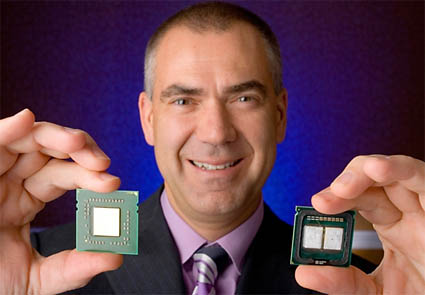 "We found ourselves with a single product line," Richard continued. "We're not in that product transition, and frankly, in some cases, at a disadvantage because it made no sense to devaluate our products to compete against old Pentium products. But on the other hand, I needed to be competitive if I was actually sold against the Core 2 Duo, which was a much better product than their preceding generation. So what you've seen in terms of this fluctuation in the channel is this very difficult guessing game of, what exactly are you competing against? As Intel started to actually roll effectively volumes of the Core 2 Duo product in the marketplace, within a short period of time, we had a situation where, at a given price point or at a given model number, we suddenly flipped from competing mainly with old Pentium products to starting to compete with Core 2 products. And that's of course a different competitive position. So that's what drove so much of the uncertainty in terms of pricing in the marketplace. Rest assured that I have no intention to go and try to fool my customers into the wrong value proposition. It's never been the case with AMD, and it will never be the case, but we also have to be responsive to the competitive environment."
For Henri Richard, the market combat against Intel was a personal affair, a chess game with real stakes. He wasn't just going along with the company line like many SVPs of other companies, as you could tell by his language above, which include his references to AMD in the first-person singular.
His short statement released late yesterday took time to make reference to that dual-core duel, which is still fresh on his mind. "I am leaving AMD at a time when the company is in position to break the monopoly that plagues this industry," he said. "I am immensely proud of my contribution to AMD, and in particular, of the strong team I leave behind."
Richard's exit may be official just days before the scheduled premiere of AMD's biggest gamble to date, its quad-core "Barcelona" architecture processors, still scheduled for September 10.
At the close of his webcast last May, Richard painted the ongoing battle with Intel in the most personal terms he could conjure. "I really think that the PC industry could do a lot better than it is doing today if it brought a better user experience, more compelling user experience. That's why I was a supporter of Vista. I truly believe that it's going to enhance the user experience of a PC. The more people who are happy with their machine, the more likely they are to buy another one, buy a bigger one, buy a better one, and ultimately that's what drives our business. So although a lot of our competition is focused on trying to kill us, I think that a greater subject to be discussing is, how do we expand the market? I think that if the competition spent more money expanding the market and less trying to hurt me, all of us - our customers, the end users, AMD, Intel, and others - would be much better off in this industry."
Unlike most any marketing executive in any industry, Henri Richard took the business of selling his company's product very, very personally. It was him against the world. What we'll remember of his tenure at AMD is the fact that this personal approach was successful - that against the world, time and again, he was winning.



