Login:
Password:

AP sets up a toll booth for bloggers citing its stories

By Tim Conneally, BetaNews

June 17, 2008, 3:19 PM

The AP's disharmony with bloggers may have only just begun, as the alternative it's now offering to being served with takedown notices involves paying an up-front sum for excerpting online articles -- as few as five words.

A meeting between the Associated Press' Vice President for Strategic Planning Jim Kennedy and Robert Cox, who heads the Media Bloggers Association, is now planned for Thursday of this week. The subject at hand is the AP's attempt to find a new way of sharing AP content, which now involves a fee per excerpt based on its word length.

On the heels of a blogosphere revolt last week because of its harsh actions against social news site The Drudge Retort, the AP regrouped over the weekend to take a less litigative -- but more bureaucratic -- approach to dealing with those who wish to quote its material.

Where the group had previously invoked the Digital Millennium Copyright Act and sent cease-and-desist orders to at least one blogger, seeking the removal of excerpted content (in some cases as few as 17 words in length), now the press service has attached an "Excerpt for Web Use" charge for passages as short as five words in length.
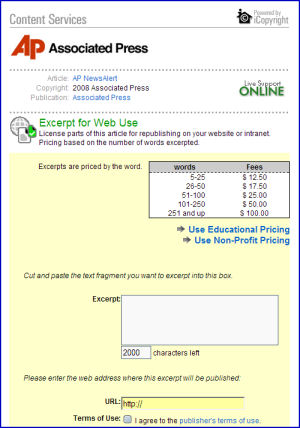
A form posted on behalf of the Associated Press for bloggers wishing to excerpt AP articles.The pricing scale for excerpting AP content begins at $12.50 for 5-25 words and goes as high as $100 for 251 words and up. Nonprofit organizations and educational institutions enjoy a discounted rate.

This scale is likely only a temporary solution, as it raises a truckload of questions. For instance: Suppose a news source holds a press conference, and makes a statement to several attendees including an AP correspondent. Does the citation of that quote count as an excerpt of an AP story? What if Reuters cited the same quote? Or worse, what if Reuters cited the quote differently, and a blogger noticed the difference and excerpted both for comparison? If the AP citation turned out to be in error, would the blogger still owe?

Also, should "boilerplate" words count towards the fee? For example, a phrase common among news stories is "[Name] had this to say:" for prefacing a published statement or quote. If the AP runs a story with this phrase, will it therefore cost anyone else $12.50 to use this 10 cent expression?

US COPYRIGHT ACT, Chapter 1, ยง 107. Limitations on exclusive rights: Fair use

Notwithstanding the provisions of sections 106 and 106A, the fair use of a copyrighted work, including such use by reproduction in copies or phonorecords or by any other means specified by that section, for purposes such as criticism, comment, news reporting, teaching (including multiple copies for classroom use), scholarship, or research, is not an infringement of copyright. In determining whether the use made of a work in any particular case is a fair use the factors to be considered shall include --

(1) the purpose and character of the use, including whether such use is of a commercial nature or is for nonprofit educational purposes;

(2) the nature of the copyrighted work;

(3) the amount and substantiality of the portion used in relation to the copyrighted work as a whole; and

(4) the effect of the use upon the potential market for or value of the copyrighted work.

The fact that a work is unpublished shall not itself bar a finding of fair use if such finding is made upon consideration of all the above factors.

How about one more: It's an unspoken fact that subscribers to the AP publish stories that use the AP's facts and that give the AP credit, though which are rewritten by their own staff on-hand, sometimes for length. If a blogger cites a rewritten but credited AP piece, whom does he owe, the AP or the newspaper or online service that rewrote the AP?

The Associated Press' Web Use excerpt system is powered by the ubiquitous iCopyright, whose own name ironically smacks of another popular trademark. BetaNews has been checking the link to the iCopyright service today, and has noted it's been down periodically.

In its "do's and don'ts" list, iCopyright warns would-be copyright infringers by saying, "Don't buy the 'I am using it for the public good' argument. That is a weak justification for infringement and sends the wrong message to students and employees."

Add a Comment (13 Comments)

BetaNews reserves the right to remove any comment at any time for any reason. Please keep your responses appropriate and on topic. Foul language and personal attacks will not be tolerated.

Name (required):

E-mail (required):

Enter Your Comment:

By xiaoxiaozxc

posted Jul 2, 2008 - 11:33 PM

Welcome to Buy wOW GoLd and Buy

World of wOw Gold. You can Sell

wow gOLd and Sell World of

wOW gold here. We are a

professional WOw goLd

marketplace on

Score: 0

By ZenaV

edited Jun 19, 2008 - 8:39 PM

Looks like they will soon be lying in the cold dead grave next to the Washington Post. In fact, I don't really think they can do this legally. If they want to charge people for quoting them, they need to get their own website that charges to get in. It's the American way. What countries are these people from? China??? Reuters has better writers anyway...

Score: 0

By ertstic

edited Jun 18, 2008 - 6:38 PM

I would assume that the use of AP articles by (at least most) blogs falls under the "fair use" policy outlined above. Most blogs - on either side of the political spectrum, use such articles, "for purposes such as criticism, comment, news reporting, teaching (including multiple copies for classroom use), scholarship, or research," and give credit where credit is due; by citing the source of the article, and/or by providing a link to the article in its original (digital) form. I should think that such use and citation should fall within the limits of copyright law (as it does for any college-level research paper), making such fees irrelevant. Would the application of such usage fees stand up in court? Somehow I think not.

My guess is that this move by AP is for two simple reasons: greed and whiny-ness. The AP is frustrated that bloggers comment on and criticize their work, that bloggers fact-check them and occasionally find them wrong, and that they come out looking stupid or unprofessional. This is their attempt to silence any voice but their own. So much for freedom of speech or freedom of the press. They seem to believe such freedom only applies to those within their ranks.

Score: 0

By Gekkobear

edited Jun 18, 2008 - 11:49 AM

Ok, so how much did the AP pay patterico?

http://www.pe.com/ap_new...ty_or_Art_346090C.shtml

"Alex is not into porn he is into funny and sometimes funny has a sexual character," Tiffany wrote in a nearly 2,000-word defense of her husband, posted on a Web site called patterico.com.

Of the several hundred files in the computer folder at issue, "the vast majority was cute, amusing and not in the least bit sexual in nature," Tiffany, a Torrance, Calif., lawyer, wrote. "The tiny percentage of the material that was sexual in nature was all of a humorous character."

The Times account is "riddled with half-truths, gross mischaracterizations and outright lies," she said. She also faulted the media for repeating and embellishing what she described as misleading statements in the Times about the material.
...

Seriously, since they're charging on one hand, I assume they're paying on the other; right?

That's a lot of words from a patterico interview that the AP didn't have, so of course they paid fair usage costs here, right?

Oh who am I kidding.

Score: 0

By dusty1215

edited Jun 18, 2008 - 12:03 AM

The news will get out inspite of them. Fark em all!

Score: 0

By strictnein

edited Jun 17, 2008 - 6:13 PM

If the AP tries to instigate this policy I see the iCopyright site being inaccessible for the next year or two.

Score: 0

By h2u

edited Jun 17, 2008 - 6:00 PM

Wow. It's amazing how a major news organization like the AP can be so woefully ignorant on this topic. Charging blogs for the privilege of fair use? Amazing! The AP should be thanking bloggers for linking their way, not trying to tax them for snipping a couple sentences.

Sometimes I feel like I'm taking crazy pills after reading such insane stories as this...

Score: 0

By smith288

posted Jun 17, 2008 - 5:52 PM

So if I posted an AP article on a hated Blog, can the blog get in trouble???? Hmmm

Score: 0

By mjmarshall

posted Jun 17, 2008 - 4:52 PM

What's even more amazing than this pricing scheme is that obviously no one in AP's management hierarchy realized just how stupid they are going to look over this.

The satirists at the Onion and Daily Show are going to have a field day!

AP probably just listened to their lawyers, who are the only people who will benefit from this...

Score: 0

By Scary Guy

edited Jun 17, 2008 - 3:52 PM

Freedom of the press isn't apparently. It should be completely free to take and quote from AP as long as it cites its references. Originally I thought it was just an issue of plagiarism but now I see the AP is just a bunch of greedy AH's.

Also fair use isn't a right, it's only a legal defense. Didn't you see a fairy use story?

http://www.youtube.com/watch?v=CJn_jC4FNDo

Score: 0

By dmastio

edited Jun 18, 2008 - 8:11 PM

Your comment that fair use isn't a right, but is instead a defense against claims of copyright infringement is a common misunderstanding. Rights and defenses are not mutually exclusive categories. For instance, "self defense" can be used as a defense in criminal cases BECAUSE it is a right.

The same is true for "fair use."

Score: 0

By TheNewGuy

posted Jun 17, 2008 - 3:47 PM

So, as long as you use less than five words of any AP article there's no problem. Does the word count equal succession or just instances? Otherwise you could end up with the following stories:

The associated press said "We've just released a" followed by "new pricing plan for" and then "licensing our content you" and finally "sheep".

Score: 0

By excelon2005

posted Jun 17, 2008 - 3:32 PM

"As few as five words" happens to be five words. Do I need to pay $ 12.50 now?

Score: 0