Bing vs. Google face-off, round 1

By Scott M. Fulton, III | Published June 1, 2009, 11:31 AM

Easily the biggest single change to the way I do business over the past quarter-century -- bigger than the ubiquitousness of e-mail, bigger than the mouse, bigger than push-button piracy -- is the search engine. Google is an invaluable research tool that my colleagues and I might have invested literally thousands in to be able to use, were it available two decades ago; though in all fairness, the search engine that truly blazed the trail in functionality in the early days of the Web was AltaVista.

Even AltaVista has some unique linguistic tricks that, if they could be applied to Google's colossal index, would yield mind-boggling results; so the notion that Google cannot be bested is probably false. But this time it's Microsoft once again that's laying down the gauntlet. This time, its search engine's latest revamp sheds what some had seen as its biggest liability: its brand name's ties to Windows, as if using Windows Live Search had anything to do with using Windows. The choice of Bing as the final title indicates that most of the good dot-com names really have already been taken; but that criticism aside, Bing deserves a fair shake.

How useful is Bing right now as a journalist-class research tool? Could it do the heavy lifting that Google often does, or is Bing really just for consumers and users who are easier to sway? With Microsoft's early full-scale launch of Bing this morning (and with full knowledge of where Windows Live Search failed miserably in the past) we decided to start throwing fast balls and curve balls to see how well Google and Bing can swing.

Obscure literary quotes

Psychologist Carl G. Jung was among the first to make a serious effort to build a contextual model of the complete human psyche, a way of discussing it objectively. But if a student or scholar is presented with just a citation -- no attribution, no annotation, just the phrase -- can he not only associate it with Jung but determine in what book it was originally written? We started with a citation that is relatively likely to be quoted in an essay or theme:

The primordial image, or archetype, is a figure -- be it a daemon, a human being, or a process -- that constantly recurs in the course of history and appears wherever creative fantasy is freely expressed. Essentially, therefore, it is a mythological figure. When we examine these images more closely, we find that they give form to countless typical experiences of our ancestors. They are, so to speak, the psychic residua of innumerable experiences of the same type.

Keep in mind that Jung wrote in German, and that this is an English translation -- perhaps one of a handful. Can we find out not only whether this is a Jung quote, but where it was originally published and when, for purposes of a bibliography?
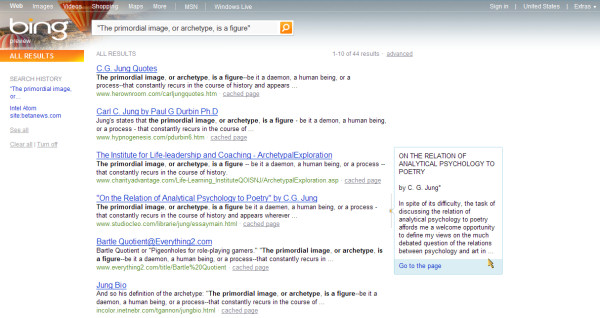
Bing tries to locate the source of a quotation by Carl Jung.

Right away, Bing did an excellent job of matching the quote. No doubt from the search results, we're looking at a Jung citation. Item #4 in Bing's list is impressive, linking to a page that gives what appears to be an accurate title. Being able to point to the little device on the right (it's not self-explanatory, though it is functional) that pulls down the first two paragraphs from the cited page, is also a clever and helpful feature.

But the thing about the Internet at large is that you can't always automatically trust the source of the information you find, no matter who or what fetches it for you. For example (no fault of Bing's), the page linked to in item 4 tells you that this essay, "On the Relation of Analytical Psychology to Poetry," was printed in 1978. Yea, you could say that, but the fellow passed on in 1961.
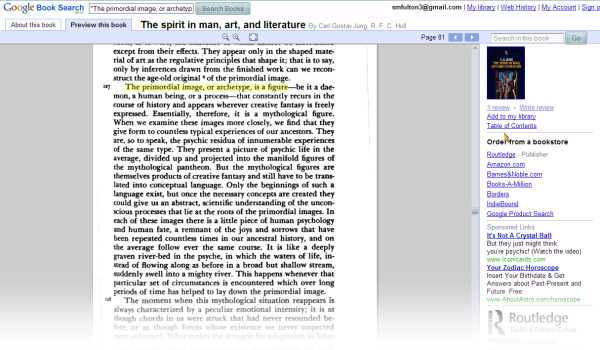
Google takes the user right to the page in the book where Jung's quotation is located.

By contrast, Google's #1 result comes from...Google itself, specifically Google Books. It takes you straight to the page in The Spirit in Man, Art, and Literature where the essay first appeared. Google Books is one of that service's more controversial features; in its original incarnation, it presented scans of printed pages for books whose authors or publishers were apparently too busy with their own lives and businesses to send Google a letter "opting out" of the service. But in this case, you have to admit that going straight to the book itself -- and from there, to links to places where you can buy the book -- is far more effective than linking to a dubious source. So for the first heat, score 1 point for Google against Bing.

Next: The best price on a 1 TB hard drive

1 | 2 | Next Page →

Comments

View comments by with a score of at least

I just tried the same experiment done here with the 1 TB hard drive and google returned the $53 hard drive that they claimed google did not find but google had already added in shipping and tax, which is probably why it appeared to be more expensive. It also came right to the front with google shopping and with bing i got a whole bunch of hard drive enclosures which is not what i was searching for. I'm sure I could wade through all the nonsense results, but why would i do that? I can just use google.

The authors last search was borderline retarded. He start by saying we're going to search for north korea's missile testing and then you go and search for "North Korea" test. Excuse me if I'm missing something here but shouldn't they have searched for north korea missile test? Also, why would the author put quotes around north korea? That is useless for a phrase so common. ALSO, ahem, the author says they used the toolbars to find this which is the same thing as using the normal search engine. I guess they don't bother to realize that just using the regular search engine is not the best way to find up to date news. Its for finding the most relevant and useful information. If you want the newest info, just click on 'news' and search there. The author CLEARLY does not understand how to use search engines.

Score: 0

|

try etihad airways. or cislabs australia or msy or sapphire processor...Google simply performs. Bing feels like a stale cake waiting to be disposed. Till it "betters" itself. I'll sleep on it.

Score: -1

|

I was searching for "Exotic Collision" near Bellevue, WA (yes - I am a Microsoftie). The first result on Bing blew me away - all the information I needed was right there, with a one-click access to directions!

Score: 0

|

You should all go BING yourselves.

I am loving it. It gets stronger by the day.

Score: 1

|

As soon as I started reading this article, I knew the outcome. Google fanboys are as bad as Apple fanboys... I use to use Google but switched to Live Search since it had better results... I've been using BING and so far it surpasses Google and Yahoo Search. Just the name "BING" is geniouse... I'm loving BING and especially loving the name... What the hell is a GOOGLE anyway, it sounds like the sound baby's make?

Score: 1

|

In mathematics, a "google" is the term used for the number One (1) with a hundred zeros in front of it.

If you can imagine the actual astronomical size of that number, and then connect it to a search engine which often returns hundreds of thousands (if not millions) of results for your search query, you'll agree it's not hard to see what a brilliant example of branding the name "Google" really is.

Score: 0

|

Wrong. Googol is what you said. Google is an (intentional) misspelling of it. Oh, and the zeros are *after* the 1, not before.

Score: 1

|

It's too bad that Google management killed the Froogle name..it was playful and good marketing (though admittedly harder to translate, which may be the real reason they killed it).

Score: -1

|

i have utilized live search with little complaint, other than there have been times that it could not produce "any" or "little" results at times.

google and ask proved to be useful otherwise.

just becuase live has been repackaged and called to bing, doesn't make it any better.

--------

unfortunately for google and others, microsoft has integrated their search engine into the i.e. browser in several places in addition to the default msn homepage.

perhaps, another marketing falacy is that just because there are several ways to "bing" doesn't make it anymore better, just manipulative.

Score: -2

|

Except the '1 Tb' drive mentioned in the article is actually a 500 Gb.
ST3 500

Score: 1

|

I've tried bing out a little bit today, and I have to say--I've been pleasently surprised with it. It pulls up the results I want for searches, it has relevant information relating to the search in the left column (the "company information" links are neat--not enough companies have them but if bing catches on this will be extremely useful), and the home page, while not quite as simple as google, is simple enough.

Is it better than google? Way to early to say, but it's definately a worthy Yahoo competitor. I'll be using it for a while to see how it goes.

EDIT: Alright I've found a pretty big complaint.

Specifically, I looked up "2009 Atlantic Hurricane Season" and did not find an entry for wikipedia's page with the same exact name. When I looked up "2009 Atlantic Hurricane Season wiki", it did not pull up any search results. When I did this with google it was the first entry, and google still had 493,000 results.

On the positive side, recent events such as "Tiller", "Flight 447", and "GM Bankruptcy" pull up plenty of relevant results, an area where many new search engines have trouble usually. Still, specifics are worse than google--for example, "Flight 447 foxnews" does not show Foxnews.com's article regarding flight 447 (google does). This type of searching is crucial if bing hopes to compete with google.

Score: 1

|

Just can't work it in. "Just" search nowadays is a little too retro for my workflow. With Google I can have my search, sites, feeds, and gadgets all on one page. Bing is still one-dimensional unless I have totally missed the "add stuff".

The blinky images (hover suqares?) are also quite distracting to me.

I can see how this would work for folks who currently use a "search page" without the frills, but it just isn't going to work for me...

Now...if only I could get my google home-page to search using "bing"...I could test results. :p

Score: 0

|

I did a search for 2009 Atlantic Hurricane Season and I got the wiki as the first result....I'm not sure why u didn't get that as a result

Score: 1

|

Every search engine handles how the query is entered differently. Order of the words, words used, that kind of thing.

Part of finding a search engine that suits each person is finding the one that responds the best to the way you query them.

For example, I can search for virtually anything on Google and get the responses I desire in one or two attempts. Any other search engine drives me nuts because they never work "right"...(In other words, they don't work in the way I have become used to in my years using Google). The crazy bas**** in the next office is a die-hard yahoo'er. The very same affliction has taken hold of him substituting Yahoo for Google. Neither of us can use Bing or Ask or anything else and get decent results.

Who knows? Bing could be the next great engine... it just doesn't work the way *I* have become accustomed to.

Score: 1

|

I like bing and google both, and especially comparing them, so I made a quick little mashup that ya'll are free to try out and use.. enjoy!

http://bingle.pwnij.com/

Score: 2

|

Nice!

Google wins on the "wtf" search. ;) (Safe search disabled)

Note: Currently, clicking a link on one of the search panes opens that page in the pane you launched it from. Perhaps it might be better if it simply opened that page (getting rid of the panes)?

Score: 0

|

yah, I'd like to make it do that, but I'm not sure how to change the links returned by google and bing. I'm looking into it.

Thanks for the suggestion.. keep 'em comin!

Score: 1

|

Google Chrome 4: Yes, it's fast, but is it usable?

As Betanews readers have responded to our stories about Chrome's JavaScript superiority...Does that mean we'd actually use this browser? Well...

Video: Netflix on PlayStation 3

Netflix has come to the PlayStation 3 via Blu-ray and BD-Live.

Verizon Wireless launches new Android, Chocolate, and ruggedized phones

The lower-priced Eris joins the Droid, while the Chocolate gets a touchscreen and more music playback.

Early sales figures for Windows 7 nicely high, but do we know why?

Fans of triple-digit surges in figures quoted by Betanews will love this one, as it appears Microsoft rediscovered how to pull off a software launch.

Myka announces its latest Linux-based 'net top box'

Myka's ION brings Boxee, XMBC, and much more to HDTVs.

What hath Mac wrought? A remembrance after a quarter-century

The reason there's a Macintosh today is not because of some brilliant flash of engineering genius, but because Apple had the audacity to learn from its mistakes.

Early build of Moblin 2.1 improves connectivity, but not device support

The Linux Foundation's Atom-centric OS yesterday received a major overhaul with the project release of Moblin 2.1 for netbooks and nettops.

The iPhone's China syndrome: Sales of 5,000 and climbing

There's actually a country where Apple's device is not a godsend, where sales can be measured in the dozens.

New European counterpart to FCC will ensure 'a more neutral net'

Late Thursday night, the ruling telecom administrators of the EU's member nations signed away their final authority to a new entity overseen by the EC.

Sophos study suggests Windows 7 UAC's default setting is self-defeating

Without any anti-virus installed, a Sophos test showed, User Account Control was only capable of thwarting just one malware package out of ten samples chosen.

Indiscreet tweet trips awareness of Web SSL vulnerability

A group of high-level security engineers had been making progress on thwarting a low-level threat to the Web, until somebody blurted it all out on Twitter.