Broadcom looks to replace HDMI with Ethernet
By Tim Conneally | Published March 31, 2009, 2:55 PM
Wireless streaming of high-definition video must still be very far off.
While it does exist in various forms today, one of the premier members of the Wireless HD Consortium, Broadcom, is proposing a new streaming video interface standard which focuses on HD over Ethernet.
Called BroadSync HD, the standard is Broadcom's own custom implementation of the 802.1 Audio-Video Bridging (AVB) standard for streaming and syncing video over standard Cat 5 cables with RJ45 connections (a.k.a., Ethernet). Broadcom said today it has assembled an end-to-end solution for A/V transmission combining Ethernet switches, end-point devices, physical layer devices and software, and is currently working to bring the technology to market.
The end goal for this standard may be no less than to replace all dedicated audio and video cabling such as component, S-Video, SCART, DVI, and HDMI with Ethernet cables. Broadcom said today that AVB will establish the Ethernet connection as "the common underlying technology for high quality network-based streaming that will eventually replace most other types of connectivity presently used in A/V equipment."
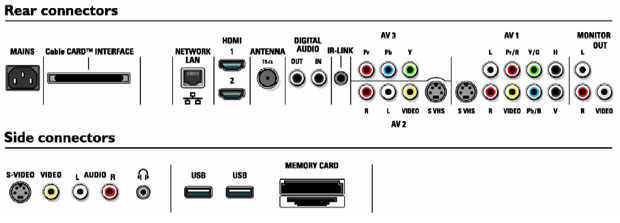
Typical high definition televisions and set-top boxes suffer from interface clutter, as this picture illustrates; and that clutter is invariably turned into a tangle of converted, sometimes spliced wires in the user's physical space. Even worse for the consumer is that high definition cabling also carries a steep price.
Broadcom's advocacy of AVB as a standard is similar to the widespread adoption of Wi-Fi and Bluetooth in notebooks and phones, but works instead on the principle of using what's available. By devising a standard for utilizing cheap and readily available parts to deliver HD content, manufacturing costs of HD equipment can go down, and the consumer can breathe more easily.

Laird Telemedia has offered an uncompressed (480p, 720p, 1080i) 1080p capable system (PhatCat) for several years that does exactly this (and they own a dozen patents on the technology as well) in the professional broadcast and distribution space. And they are 'just' sending HDMI over Cat5/6.
The notion that anyone can simply implement this at the same price as existing technology has their head in a far too far inaccaessible location.
The cost of transmitters, tranceivers and receivers - let alone routers and switches - is no trivial issue.
Score: 0
|So far, I haven't seen any consumer 100 Gigabit switches on the market, and if there were they'd be so price-prohibitive that they'd never sell. The extra circuitry that would be required within the consumer equipment would also price this thing out of the market. I don't think TV and DVD manufactures are going to give up the dozen RCA & S-Video jacks that cost $2 to implement for an Ethernet port that'll cost $20 (or more) to implement.
Wasn't HDMI supposed to be the universal all-in-one does everything you need cable? Wasn't it supposed to replace all RCA, S-Video, coaxial, fiber, & DVI cables?
Score: 0
|HDMI v1.0 4.9 Gbit/s 0.6125 GB/s
HDMI Type B 20.4 Gbit/s 2.55 GB/s
100 Gigabit Ethernet (100Gbase-X) 100,000 Mbit/s 12,500 MB/s
theres a bit of a difference there... right?
Score: 0
|Hmmm, wasn't USB originally conceived to do this??
Score: 0
|Sounds like a great idea, unfortunately we won't be seeing it anytime soon. First off, this is a Broadcom solution, not an industry standard. If Broadcom can do it then any other networking giant can too. Then once all those "standards" hit the market it takes years to whittle it down to a universal standard. See the US cable TV market for a lovely example.
So yes I think it's a wonderful idea, but I don't expect to see it on my TV anytime next decade except as yet ANOTHER port.
Score: 0
|I hope this becomes an industry standard for HD. I'm curious how far the A/V signal can go over Ethernet cable.
Score: 0
|I think it's a great idea. 1 standardized connector instead of over a dozen, some of which are fairly expensive. And Ethernet has more bandwidth than USB.
Score: 0
|

