Chrome Frame erodes IE from the inside: Can Google get away with this?
By Scott M. Fulton, III | Published September 23, 2009, 2:53 PM
Yesterday's revelation by Google that its open source Chromium lab developers have been testing deploying the Chrome browser engine as an Internet Explorer add-on called Chrome Frame, and its subsequent opening up of that project to the public, is a surprisingly ballsy move from a company typically known for being cool, plain, and innocent-looking. Quite seriously, the complete engine is being offered as a downloadable add-on, with the promise that developers will be able to retool their sites to let IE users render them using standards accepted by developers rather than those deployed by Microsoft.
But that's not exactly what happens -- and in fact, that last phrase could apply in any number of cases to how the browser-within-a-browser actually works. First, for developers to be able to utilize these standards, they're being invited to include tags in their code that target a specific browser, such as <meta http-equiv="X-UA-Compatible" content="chrome=1"> But as you can plainly see, that browser isn't IE. It's Chrome, which means that Google Frame is actually an incentive to get more developers to target Google's browser specifically.
"When Google Chrome Frame detects this tag it switches automatically to using Google Chrome's speedy WebKit-based rendering engine. It's that easy," reads yesterday's blog post from a trio of Google engineers. "For users, installing Google Chrome Frame will allow them to seamlessly enjoy modern Web apps at blazing speeds, through the familiar interface of the version of IE that they are currently using."
But that's not exactly what happens. Chrome Frame doesn't completely replace the IE rendering system, nor does it give the user (yet) any option to do that -- at least, not an obvious one, though we're actively looking for a non-obvious one and we won't be surprised if we find it. You would think that, by "modern Web apps," Google would mean its own, naturally. However, our own tests clearly reveal that not even Google itself has utilized its own tag; if you launch Google Docs, for example, in Internet Explorer 8, the rendering engine will be IE8.

To overcome this little hitch, users themselves can trigger the Chrome Frame add-on by adding cf: as a prefix before the URL prefix, as in cf:http://spreadsheets.google.com... For our Google Docs test, we had to log in through the ordinary IE8 page, then hack the address line ourselves with the prefix to engage Google Frame. (One way to tell which rendering engine is responsible for what you're seeing is by right-clicking on a blank spot on the page. Chrome Frame's options only appear when it's in control.) But not even this method is foolproof: In Betanews tests this afternoon, we were unable to get Chrome Frame to load locally saved Web files, probably because the two browsers' protocols for local files (Chrome uses file:// with forward slashes, while IE reverts to the DOS-style filename with the backslashes) are incompatible.
We also noted that Chrome Frame didn't leave IE in good running order after returning to a page rendered by IE -- for instance, when pulling up a locally stored bookmark. IE frequently crashed, though was able to restart itself and pull up the crashed pages. Still, this leaves open the question of exploitability -- whether by crashing Internet Explorer, Google is actually creating a new security hole.
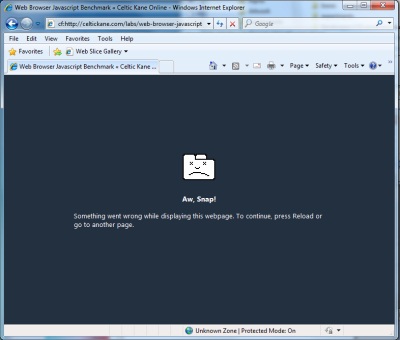
We also noted Chrome Frame expects to be Chrome -- it doesn't know how to respond to some user events in the context of a window other than Chrome. For example, dragging and dropping a page from the Desktop or an Explorer file listing into an IE tab that's being rendered by Chrome Frame, crashes Chrome, which responds with its "sick folder" icon reminiscent of old Macs. It does not crash IE, however; it still permits the crashed tab to be closed.
Until we discover, or someone kindly tells us, the secret to getting Chrome Frame to render locally-stored files, we can't test our complete Betanews browser test battery within Chrome Frame. We were able to obtain a few scores in some computational tests: In the SunSpider JavaScript benchmark, for instance, Chrome Frame in Windows 7 RTM posted a phenomenally high score of 58.32 on our index -- representing over 58 times the performance of Internet Explorer 7 on Windows Vista SP2, on the same physical platform. That was a surprise for us, since the most recent scores we'd obtained for the stable build of Google Chrome 3 was 49.76 on the same test. IE8 posted a 5.66 for the SunSpider battery.
In the Celtic Kane computational test, Chrome Frame posted an 8.94, compared to 9.22 for Chrome 3, and 1.97 for IE8.
What's even more curious than how well Chrome Frame performs is the subject of what Google may intend to do with it once it's done (if it's done). From a standpoint of pure user convenience, it appears much easier for folks who want to see Web pages rendered in Chrome, to download and use Chrome -- it's a free product, and there's nothing stopping them. It can import bookmarks from IE, and although it doesn't make use of IE's other add-ons, there aren't too many that are exclusive to IE anyway. So there doesn't really appear to be much of a value proposition in encouraging users to install Chrome Frame either as an alternative to Chrome, or as an add-on to IE triggered either by developers' tags or user influence.
But if Google Apps, including Docs and Gmail, or possibly the Google Toolbar add-on were to at some point include Google Frame, then the company might have a way to grease the wheels for Chrome to pick up a few more points in usage share. Google tools users would end up using Chrome, assuming its engineers figure out the "seamlessness" part. Yet that would be an uncharacteristically snake-like way for Google to begin marketing Chrome, reminiscent of when Apple iTunes users woke up one morning to discover they were connected to MobileMe.
Even as a simple experiment to "augment" the most widely-used browser by replacing it, the Chromium team's project does seem a little wanton, and appears to have taken Microsoft completely by surprise. Not only is there the issue of Chrome Frame's appropriateness, but also the legal issue of whether someone licensed to produce add-ons for a product may market an add-on that actually contains the competitor of that product, in essence or in its entirety.
Responding to Betanews' inquiry, Microsoft's corporate communications team has deferred comment on Chrome Frame, for now, to the Internet Explorer team which has yet to craft a response.

Chrome Frame probably got the higher scores because it isn't having to run and integrate with the Chrome browser interface.
Score: -1
|I think that Chrome will be the default browser I use once it incorporates a few more useability features. I really love it's rendering speed but the convenience of IE8 is more than Chrome can offer at the moment. As for Chome Frames, busting out IE8...I like it, seems like something Microsoft would have done eventually.
Score: -1
|So now, Google comes up with a web version of the chestburster from the movie ALIEN. Why am I not surprised by their latest parasitic move?
Score: 0
|Chrome is fast but damned glitchy... first time I used it, crashed 5 times in 10 minutes
Score: 0
|Imagine Microsoft doing something similar....World War III.....Of course Google gets away with it (and many many other similar tactics), cause it's the ...good company.We'll see for how much longer this will last...
Score: 0
|This is very good.
Hopefully google can create a seamless noticeable experience.
Companies with the old version of IE could use this!
I really see them do that.
Because it's just an addon for IE, not actually installing or replacing a new program.
Score: -1
|Very cheeky IE plugin methinks. lol
Score: -1
|If Google Search attempts to install ChromeFrame, I will start using other searches. While Google returns more results, I am tiring of scanning pages 2-23 for relevant results. Seems the time has come to check out Bing, Ask, ...
Score: -1
|Yeah good luck with that.
Score: -1
|I see no legal or appropriateness issues with this Google Chrome Frame thing, since there are plenty of "View In IE", "IE Tab", etc. add-ons and plugins for Firefox, Opera, etc. Since it's okay to build add-ons and plugins to run IE inside other browsers, it should be okay to build add-ons and plugins to run other browsers inside IE too.
How useful it is, it's another thing.
Score: -1
|Google wants people to run its apps, and run them as fast as possible.
Score: 1
|Microsoft already does this for Firefox...it is called Silverturd. And they install it without asking permission as well.
Score: -8
|I am in IT and find it Bing to be a better search engine than Google. You are right in that there are more irrelevant links in Google, and it is getting worse. I performed several side-by-side searches in the past and found very similar results in both engines, but that has changed over the years. I also enjoy the addition of the images (with links)to the Bing start page. I sometimes will click on those before doing my search.
I look at how much this app will be exploited in the future and how many calls I will be taking from customers on why their browser keeps crashing, maybe even getting infected. This will lead to some people claiming that IE8 is rotten and they should install Firefox, Opera, Safari, or Chrome as an alternative. It never ends.
Score: -1
|I see it more as Google is exploiting IE to get more users to use their product. (even without them knowing) Just like their toolbar, it will be likely that the installation will be bundled with other software and the "regular-joe user" will not even know it is being installed until it has a problem. That truly is the sadness in all of this. The unsuspecting users that are forced into using product just so companies can increase their numbers. Firefox, and just about every toolbar comes to mind using this very tactic.
Score: 0
|No, it won't be bundled with other software. The first application by Google that will use Chrome Frame is Google Wave. IE users will be presented with a notification telling them that they will either need to use an HTML5 compatible browser, install Google Chrome Frame, or continue at their own risk. There wont be anyting subversive about it. If Microsoft would just keep their browser up to date this wouldnt be an issue.
Without Chrome Frame Google has two options: Dumb down their applications (horrible idea), or spend a lot more developer time making it IE compatible, which is essentially equivalent to spending less time developing new features.
Score: 0
|Just like Apple did to Palm pre, Microsoft should stop Google from having a easy run....
Microsoft should sue Google !!!
Score: -3
|Some other company sueing Microsoft (and not getting sued themselves), now that would be something to write about. ^^
Score: -2
|Apple is actively trying to break iTunes on the Palm pre.
This is not comparable to Google.
Google actually creates something that WORKS on Internet Explorer!
MS fan boy!
Score: -3
|I am sure you have misread the article as the application does "not" work. It crashes and doesn't render local files. It is still too early to make any judgements or opinions on any thing else at this point as well.
Score: -1
|My only beef with Chrome Frame is that it represents another diversion from Google's long-promised but still undelivered API for add-ons.
For all of IE's faults and weaknesses (personally, it's not my favorite nor my default browser), IE has always been friendly to third-party integration. Not only is it very easy to develop your own app with IE embedded inside, it's also very easy to deliver your own app inside IE. Firefox has been the only other major browser to ever come close in terms of extensibility.
So it's ironic that Google is essentially taking advantage of Microsoft's openness, while keeping Chrome a sealed black box. In this regard, it's worthless that Chrome is open source. If I took the code and created an add-on API for it, who would write add-ons using my API, knowing that their work would go to waste when Google finally delivered its API? Microsoft's API may be buggy, inconsistent, and badly documented, but it exists and is clearly good enough for third parties like Google to be able to deliver add-ons like Chrome Frame.
Score: 1
|Google is working on extensibility for the next version. I think what they have done in a year based on the original beta is quite amazing. Open source is critical, of course there are offshoots of Chrome that can add their own extensibility.
Score: 0
|"Can Google get away with this?"
Sure. Because no-one will ever use it.
Seriously...like anyone is going to alter all of their web documents for something that maybe, if Google is lucky, will see a .0001% usage.
Score: 1
|Chrome already has significant share (after only a year of penetration) based on pushing it on Google sites alone. I could see a case of additional share if Google wanted people to have it.
Score: -2
|LOL I would not be so sure and bold to say that. I remember 12 years ago (more or less) when people said the same thing about Mozilla Browser when it first came out that it would not amount to anything, and today it is FireFox and one of the best.
Score: -1
|@mjm:
Google ahs been pushing Firfox (and now Chrome) from it's website for ages. If pushing it from their pages worked, it would have by now. The hold-outs don't care and Google isn't going to force the issue by rendering only in Chrome/Firefox....talk about suicide.
@Lakota:
Firefox and Netscape are entirely different browsers, managed by entirely different people and processes. I was there when Netscape died. *ANY* browser could have putt thier lights out. It just so happened that Microsoft was the first challenger.
Score: -1
|PC_Tool: You seem to think change happens overnight. I think not.
http://www.w3schools.com...sers/browsers_stats.asp
Score: 0
|This is a BIG BOON for website developers. Currently they have to write 3 CSS files - one for IE< 7, one for IE => 7 and one for all other (read standards-compliant) browsers. Now, they can just write ONE standards-complainant CSS file, and put the one liner for Google Chrome Frame, and FORGET IE forever! This will bring down dev and test efforts by a HUGE percentage!
Score: -3
|@rajesh.shenoy
Exactly. Web development is painful because you have to support IE and all its brokenness. Supporting Webkit based browsers and Gecko are trivial in comparison because they actually do a pretty good job of adhering to standards unlike Microsoft Internet Exploder.
Score: -5
|@mjm:
So pushing a plugin for IE is going to alter the market-share...how, exactly? If anything, it will *decrease* the number of people downloading chrome. Why use Chrome when you can use a tested, tried and familiar interface with the Chrome engine?
I don't think this is going to cause any changes. The current trends will likely continue, but I just don't see this as having any major impact on share.
Score: 0
|Very well said and in a very elegant manner. Major changes are needed to make the changes some seem this will do. I just have a problem with their tactics for some of their products and can see this being misused to alter those numbers.
Of all my customers I service, 3/4 of them have the Google Toolbar installed. Maybe, and I mean maybe about 1/3 of them use the product. Of the remaining 1/2 didn't even know it was installed, the other 1/2 knew it was installed, but never used it yet did not know how to remove it from their machines. This is both young and old users. I am called to homes where claims of IE are not working right and I find countless toolbars installed with popup blockers this and antispyware/virus that. After removing them(including Microsoft) their running smoothly again. Pages loading faster than before and new windows responding as they should.
I think there is a huge gap between what companies say that their customers want and what the actual user wants. This is one of them.
Score: -1
|I laugh at your statistics. The fact that Firefox is even installed on those machines is due to a few people in the IT industry that made it so. It does not mean that they actually use the product or if they wanted it.
Everytime, and I mean everytime someone starts out about Firefox, I ask them where did they hear that. It is from some IT guy or computer tech guy that has told them. You know, Firefox has gotten much better in recent years, but back then, it made me laugh. How about giving people a real choice, and then taking statistics from that.
I worked in a school district where IE links were stripped, only Netscape was offered. From this my fellow teachers(at the time) complained and was able to force and option. Then came Firefox. Many of my customers now have it installed because they were told they had to by some IT guy. They were told it was better compatible and secure with their internal site and the Internet all around. They had to use it.
Statistics are the easiest to exploit and I see it much too often in these types of forums. You have to take them with a grain of salt.
Score: 0
|Doesn't look like you CAN use local files with Chrome Frame. A work around would be to run a local HTTP server such as Apache and put whatever files you want to view on there, for your benchmark.
Score: 0
|I would like to know the Google reaction if Microsoft developed a embedded add-on (or script) in IE that changed the search engine to Bing in all Google pages...
Disclaimer: I don't like Microsoft (and Google is being evil every day).
Score: 0
|"and Google is being evil every day"
How?
Score: -2
|Opera did something similar to msn.com several years ago after they specifically blocked Opera from rendering msn.com. That was quite an amusing sequence of events.
Ended up with msn.com redering in Swedish Chef from the muppets language in Opera. Google "Opera Bork" if you're bored.
Score: 0
|Don't really see the point. I have Chrome, IE, Firefox, Safari and Opera all installed. Generally I run Chrome, but to access some ill behaved things like Sharepoint, I use IE. Seems just as easy (and a lot clearer) to just run multiple browsers than to put things like cf: at the from of URLs.
Score: 1
|Have to commend Google for trying to fix the horribly engineered IE engine.
Score: -9
|

