
Copyright board leaves rates unchanged, iTunes lives for another day

The recording industry's efforts to compensate for lagging CD sales by promoting hikes in royalties rates, suffered another serious setback yesterday in the US as a panel of judges ruled mechanical royalties rates should stay put.
Apple's threat earlier this week to shut down its iTunes service cast a brighter spotlight on the Copyright Review Board's royalties review process than at any time since 1909. As of this morning, the CRB hasn't actually publicly announced its decision yesterday, although the Associated Press learned from sources who participated in the meetings with the three-judge panel that it decided not to raise the rates for mechanical reproduction royalties above the current base rate established in January 2006.
That rate now remains set at 9.1 cents per song, or 1.75 per minute for any song lasting longer than 5:12, whichever is higher.
The anticipation -- at least among the CE clique -- resembled the mood of investors awaiting rate cuts from the Federal Reserve. The resolution means that services that sell songs for download will not have to pay any more to music copyright holders than they currently do.
As most iTunes customers know, Apple sells songs for a flat fee of 99 cents -- a price with which most customers now seem quite comfortable. Although Apple has yet to validate this information officially, based on testimony it's given in the past, it's believed the company already pays record companies between 70 and 75 cents for each track iTunes sells. Those companies were believed to have proposed a mechanical royalty rate increase to 16 cents per track, which could have cut into Apple's already razor-thin margins by as much as 27%.
Such a move could have forced iTunes to raise its download prices by as much as a dime, though any move north of the one-dollar barrier may have driven sales appreciably down.
|
| A chart showing mechanical royalty rates in the US since 1909. [Source: US Library of Congress] |
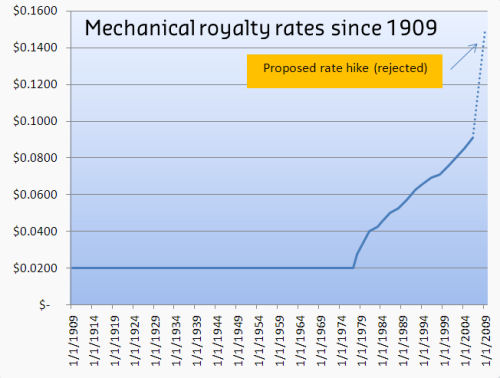
For 69 years, the Copyright Act of 1909 had set the rate for phonograph companies to compensate rights holders for the fact that customers could reproduce music through their Victrolas, at two cents per song. In the late 1970s, when the formats of 33 rpm record albums were acknowledged to have changed so that tracks lasted longer than on the typical 45, Congress decided to impose escalating fees for songs longer than about five and a third minutes.
Since then, the recording industry has generally been able to raise the base royalty rates every two years, by in-between a quarter- and a half-cent. The last rate increase that took effect in January 2006 was 0.6 cents -- at the time, unprecedented. So a 5.9 cent increase would conceivably have been catastrophic.
In a statement late yesterday, Digital Media Association President Jonathan Potter said, "During this challenging time for the music industry and digital stores and services, we are pleased with the CRB's decision to keep royalty rates stable for the next five years. Keeping rates where they are will help digital services and retailers continue to innovate and grow for the next several years, which will benefit songwriters, artists, labels and publishers." ITunes is a member of DiMA.
Terrestrial radio stations have historically been exempt from having to pay royalties for mechanical reproductions and for performance rights holders, though they do pay annual fees representing compensation to songwriters. In an agreement reached two weeks ago, Internet streaming broadcasters will have to pay both performance and mechanical reproduction royalties, the latter tier most likely using the 9.1 cents per song rate affirmed yesterday. But the total of the combined rates will be capped at 10.5% of net revenue, ensuring that royalties can never completely usurp a net broadcaster's profits.
If you don't think you make enough money as a songwriter, however, wait until you publish a piece that's popular enough to become a ringtone. The CRB yesterday did accept a proposal yesterday to raise the mechanical royalty rate for ringtones to 24 cents, plus a possible 1.5% late payment fee.



