DTV broadcasters: Suddenly loss of signal could be a problem

By Scott M. Fulton, III | Published March 5, 2009, 5:05 PM

A series of comments filed yesterday with the US Federal Communications Commission on behalf of the National Association of Broadcasters and the TV industry's technology research laboratory, the Association for Maximum Service Television (MSTV), came to the conclusion that educating the American consumer about the existence of the digital TV broadcasting switch (now set for June 12) is no longer a serious problem. Much more serious, they condend, is the real possibility -- one which broadcasters are apparently just now addressing -- that certain viewers including those on the outskirts of analog broadcasting signals' coverage areas may suddenly find themselves without service.

"To strike an appropriate balance, stations that are predicted to lose two percent or more of their analog viewers as a result of a change in their geographic coverage area should have the flexibility to design the best way to communicate information, over-the-air, of this potential loss to their viewers, and, importantly, how to obtain specific information," reads the comments of the two industry leading groups (PDF available here). "We would support having these stations include in weekly on-air consumer DTV initiatives of their choosing a notice, such as: 'a small percentage of current viewers using an antenna to view this analog station may have problems receiving this station's digital signal; you can go to www.AntennaWeb.org to determine this and to see what outdoor antenna type will best serve your specific geographic location.'"

What broadcasters now perceive as the critical issue facing consumers is not confusion over the existence of the DTV transition, or the technology issues regarding how to acquire or use a converter box. In testimony before the FCC this morning, NAB President and CEO David Rehr stated that among cities where some analog stations did elect to throw the switch last February 17, the low amount of consumer confusion and panic made the switchover a "non-event," as he put it, with fewer than one percent of viewers in affected areas placing calls to FCC call centers overall, and with certain cities reporting as few as 50 calls.

A key problem, however, as Rehr told the FCC, is the possibility of signal loss -- that some viewers won't get the signals from the channels that used to serve them. During Hawaii's early switchover on January 17, the biggest issue consumers there reported to call centers, according to the Honolulu Star-Bulletin, was the inability to get a picture.
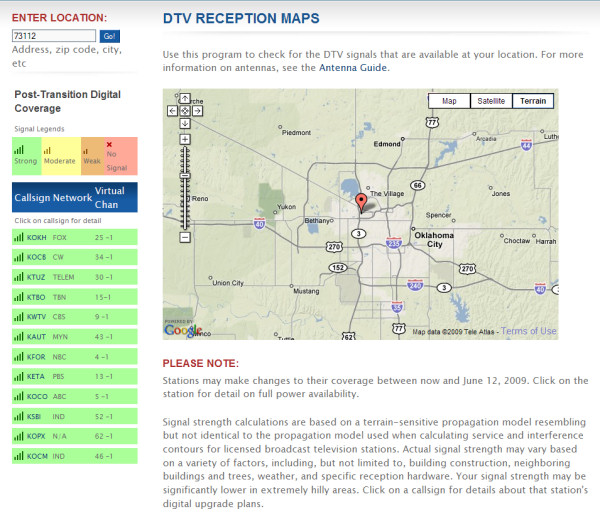
An example of the FCC's DTV reception map service, showing receptivity in the area of Oklahoma City.

Currently, the FCC provides a live testing page for viewers to estimate the strength of signals for each DTV broadcaster serving a given ZIP code. But aside from virtual tools such as this one, the NAB would like for broadcasters to be able to notify viewers about the possible need for them to upgrade their aerial antennas. Some inside the Commission have suggested that stations mail notices to viewers in their area; but the NAB and MSTV are advising the Commission to avoid forcing stations to resort to mail campaigns, asking that it instead allow broadcasters to...well, broadcast the message instead.

A secondary problem some consumers may face, the NAB points out, is the likelihood that they'll need to rescan the DTV spectrum for stations after new stations throw the switch. Currently, a DTV converter box retains a list of "found" stations in its memory, and only tunes to the stations on that list. That's different from the analog days when viewers scanned the dial past dead-air for clear signals. Had every station thrown the switch on the same day, as originally planned, consumers might only have to scan the spectrum once. So now, stations are considering telling their viewers to keep scanning their converters periodically to check for new signals.

"Although we are still mining information from the February 17 transition of hundreds of stations to digital-only broadcasting to better prepare for the June 12 nationwide switch, information reported to NAB suggests that the number one consumer question [is] related to rescanning of over-the-air digital sets or converter boxes," the comments report reads. "Therefore, the Commission's proposal that television stations provide notice to consumers about the need to periodically 'rescan' when using over-the-air digital televisions or digital converter boxes connected to analog sets makes sense."

Comments

View comments by with a score of at least

a slightly different twist - hardly any good analog here to begin with - no DTV, dish says because of agreements made with providers they can no longer provide local stations as a concession to DTV legislation. Catch 22. And sorry foxfyre it is a question of the right antenna - lame comment. Have tried them all. Why I am forced if I want any TV to pay for satellite. Rural America is screwed once again. Enjoy your citified directional DTV.

Score: 1

|

My grandmother receives her CBS station in completely clear on analog; however with her new digital box this station glitches, artifacts or is just plain unavailable. I'm glad people are starting to look into this issue.

Score: 1

|

Oh no!!!

Dude, the 'box' simply converts a digital signal to an analog signal your (or her) old set can recognize.

It is not magic.
Nor is it a substitute for an appropriate ANTENNA capable of picking up the signal with sufficient gain for the set to process it.

So, instead of whining here, why not get off you lazy @ss and get her an appropriate ANTENNA???

Just who are you waiting for to do that for you?????????? Hmmmmmmm?

Score: -1

|

Wow, my area gets nothing but PBS. Not that I don't like PBS, I really do. It's a good thing I can get cable TV.

Score: 0

|

The antenna web map shows that we will get no signal which corresponds to the fact that we can not even get acceptable analog reception. The federal map shows that we will be getting a reasonably good signal and are well within the signal range. They seem to overlook the fact that twisting river valleys bordered by mountains are not really good places to get a signal.

The fact that the maps of the roads in the area are just plain wrong and tend to show my address as being about 3 miles away on a non-existent road makes using these tools even more interesting.

Score: 1

|

Just imagine....in 1 year...NO ONE WILL CARE!

Score: -2

|

People care now?

I mean, aside from the broadcasters and the entitled masses....

Score: 0

|

"DTV broadcasters: Suddenly loss of signal could be a problem."

Yeah...a problem for whom ??

What none of the stations and broadcast executives will dare to admit is their fear that a large portion of those people who are left with no signal at all will suddenly discover how easily they can get along without such earth-shaking content as "American Idol", or "Dog The Bounty Hunter" or even (gasp) "CSI", and they will find other, more interesting things to do, than watch television.

One can even imagine an article on this very website at some point in he future concerning the growing number of Americans who have discovered the joys of "Life Without TV". That prospect terrifies the broadcast executives, which probably the real reason they have been advocating for a delay.

Score: 0

|

I'm afraid there's no remedy for the required weekly dose of House, though.

Score: 1

|

The most popular channel in my area no longer comes in for most people. Not only that but two of my neighbors, including my grandparents, have already had converter boxes fail on them in their first few days of usage. This is a textbook example of how not to execute a technology transition.

Score: 1

|

Congratulations, you have in one fell swoop demoted yourself to "troll". Whatever respect I or anyone else ever had for your opinion, you just forfeited. Please find a new forum to pollute, you are no longer needed here.

Score: 2

|

ha ha dude do you work for a big TV station or something? Well no I take it back, you sound too retarded to turn on a TV, LOL

Score: 0

|

so let me get this straight:

you are telling people who used a passive indoor antenna to get all of their channels clearly (and even the whacky religious nut channels that no one watches or even knows exist, or the community channels that the local cable company puts on the digital 3-digit number tier) that because THE STATION has a crappy, weak digital signal that can't be picked up with the same antenna now connected to a digital box or tv with a digital tuner that these people need to buy an outdoor antenna and possibly pay someone to install it for use. or even that they need to subscribe to cable or satellite. or that some people who have cable or satellite but still have tvs not connected (because it's not feasable to do so) need to find some way to get additional cable or satellite lines installed. this is the insanity you're saying right? that's sure one hell of a commitment to the community you have there, blaming the viewer for living in the wrong spot or finding out that the antenna that they used before are now inadequate.

remind me never to hire you for customer service.

Score: 1

|

@ctk, that is exactly what he is saying.

Since when is it your "right" to recieve Television signals in the format you choose?

Did you *chose* analog? Hell no. It's all that was available unless you wanted to pay.

And that right there is the issue. People are still whining when they have to *pay* for something they feel *entitled* to.

Get over it. TV isn't a right.

Score: 0

|

I agree with PC_Tool (was that out loud?)

Score: 0

|

Indeed.
In the UK I don't actually know of anyone using an indoor "rabbit ears" antenna to recieve TV.

Score: 0

|

Last time I checked we own the airwaves - kinda hard to transmit emergency and public services messages on anything but a free analog airwave. Like radio. AM? FM? When was the last time you were in an emergency situation and only had the free airwaves for information vis a transistor radio? Let's please get real here - by virtue of owning the airwaves and letting the stations make money on their use we are entitled to a certain element of free and essential service. I also firmly believe PBS/NPR should be widely available and paid for by the government or the stations leasin our airwaves for profit for all rural locations in marginal or no signal areas. And oh well if you disagree. Why should we be subsidizing your service in the cities if you refuse to subsidize ours in the rural areas when we have equal ownership?

Score: 0

|

Well I need a rooftop antenna it would seem to get VHF. And I'm not wasting time and money for that. So anybody switching to VHF won't be coming in. Unless the broadcaster offers a rooftop antenna for free.

Score: 0

|

And now it finally dawns on them that delaying the changeover wasn't such a good idea. We need people in government who know technology or at least have access to people who know it, it doesn't appear as though that's the case.

Score: 0

|

The lack of a universal transition was NEVER the problem. The problem was and has always been that switching to digital instantly cuts your effective range by 25% - and that's when the transmission is tweaked for maximum reach. I will agree, however, that we are getting a perfect demonstration of the monumental incompetence that results from government interfering in the private sector for no good reason. (This seems to be the order of the day in Washington, and our country will suffer for it greatly, but that's another story). NOBODY needed digital TV except the white space lobby. I used to think this concept had real promise but upon digging deeper I came to realize this technology has a long way to go before its practical. While I am all for some kind of ubiquitous wireless internet, government disinformation and the hijacking of reliable airwaves was not the way to go about it. The bottom line? If someone says "I'm from the government and I'm here to help you," keep one hand on your wallet and another close to a firearm.

Incidentally, there is no possible way the broadcasters were ignorant of this problem. I can only assume their costs are being partially defrayed by taxpayer dollars and therefore they were eager to use the transition as a way to save on equipment upgrades.

Score: 2

|

"we are getting a perfect demonstration of the monumental incompetence that results from government interfering in the private sector for no good reason. (This seems to be the order of the day in Washington, and our country will suffer for it greatly"

Amen.

Score: 0

|

You miss the point, which is, that the entire undertaking was ill advised. Letting the FCC articulate the parameters for broadcasting is like letting Mrs. Smith's 6th grade class in Peoria plan the NASA mission to Mars.

Score: 1

|

It's more than 25%, because the actual radiated power is lowered by a factor of 2-3 times. In some areas, the lowered power, the poor system used to broadcast the signal (how a 3rd rate system like the one designed by LG was chosen is probably a topic for a book exploration), and a lowered antenna height all combine to make things much worse than your figure.

The anecdotal stories of what people will do to get reception will be fodder for comedians for the next few years.

Score: 0

|

technology doesn't exist right now for effective small antenna's. How many can afford a rooftop antenna? That and it's pointless. Wait a few years and either broadcast is gone or there will be a better way to recieve. Weren't anywhere near ready in that dept.

Score: 0

|

incidently, the one that we can't get anymore, the digital signal box was moved higher up the antenna. But two things again are problematic. 1. It's VHF. 2. They are running at 4% power until sometime mid to late March.

Score: 0

|

Google Buzz: Another attempt to harness the content firehose

Similar to how Google successfully remolded RSS into a Google tool, the company now wants to remold Gmail into one big Google party

Success: Google's Nexus One shipping support line takes tech support questions

UPDATED Though the support line had been set up for shipping, it now appears Google personnel are happy to hear technical concerns.

Goodnight, moon: What I learned from a space shuttle

Carmi Levy | Wide Angle Zoom: Can the tech sector learn a few lessons from the space program? Certainly, if you believe in learning from someone else's mistakes.

Netflix to FCC: NBCU + Comcast could bypass net neutrality

Weaning itself from the post office as its main means of video transfer, Netflix would like someone to ensure the Internet remains just as unencumbered.

Rhapsody to become an independent company

RealNetworks and Viacom subsidiary MTV Networks have begun the process of spinning off music service Rhapsody into an independent company.

Nvidia debuts new dynamically-switched graphics card technology

Today, Nvidia announced that its Optimus technology for GPU switching will soon be available in a handful of Asus notebooks.

Google lowers 'unusually high' early termination fee on Nexus One

Google has lowered the Nexus One's early termination fees which were twice as high as the norm.

Netgear and Ericsson introduce a mobile broadband hotspot with a twist

It's a mobile broadband hotspot, but it's for use in the home.

Report: Streaming video drove 72% global increase in mobile data consumption

A new study says streaming video is "the single most influential factor driving the need for increased mobile network capacity."

Stymied by continuing Nexus One 3G issues, Google blames the environment

If you're still afflicted with the 3G flip-flop trouble, then you might consider moving. That appears to be the only suggestion Google can give for now.

Wolfram|Alpha makes a strong argument for virtual keyboards

"Answer engine" Wolfram|Alpha has updated its iPhone/iPod Touch app, harnessing the strength of the virtual keyboard.

