EC hopes to beat US, Google in book-scanning race, may rewrite law to do it

Out of concern that Google may yet be able to scan the printed works of authors worldwide and make them available to Americans but not Europeans, two leading European Commissioners this morning set forth on a plan they hope could beat Google to market. Their plan involves Europeana, the online portal for the collected works of the EU's member countries, which is still officially in beta, though has come a long way from its extremely rocky first tests last year.
Commissioners Charlie McCreevy and Viviane Reding this morning issued an official "Communication" regarding their plan to use Europeana.eu as a portal for the publication of printed European works that have fallen into the public domain, as well as "orphaned" works -- books that may still be under copyright protection, but which no author or publisher has recently claimed.
Orphaned works are the subject of the ongoing settlement talks in the US between Google and representatives of some publishers. While both sides appear willing to settle, Google has taken the unprecedented step of petitioning to settle any dispute that may arise in the future between itself and parties that have failed to claim rights to orphaned works up to now. Two weeks ago, the judge overseeing the settlement threw out the latest draft, and ordered the parties to create one that wasn't so much of a legal stretch.
That order may have given Comms. Reding and McCreevy the window they need to retool Europeana as a competitor site. As Comm. Reding stated this morning, "If we act swiftly, pro-competitive European solutions on books digitization may well be sooner operational than the solutions presently envisaged under the Google Books Settlement in the United States."
However, they admit they'll need to make changes to the law to do it. Up to now, the EC's policy has been to respect the various other policies of the copyright bureaus of its member countries, for what it's called "harmonization." But those countries appear to differ with respect to the answer to the question, "What does 'public domain' mean?"
You might think it's a simple enough question to answer, but keep in mind that when countries originally made their respective decisions, the concept of scanning books for worldwide dissemination over an electronic information service did not exist. Since public institutions can't exactly do this job themselves, money will have to come from somewhere. And who's to say that, when the silent authors of orphaned works let their copyrights lapse, their rights to collect from some future technology lapsed with it?
With that question unanswered, some countries are taking the step of claiming national rights to orphaned and public domain works. That makes it difficult for a continental institution like the EC to find a sponsor.
"While some of the cultural institutions explicitly indicate that the material they bring into Europeana is in the public domain, others claim rights on the digitized copies and/or charge for downloads," reads an August 28 Communication from the EC (PDF available here). "A few institutions apply watermarks and, in one case, viewing the material in a reasonable size is subject to payment. The different practices reflect the wide range of approaches across the EU, which are sometimes dictated by increasing pressure on cultural institutions to raise direct income from the assets they hold. Requiring payment for digitized public domain works also reflects the fact that digitization has a cost. At the same time it seriously limits the cultural and economic potential of the material.
"From a legal point of view the question is whether digitization in itself creates new rights. Normally this would not be the case," the August report continues. "However, the level of originality needed for the creation of copyright is not harmonized at European level, so the answer to the question may differ from one Member State to another. It may also vary for different types of digitization (for example the scanning of books is not the same as costly 3D rendering of objects)."
So just because a work has become free, does that necessarily mean anyone and everyone has a right to profit from it? Answering "yes" to that question would actually present the real problem for the EC, because it probably won't be the member states that contribute the most to Europeana (the Communication acknowledges that about half the site's material comes from France alone). The big problem, which commissioners are acknowledging today, is this: If the EC won't do it, Google will.
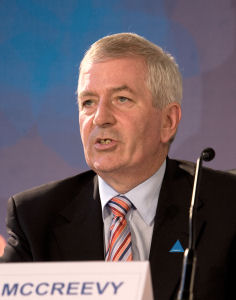 As reads a statement this morning from Comms. Reding and McCreevy, "The recent information hearings held by the Commission on the Google Books Settlement Agreement highlighted the anomalous situation that would arise were the settlement to be approved, namely that the vast number of European works in U.S. libraries that have been digitized by Google would only be available to consumers and researchers in the US but not in Europe itself. Ensuring that Europeans are given access to their own cultural heritage, while European authors are fairly remunerated, is therefore of immediate concern and will require European responses."
That European response could very well be the creation of a continent-wide clearinghouse for media rights, a single collective library for all the other libraries and copyright bureaus in Europe. But getting that accomplished might mean throwing away parts of the EC's 2001 directive on "harmonization" of various countries' copyright laws -- a fact which Comms. McCreevy and Reding acknowledged in their Communication released this morning (PDF available here).
"The orphan works problem will be examined in an impact assessment which will explore a variety of approaches to facilitate the digitization and dissemination of orphan works," this morning's Communication reads. "Possible approaches include, inter alia, a legally binding stand-alone instrument on the clearance and mutual recognition of orphan works, an exception to the 2001 Directive, or guidance on cross-border mutual recognition of orphan works."
Facilitating such a broad new annex of Europeana would require a new degree of public and private cooperation, where private interests are allowed to contribute works or links to their own hosted works, and are perhaps compensated with a share of proceeds or with advertising. That may go against the grain, if not the letter itself, of some member countries' existing copyright laws. So the course of action today's Communication is suggesting that the Commission suggest that it consider suggesting, is essentially to throw out those parts of "harmonization" with which they just can't harmonize.
The most expedient way to accomplish that may be, ironically enough, in the name of harmonization itself: by the continent-wide adoption of a new Lisbon Treaty updating the EU Constitution. That document contains the Europe-wide copyright system that commissioners are hoping for.
That's what Comm. Reding said last Friday in a speech in Vienna: "Politicians nowadays talk in every Sunday speech about the need to counter the digitization power of Google, but they still shy away from making Europe a strong player with regard to copyright. The new Lisbon Treaty will give Europe a powerful tool in this respect, as the new Article 118 will allow the creation of a European copyright title. I hope Europe will have the courage to make use of this soon. According to Commission studies, revenues from online content could more than quadruple by 2010, to €8.3 billion [annually], if we finally bring about a functioning single market for creative content offers."