EU to test Microsoft's revised proposal for Web browser ballot screen

Nearly ten weeks after Microsoft issued a proposal to the European Commission for a mechanism to let Windows users and installers choose the default Web browser they want to use during setup, the EC issued a statement this morning saying it likes Microsoft's basic idea, but will give the rest of the market an opportunity to weigh in with its opinions.
The EC statement admitted for the first time that Microsoft had submitted at least one "improved" version of its ballot screen concept since last July.
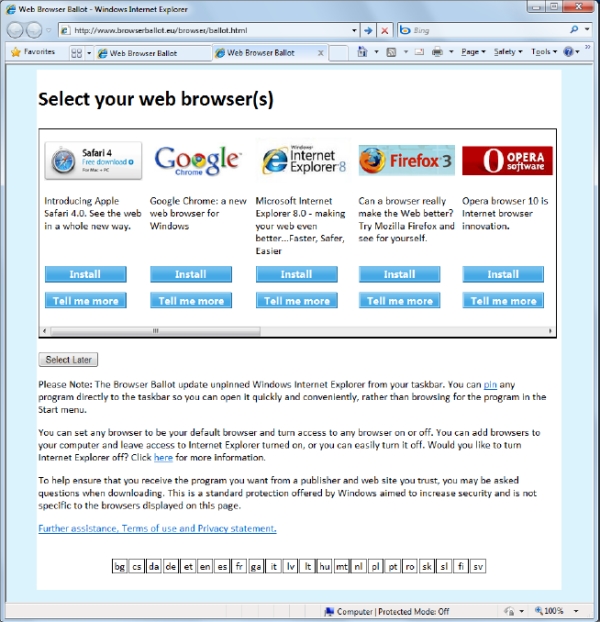
"The improvements that Microsoft has made to its proposal since July would ensure that consumers could make a free and fully informed choice of Web browser," reads this morning's statement. "Microsoft has in particular agreed to present users with a first screen explaining what Web browsers are. 'Tell me more' buttons for each browser would also enable users to learn more about the web browser they may wish to install. The user experience would be better and the choice screen would better represent competing browser vendors. Finally, the proposed commitment would now be subject to a clause allowing the Commission to review it in the future to ensure that consumers would continue to have a genuine choice among browsers."
The new version of the ballot screen would be offered to all European users of current versions of Windows -- meaning XP, Vista, and now Windows 7 -- for a five-year period. This would apparently not mean that Microsoft would have to ship a unique "Windows 7 E" version for Europe, which was the company's original plan. But beginning with Windows 7 and on into the five-year period, OEMs would be given full options to install competitors' Web browsers and uninstall, or not install, Internet Explorer.
The EC admitted today it likes Microsoft's idea. But rather than simply give the company the go-ahead, it has decided that in the interests of ensuring competition among IE's competitors, it will be "market testing Microsoft's proposal in light of these requirements." Microsoft itself released a copy (PDF available here) of the EC's Market Test Notice, which opens up a one-month period starting today, during which, "the Commission invites interested third parties to submit their observations on the proposed commitments...Interested third parties are also asked to submit a non-confidential version of their comments, in which commercial secrets and other confidential passages are deleted and are replaced as required by a non-confidential summary or by the words 'commercial secrets' or 'confidential.'"
"Interested third parties" presently include many of IE's competitors which have signed on to participate in the case, including Opera Software, Firefox maker Mozilla, and Chrome maker Google.
Microsoft made copies of its improved pledge to the European Commission this morning. The crux of the pledge is actually not about the browser screen, but a pledge to consistently provide interoperability information about the protocols used by its key software -- not just Windows and IE, but also .NET Framework, Exchange Server, SharePoint, and Office (especially Outlook). Although the interoperability pledge was supposed to have been on a different track, Microsoft General Counsel Brad Smith said today, the company is willing to implement this enhanced interoperability pledge the moment the EC signs off on the Web browser commitment.
"Microsoft's proposed undertaking will ensure that developers throughout the industry, including in the open source community, will have access to technical documentation to assist them in building products that work well with Microsoft products," said Smith. "Microsoft will also be required to support certain industry standards in its products and to fully document how these standards are supported. Microsoft's proposed undertaking will make available legally-binding warranties that would be offered to third parties."
Also included in that pledge is a promise to support "open, public standards" in its software, to the extent that it can. Here's how the company defines that:
"Microsoft shall provide support for applicable standards by either (i) implementing the required portions of the applicable standard that relates to functionality of the implementing product, or (ii) completely and accurately documenting instances where required portions of the applicable standard are not implemented or are implemented with variations. Microsoft shall make this documentation publicly available in a Timely Manner."
The newly proposed ballot screen does feature some obvious tweaks: First, it contains a bar of language selection buttons now familiar to many European residents. The selection of browsers is now in alphabetical order by manufacturer, so Apple Safari appears first and Opera last. There's also a notice saying, "Please Note: The Browser Ballot update unpinned Windows Internet Explorer from your taskbar," which indicates that this screen applies to Windows 7, but also that the update -- which arrives on users' computers through the Windows Update mechanism -- takes initial steps unilaterally to unregister Internet Explorer as the user's default browser.
But at least in this mockup, there is one element which may continue to prompt criticism from the EC's market testers: the fact that the ballot screen appears in Internet Explorer, complete with its logo in the upper-left corner -- which some have said implies a preference on the part of Microsoft. In its revised pledge, Microsoft states, "Nothing in the design and implementation of the Ballot Screen" can be construed to favor Microsoft, although it's arguable that since one needs a Web browser to see the ballot screen, it's impossible to turn off the "Internet Explorer-ness" of IE.
The Ballot Screen Update would be flagged as "Important" on Vista and Windows 7, and "High Priority" on Windows XP. Once downloaded, it would give the user an opportunity to execute it now or later; and if the user chooses later, it will install a shortcut on the desktop.
While only five browsers appear in Microsoft's proposed design, the company acknowledges that number could rise: "The Ballot Screen will be populated with the 12 most widely-used Web browsers that run on Windows based on usage share in the EEA as measured semi-annually by a source commonly agreed between Microsoft and the European Commission...In addition, if a browser's usage share is among the top 12, but that browser is no longer actively offered by its vendor, that browser will not be included in the Ballot Screen."
In his statement this morning, Brad Smith concluded, "As we've said before, the steps described above will require significant change within Microsoft. We believe that these are important steps we should take in order to resolve the Commission's competition law concerns. Today is an important day. Although the European Commission has not made its final decision, today's news is a major step forward, and we're hopeful this will help move us towards closure to the past and the building of a new foundation for the future."
The EC's call for a market test comes just one day after something resembling an alternative ballot screen emerged from Google Labs, ostensibly as a response to a marketing video depicting ordinary folks as ignorant of the difference between a Web browser and an operating system.