
Fast Flip: A peek into the future of Google News

Today's launch by Google of a beta service of something it's calling Fast Flip fits the profile for what could become the company's bid to republish and redistribute most of the world's online news content, in a manner which claims to benefit the publisher. My partner Tim Conneally took a look at the mobile version of Fast Flip earlier today.
At a book festival last April, Google CEO Eric Schmidt let loose another interesting fact about its business plans: He told Hollywood reporter Sharon Waxman of The Wrap that his company was working on a new and advanced news search algorithm, that would automatically serve users the topics and news providers they're interested in, based on its assessment of what the reader has pulled up in the past -- "to determine what the reader is looking for without knowing they're looking for it," Waxman wrote.
Google would then sell ads to go alongside the results its algorithm would retrieve. While those ads would not directly benefit the publisher, Schmidt told Waxman, the traffic the service would generate would indirectly benefit it by increasing its impressions.
In a speech that same month to the Newspaper Association of America -- one that was literally received by its members as a direct tell-off -- Schmidt suggested such a service would conceivably replace the newspapers' entire model of news delivery. "We need to reinvent the way the Web delivers this content, so that you can have the kind of experience, when people are wandering around with their phone and so forth, that you can have with a printed magazine," the Los Angeles Times quotes Schmidt as having said.
Then just last week, in a questionnaire response to the same Association, Google said it was developing a micropayment model for online news service delivery, and would be happy to host newspapers' content on its own servers in order to see that micropayment service work.
This morning's Fast Flip beta rollout lets readers peruse multiple thumbnails of articles from a handful of selected publishers -- not yet the gamut of all online news production. I'm on record with my opinion that it's not always possible for someone to make a sensible choice about whether to read a Web page based on its thumbnail; it's an idea both Mozilla and Google have tried with the "New Tab" functions in their beta Web browsers, with varying degrees of success.
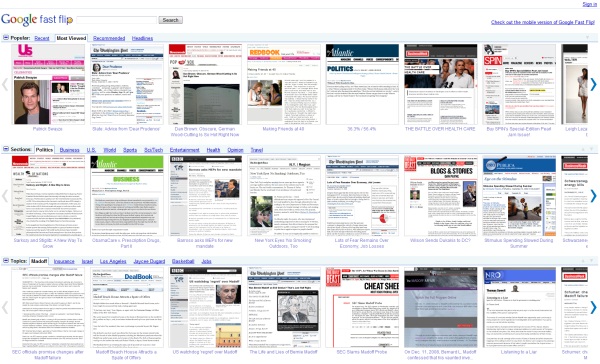
Certainly there are exceptions, as when a thumbnail includes a large enough picture of its subject matter, as in the case with some of the selections in this screenshot. Fast Flip captions each of its screenshots with main headlines, so even in situations where the thumbnailed headline is too small to read, the user can at least see what the story's about. But since the headline is the most important element anyway, many pages would best be served with just a headline anyway and not a thumbnail.
But the ability to see microscopic, illegible representations of the world's articles and choose which one is worth reading at a proper point size, is certainly not the most noteworthy element of Fast Flip. As a Google blog post late yesterday revealed: "Fast Flip also personalizes the experience for you, by taking cues from selections you make to show you more content from sources, topics and journalists that you seem to like. In short, you get fast browsing, natural magazine-style navigation, recommendations from friends and other members of the community and a selection of content that is serendipitous and personalized."
For online news publishers, this validation of Eric Schmidt's declaration from last April may be taken as a dire warning. As it stands today, news services (including Betanews) receive a substantial percentage of its readers through Google News. They depend on Google News' algorithm, which in all sincerity does its best to fairly level the playing field with regard to whose stories are featured in Google News headlines, at what location, and for how long. Some publishers have taken the perhaps excessive extra step of relying on Google News as part of their business models, providing them with the promotion and accessibility to a wide audience that their own respective home pages or advertising campaigns (when they have them) are incapable of providing.
Should Fast Flip become Google News, or should it at the very least replace Google News in the public conscience if not on the Google Toolbar, then these publishers will be in serious trouble. When Fast Flip is capable of choosing what it believes each reader wants to see based on his assessed preferences and reading habits, then whatever he's seen before will be amplified next time. (Like Tim said, this is how songs on Pandora eventually get repeated on users' personal stations dozens of times per day.) That means it will be up to those publishers themselves to promote their own value, rather than rely upon some Google-derived quantum of fairness to do it for them.
Now, perhaps this is as it should be anyway -- if Google stops trying to be fair to everyone and forces publishers to sink or swim on their own, it can be argued that this is how a free market is supposed to work. On the other hand, as we've seen with similar social recommendation services in recent years, when an individual relies upon a plurality to make recommendations, the nature and value of those recommendations tends to become homogenized -- which is not what many would expect.
In any event, a great many small publishers and some large ones should perhaps have paid greater attention to Schmidt's clarion call from last spring.



