Login:
Password:

Fujitsu's 'Nanohole' Tech Could Triple Hard Drive Capacity

By Scott M. Fulton, III, BetaNews

August 10, 2007, 3:48 PM

Last November, we reported on Fujitsu's efforts to overcome a curious problem with the physics of hard disk drives: storing magnetic data at densities that are smaller than the grains of the underlying ferromagnetic medium should physically allow. The company's solution involved a combination of lasers to locate precise locations on the drive, and also to pre-heat data spots to make them more conducive to holding data at precise locations.

But all that assumes that the precise locations in question...already exist. Yesterday, we learned from Fujitsu how they intend to accomplish that, and we also got a peek at some areal density goals.

The problem facing HDD engineers has been that perpendicular recording - the process that has already led us to the one-terabyte era for desktop storage - can only go so far. Even higher-capacity drives will be needed soon, not for storing spreadsheets but for serving media...unless CE manufacturers expect every digital home in the 2010s decade to drive their own SANs.

Fujitsu's next big idea literally came from those aluminum "hologram" stickers you frequently see on the front of cereal boxes, and the certification tape of sealed software cases. Making those pretty colors onto aluminum uses a process called anodization, which is a kind of electrolytic "washing" that leaves pits beneath its surface. The non-pitted regions become oxidized to form what's called alumina.

This pitting can change the color of aluminum, but it also increases its corrosion resistance. The size of those pits has already been known to be "nanoscale." What if the location of those pits could be predetermined, so a manufacturing process could place pits in an exact arrangement? Then those pits could be exploited for use as bits, in the data sense.
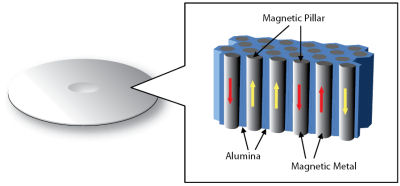

A diagram of Fujitsu's nanohole-pitted HDD surface.Cobalt is seeded within specially created grooves of anodized aluminum, leaving behind pillars that direct bits right to their holes. (Courtesy Fujitsu)


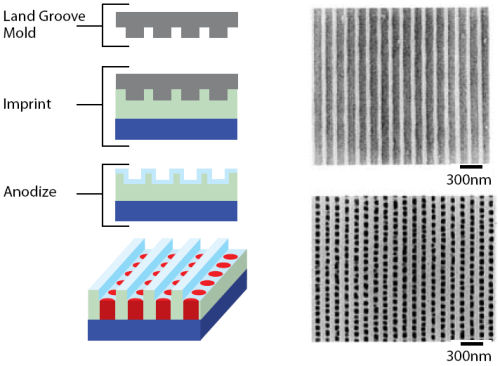
The solution Fujitsu engineers came up with is in a sense anything but novel, and proof positive that Edison had the right idea a century ago. First, they create a mold of the inverse of the surface of their nanoscale HDDs, and into this mold they inscribe grooves. If you've ever played a vinyl record album...yes, that kind of groove, except just not spiral. Its pitch is just 45 nm wide, which is perfect for the spot size of the guiding laser Fujitsu has in mind. This "land groove mold" is then imprinted onto the HDD surface, with the embossed areas carving little notches, like in a potato garden, where pits can be planted and grown.

If you've ever gardened, you know the secrets to beautiful flora are frequent watering and proper fertilization. In Fujitsu's case, the "watering" comes from the anodization wash. This creates alumina pillars that enable the grooves to be more magnetically stable than the outer surface - so that magnetic data is drawn toward the grooves where we want it to be. For fertilizer, Fujitsu uses cobalt, which is a cheap, ordinary material that happens to be very, very small. The alumina pillars create fenceposts, while the cobalt-induced pits give the bits someplace warm and comfortable to rest.

Yesterday, Fujitsu's public relations threw out a number for the press to chew on: One terabit per square inch areal density, achievable by 2010. This is a repeat of what the company said last year, when the company announced the optical spotting technique; and again last April, when Fujitsu first announced it had achieved nanohole spots at 25 nm depth. (Yes, Fujitsu actually announced this back in April, to the Asian press.)

One Tb/sq. in. is roughly three times the theoretical maximum capability of perpendicular HDD media today, and more than five times what's commercially available. But that number is nowhere close to where Fujitsu engineers are really aiming: The theoretical areal density achievable through this "nanohole" technique, according to Fujitsu documents, is actually four terabits per square inch.

And since the dynamics of this technique are predicated on the physical sizes of the materials involved - for instance, cobalt molecules - there's actually a probability, if we read Fujitsu's documents correctly, that it won't work its way up to 4 Tb/sq. in.; rather, it may have to jump over this strange 1 Tb/sq. in. number all the way to 4, and work its way up from there.

At any rate, what Fujitsu's PR is saying is to expect 2.5-inch and 3.5-inch HDDs with capacities at least three times what we're accustomed to today, in three years' time...which seems just about right.


Fujitsu's "land grooves" create pits where bits seed themselves, as seen by electron microscope.
Fujitsu's "land grooves" create pits where bits seed themselves, as seen under the electron microscope. (Courtesy Fujitsu)

Add a Comment (24 Comments)

BetaNews reserves the right to remove any comment at any time for any reason. Please keep your responses appropriate and on topic. Foul language and personal attacks will not be tolerated.

Name (required):

E-mail (required):

Enter Your Comment:

By andres.s.14@hotmail.com

edited Aug 12, 2007 - 4:38 PM

a las 4 sera mejor

Score: 0

By NULLedge

posted Aug 12, 2007 - 4:09 PM

sweet. for the guys who think those holes are "messy," it might be time to look up just how big 23nm is.

http://www.nikon.co.jp/m...universcale/index_f.htm

for as small as it is it looks pretty damned organized to me. if they can make it work, who cares how it looks. brilliant work!

Score: 0

By Program86

posted Aug 14, 2007 - 2:43 PM

Very cool link. Reminds me of the "Powers of 10" book.

Score: 0

By uberfly

posted Aug 13, 2007 - 7:04 AM

Loved the nikon site page you linked to. Thanks.

Score: 0

By Galway

edited Aug 13, 2007 - 12:13 PM

Sure looks good.

Score: 0

By xsnred

posted Aug 12, 2007 - 3:34 PM

There are comments I've been looking for: Where is the solid state technology? We all know it's here so why not use it. I know the one reason is the cost of solid state material, so I've been told, but non moving electronically moved information is surely the way to advance. Hologram technology certainly IS Star Trek area. Beam me DOWN Scotty, life is too intelligent for me up here right now!

Score: 0

By Paul Skinner

posted Aug 13, 2007 - 6:49 AM

Solid state technology is stuck with the problem of it wearing out too soon to be viable.
And the cost, obviously.

Score: 0

By Galway

posted Aug 13, 2007 - 12:09 PM

One would assume a certain amount of redundancy, with bad blocks mapped out and with more actual memory than available to make it work.

If they could map out bad blocks it might just then decrease in size. With a util to manage it that does it on the fly without data loss.

You point is true though, NTFS would wear it out rather quick.

Score: 0

By NunjaBusiness

edited Aug 11, 2007 - 9:16 AM

This is very cool and I am looking forward to pocket TB drives.

Re: "other technology"
When I worked at IBM nearly 20 years ago, some engineers were playing with development of 3-D silicone "cubes" for storage that were written perpendicularly. IIRC, they could read OK but not write easily or vice versa. I was always picturing drives that were silicone "shards" a la Superman's data storage crystals at the Fortress of Solitude.

If you remember the original Star Trek series, they had tiny circular silver disks (like micro-CDs) that stored data. I also imagined we would have something like those, but that they were so durable you could fling them at a brick wall and not damage them.

Man, I love the future!

Score: 0

By ravemanson

posted Aug 11, 2007 - 4:22 AM

Um, that second microscope image there... is that actually how this harddrive so far looks like? That looks very irrigular and inprecise. Ugly. =S

Tripling in three years? Has it done anything else than that the last three years or the three years before that? 8|

Score: 0

By ladylust

posted Aug 10, 2007 - 11:22 PM

Isnt there any company out there that is working on some new type of storage media out there? Everything seems optical these days, but optical is still slow. I dont know if I would trust a 4tb single hard drive.. if that puppy goes... OUCH!

Score: 0

By JonathanD

posted Aug 11, 2007 - 12:55 AM

From what I understand there is alot of work going on in holographic memory. I dont know how it will turn out :) My guess is that CD's and DVD's will cling to life a while (not gonna touch Blu Ray VS HD DVD...) much like the now nearly dead floppy drive.
I dont know about loading up Quake 6 off of a cube.... lol

Score: 0

By Galway

edited Aug 10, 2007 - 8:03 PM

I think that although this idea is good, and the principle is theoretical, this is too much for me to trust my information in it. I think we are approaching the time in which if we are in need of more storage then the market needs to use raid and the need to utilise tried and tested technology to expand its basic characteristics to accomplish the desired target rather than introduce this form of technology. The trouble is the hard drive manufactures know that it will ultimately mean the profit margin for them will be further tightened and so they are creating/extending a market for themselves.

In brief, when the need to introduce lasers into hard drives to become necessary to achieve greater capacity, then that is the time to say enough is enough and no thanks. Maybe im too sceptical, but I think its not the way forward.

Score: 0

By Niro

posted Aug 13, 2007 - 5:50 PM

So what you're saying is...you want companies to stop inovating and working on new technologies...because what we have now is "good enough"?

Score: 0

By Hall9000

posted Aug 10, 2007 - 7:50 PM

Spock told me it was very logical! :P

What surprises me is this quest for data storage on moving parts, hard disks, as simply a continuation of floppy technology. Hard drives die usually because of ball bearings going bad or surfaces going bad. Where is the "solid state" memory at at the moment that could replace standard hard drives? Think SD cards for example but with lightning fast input/output.

Score: 0

By Galway

posted Aug 10, 2007 - 8:08 PM

Trouble is the price for memory means although its technologically advanced it commands a price of peanuts and consumers want it at a very low cost. look at flash memory prices and then actual life expectancy of such technology in a hard drive envoroment formatted in NTFS and it is just not suited to such an environment.

Score: 0

By PC_Tool

edited Aug 10, 2007 - 4:14 PM

The solution Fujitsu engineers came up with is in a sense anything but novel, and proof positive that Edison has the right idea a century ago.

Had. *Had* the right idea. He's dead, you know.

If you've ever gardened...

The key to journalism is to know your audience. Either I'm *way* outside the tech-head norm, or you just lost 80%+ of your audience. :p

Nits. Picked 'em myself. ;)

Score: 0

By SMFulton3

posted Aug 11, 2007 - 11:45 PM

Some of us who don't spend our entire lives in our parents' basement get out, breathe air, experience direct sunlight, and tend to the soil. When you start getting old...if you start getting old...you may actually come to appreciate having some experience living in a world that hasn't been manufactured, or worse yet, rendered.

So if 80% of my audience is stuck with you in the basement, would you please let them go. It might explain the stuffiness.

-SF3

Score: 0

By PC_Tool

edited Aug 12, 2007 - 12:26 PM

So if 80% of my audience is stuck with you in the basement, would you please let them go. It might explain the stuffiness.


That was funny.

Some of us who don't spend our entire lives in our parents' basement get out, breathe air, experience direct sunlight, and tend to the soil. When you start getting old...if you start getting old...you may actually come to appreciate having some experience living in a world that hasn't been manufactured, or worse yet, rendered.

That was stupid. I was just messing with you, man. What happened to that sense of humor of yours? Dog get run over?

FYI: I am 32, I am married, have 3 children, and haven't spent more than a day at either of my parent's homes in well over a decade. Our house doesn't even *have* a basement. I spend about 8 hours a week in total on my lawn (which I am proud to say is damn near, if not *the* greenest in the neighborhood). :)

Score: 0

By Paul Skinner

edited Aug 12, 2007 - 5:14 AM

Ouch.
I thought personal attacks weren't allowed on BetaNews?

*Tisk* One rule for you, another for the others.

Score: 0

By PC_Tool

edited Aug 12, 2007 - 12:28 PM

I thought journalists were supposed to be able to handle criticism without devolving? Part of being in the public spotlight and all...

*shrug*

Score: 0

By thebigwee

posted Aug 10, 2007 - 9:31 PM

Nice nits. I thought it was a pretty goofy analogy too. LOL

Score: 0

By PC_Tool

posted Aug 11, 2007 - 10:33 AM

I know. I read that and sat back wondering, 'Who the hell is he talking to?'.

Couldn't help but laugh. Gardening and 'beautiful flora'. I think most Geeks lost out on the green-thumb gene, Scott.

Score: 0

By magdiwang

posted Aug 11, 2007 - 7:32 AM

will there be a time that we would not be needing a hard disk to store temporary internet files rather using hosts or use a little less space on the medium?

the question in this computer age still on hold, what could replace magnetic hard disks.

Score: 0