Germany gains a foothold on Top 500 supercomputer list

In the inaugural edition of What's Now | What's Next, we mentioned that the Jülich Supercomputer Center was boasting it had used the IBM supercomputer design responsible for the world's fastest machine several times over, to build what would likely be recorded as the third fastest supercomputer in the world. This morning, Mannheim made that official with the release of the June 2009 edition of the Top 500 Supercomputer list.
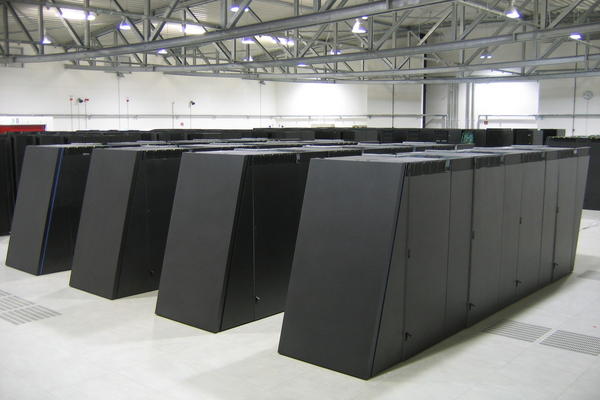
There, Jülich's BlueGene/P -- a 294,912-core, 850 MHz PowerPC 450-based cluster -- claimed the #3 position, with an Rmax score of 825,500. The design that inspired it, former champion BlueGene/L at Los Alamos National Labs, lagged 72.6% behind with its historical score of 478,200.
Twice each year, the rankings of 500 of the world's supercomputers are assessed by the University of Mannheim in association with Berkeley National Laboratory and the University of Tennessee, Knoxville. Those assessments use the industry standard Linpack benchmark. Supercomputers' scores are sorted by tested clusters' maximal observed peak performance, in gigaflops (GFlops, or billions of floating-point operations per second). This performance is called the "Rmax rating," although Mannheim does publish theoretical peak performance ("Rpeak") as a comparison, representing how fast the system architects believe each system could or should perform. Dividing Rmax by Rpeak rating produces a yield ranking, which represents how well each system is performing to engineers' expectations.
The German supercomputer dubbed "JUGENE" posted a yield of 82.3%. But that's was the biggest action to be reported in a relatively tranquil list that saw not too much elsewhere. The #1 and #2 slots remained unchanged, with Los Alamos' successor Roadrunner sitting pretty in the catbird's seat, and the machine built by resurgent Cray from AMD Opteron processors for Oak Ridge National Labs remaining at #2. Their Rmax scores are unchanged as well, perhaps reflecting reduced activity in the supercomputer field due to the subdued economy.
While a Windows-based cluster claimed the #10 slot last November, that machine fell to #13...and is now listed as being driven by SUSE Linux. So Windows' highest performing platform is now at #15, an AMD Opteron-based, 30,720-core cluster built by Dawning for China's Shanghai supercomputer center, with an Rmax score of 180,600. Only five of the Top 500 supercomputers currently use Windows HPC, compared to 472 which run some variant of Linux.
Though AMD could lay claim to only 43 of the world's Top 500 this time, they include 10 of the top 25, including #2, #6, #8, #11, #12, #13, #15, #19, #21, and #23. IBM Power clusters claimed 55 slots including the coveted #1, while Intel cleaned house with 393 EM64T (x64) clusters and 6 Itaniums.
HP can claim to be the top manufacturer on this list too, with 212 supercomputers to its credit versus 188 for IBM, and just 16 for Dell.