Gun control laws get applied to pre-paid phones

By Tim Conneally | Published July 17, 2009, 12:44 PM

"We want a Mexico without fear; we want a free Mexico," President Felipe Calderon said yesterday, regarding the dispatch of more than 5,000 armed servicemen to Michoacan.

The Mexican government is attempting to establish order over a population fraught with organized crime; and while police respond to violence, the government and its law-abiding populace has already begun its response to criminal communications by establishing a nationwide database of prepaid cell phone users.

Similar to the way every gun sold in the US must be registered, so too must every prepaid cell in Mexico. Because of the anonymity and freedom the devices afford, they are frequently used as the central tool in intimidation, extortion, and kidnapping plots and are smuggled into jails to keep imprisoned gang members connected. Kidnapping is pandemic in Mexico, and though many go unregistered with the police, some estimate that more than 70 people are kidnapped in that country every month.

By assigning an identity to prepaid devices, legislators are hoping to see a drop in this sort of criminal activity.

The Federal Telecommunications Act was amended on February 9 this year, adding the clause that all prepaid cell users will be logged in a national register known as RENAUT. There, operators must store all call logs, texts, and voice messages associated with each user for one year. The information in this database will only be made available with a court order in legal proceedings.
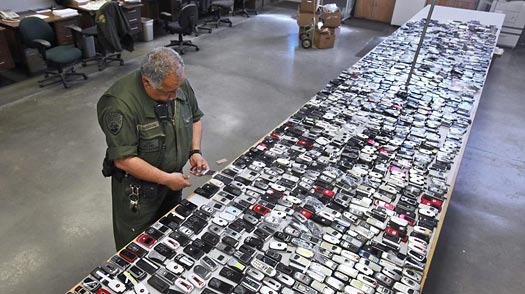
Confiscated prison cell phones

[Photo credit: Rich Pedroncelli / Associated Press, as posted to the Prison Photography blog on Wordpress.com.]

Since April 10 of this year, all new prepaid phones have had to be registered before they could even be activated. Existing phones must be registered with the RENAUT before April 10, 2010, within one year of the law's enactment. If not registered before April 10, the line will be suspended without liability for the service provider.

The Mexican Federal Telecommunications Commission (Cofetel) said this week that in the three months RENAUT has been in place, it has already collected data on 8.73 million mobile users out of the estimated 76.6 million total.

Users can register via a free text message, directly through their service provider, or through the RENAUT Web site, which demands that the user enter his name, address, and CURP (Clave Unica Registro Poblacion), the national ID number which is used in the same way a Social Security number is used in the United States. This also means if someone loses their prepaid phone, it must be immediately reported to the carrier.

Similar laws are coming into effect elsewhere in the world, such as in Greece, where Minister for Transport and Communications, Evripidis Stylianidis, said anonymous cell use by "drug dealers, immigrant smugglers and blackmailers" is hindering the police. In Greece, anonymous prepaid phones were used in an illegal wiretapping scheme during the 2004 Athens Olympics that targeted the Prime Minister.

Comments

View comments by with a score of at least

The big difference between guns and cell phones is that cell phones are useless without a service that must be provided externally and those service providers can be audited. There are always ways around any system, but if made difficult enough most people wont be able to manage it (or bother).

Score: 0

|

CAN YOU GET A CCW TO CARY A CELL PHONE IN MEXICO

R.G.S.

Score: 1

|

And i am sure that cell phone registration will work just as well as it does for guns too.

The law abiding will be tracked, the bad guys will use stolen phones, cloned phones, and legit phones obtained using stolen identities.

Or at the absolute most difficulty for the bad intentioned, they may have to switch to using VOIP applications through onion routers.

Score: 2

|

I couldn't agree more. This seems to me like a few bad apples ruined a system for everyone, and subsequently, this new system won't even really stop them.

Score: 1

|

Ditto, here too.

Maybe cell phones should just be banned altogether

Score: 0

|

PDC 2009: What have we learned this week?

There was the freebie that no one will forget, the heebie-jeebies courtesy of Scott Guthrie, and a teensy bit clearer picture of how this cloud thingie should work.

Live report: Will Google Chrome OS change Linux?

The mysteries of just what Chrome OS is, and how much of an operating system it truly is, may be resolved today.

PDC 2009: Microsoft cares about Web browser performance

The effort to give users of the world's dominant Web browser the impression of quality, is a personal one for the man who leads that battle.

Nokia re-affirms its commitment to Symbian, sort of

Maemo won't necessarily be replacing Symbian in the Nokia N-Series, but that's definitely a place where it will be found.

E-book readers will be in short supply this holiday season

E-readers are hot this year, and a lot of compelling new products have been released, but are there enough electrophoretic displays to go around?

Sony looks to finally open a single storefront for downloads

Sony has had many different download portals for movies, music, e-books, and games, and now it's looking to make a single shop for all of it.

Tuning out the tablet: Time to give the endless speculation a rest

Wide Angle Zoom: Wishing and hoping and thinking and praying....won't put an iTablet on the market.

Five improvements for IT managers in 2010

If businesses are to improve their efficiency for next year, they need to stop and reassess the basic tenets of their job.

AOL's spinoff from Time Warner to shed 2,500 jobs

As AOL moves toward become an independent company again, it will cut nearly a third of its workforce.

Gartner: SMS-based money transfer will be bigger than mobile browsing, search

Gartner issues its predictions for the 10 things our phones will be doing in 2012.

Don't forget to upgrade to Firefox 3.6 beta 3 today

Mozilla has released the latest beta its Firefox 3.6 browser software, just over one week after beta 2.