Is Google optimizing Chrome 3 for Windows XP netbooks?

By Scott M. Fulton, III | Published July 17, 2009, 12:12 PM


Download Google Chrome 3.0.193.1 for Windows from Fileforum now.

Banner: Test Results

Over the last few weeks, Google has been releasing development builds of its Chrome 3 Web browser in a fast and furious pace. And with each release, the browser has been leaping forward in performance, particularly in Windows XP. With yesterday's release of beta build 3.0.193.1, Chrome 3 has given Betanews reason to suspect that these performance gains are no accident.

But why would Google want to optimize its browser for Windows XP? The reason could lie with netbooks, the arena that Google seeks to invade with its own operating system, perhaps as soon as next year. Google may want to demonstrate its presence on netbooks early, and it might be able to do that by producing the best performing Web browser for netbooks in the interim.

In Betanews tests conducted yesterday, Chrome 3.0.193.1 had gained more than half a point in our performance index over the 3.0.192.1 build we tested just last week, on our physical Windows XP SP3 platform, with a record index score of 18.58. That gain alone is the equivalent of swallowing an extra 57% of the performance of Internet Explorer 7 in Windows Vista SP2, in just one week's time. This while the latest Chrome 3 build actually lost performance in the Windows 7 Release Candidate.
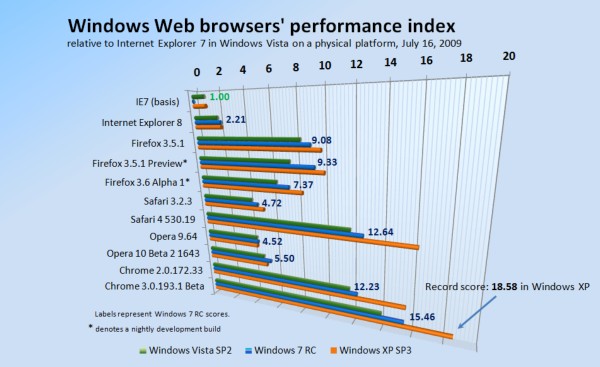
Relative performance of Windows-based Web browsers, July 16, 2009.

If Google is optimizing Chrome 3, it's clearly not for Windows 7. In fact, the gains it's making appear to be custom-made for XP. Specifically, Chrome 3's XP performance surged by as much as one-third over its previous build in the areas of Document Object Model management and AJAX handling, AJAX already being one of Google's strengths. There were some tradeoffs, particularly in complex math and page load speed, though they were not enough to offset these other impressive gains.

An updated word about our Windows Web browser test suite

Meanwhile in Windows 7 RC, Chrome 3 slipped from 15.85 in our index to 15.46. In Win7, the losses in math and page load speed did more than offset smaller performance gains in DOM and AJAX. And in Vista SP2, Chrome 3 overcame some earlier performance losses to regain almost a full point of performance, from 12.97 to 13.95.

A performance lead for Chrome on XP netbooks could give Google some early inroads into the netbook market, greasing its path, if you will, for a future Chrome OS onslaught. Windows XP remains the leading operating system on commercial netbooks in recent months, mainly because Vista won't fit; Microsoft promises Windows 7 will make a better fit, but OEMs may wait to see how much of a performance hit they'd have to incur. Although faster than Vista, Win7 remains slower than XP.

While Chrome 3 surges ahead, the Opera 10 Beta is trying to find its way. Yesterday Opera released the second round of its public beta 2, but without the Unite feature that makes browsers into servers. The company is saying it may not be ready for a full public beta round yet, although immediately after the public Beta 2 release, it produced a daily build of Opera 10 (build 1643) with Unite included. That's the version we tested yesterday, but we didn't notice much of a shift in Opera's performance profile: a 5.50 score in Windows 7 RC versus 5.43 for the previous daily build we'd tested.

Finally, after yesterday's early release of Mozilla Firefox 3.5.1, rushed out to address a major vulnerability that was discovered just a few days ago (let's face it people, Bugzilla tracks a zillion bugs, and just because this one was on there since July 9 doesn't mean it was exactly public knowledge), we wondered whether Mozilla had the opportunity to include some tweaks to JavaScript that it had originally planned for the 3.5.1 release.

Its logs say yes, yes, yes, but the performance profile says no, no, no. The new 3.5.1's performance profile is very much on par with the original 3.5, while our tests of earlier daily builds of 3.5.1 show measurable performance gains are still to be realized, particularly in TraceMonkey's handling of arrays in memory. Currently, the final 3.5.1 continues to post a very respectable index score of 9.08 in Windows 7 RC, a little lower than for the previous 3.5 but still sustainable in the wake of a major bug fix.



Download Mozilla Firefox 3.5.1 for Windows from Fileforum now.

Comments

View comments by with a score of at least

I sure hope so. We have staked the future of our company and product on AJAX. Our customers are application developers who want/need to deliver high-performance web apps to their clients. We've re-engineered our visual database, Alpha Five, to generate AJAX GUIs on the fly. It's more than a visual thing. Once you front-end a web database with an AJAX GUI, the app provides persistent access to the back-end data, meaning users never have to submit pages or wait for pages to reload. BUT (and it's a big but!) the resulting apps are only as fast as the weakest link in the chain. While AJAX-powered apps (such as Google Docs) runs admirably on IE and Firefox, they run FANTASTIC on Chrome. The optimized JavaScript engine is the key. I myself have switched to Chrome, and recommend everyone seriously try it and consider it. The performance difference, especially when dealing with contemporary AJAX apps, is perceptible. And if you're building AJAX apps for the enterprise or consumers, it pays to recommend they switch to Chrome.

Richard Rabins
Alpha Software
http://blog.alphasoftware.com

Score: -1

|

just drag the tab to another part of the screen from the main window and chrome will detach it to be a separate window

http://ezinearticles.com...ning-Gel&id=2539008

Score: -1

|

I am not at all surprised. It was a coincidence that two days ago I felt my Win7 RC was thrashing due to Chrome. When I checked the Process Explorer, I found that the degradation was due to enormous amount of Context Switches and PageFaults Chrome was giving. The complete stats are given here. I am using Chrome 3.0.193.0. Maybe you guys could compare the two versions and see the process performance.

On another note I dont think this is a policy decision on the part of google. Maybe a programmer over indulged in optimisation on his Windows XP laptop that it affected the other builds

http://techdigger.wordpr...h-are-killing-my-system/

Score: 1

|

You should actually file a report to WebKit bugzilla at https://bugs.webkit.org so it would also be addressed in Safari. By doing so techie blokes like you make this platform the fastest as confirmed above.

More about the success story behind WebKit, see a selection of articles at http://tekkie.flashbit.net/tag/webkit

Score: 0

|

Hope to see Windows 7 RTM benchmarks soon.

Score: -2

|

Google Chrome 4: Yes, it's fast, but is it usable?

As Betanews readers have responded to our stories about Chrome's JavaScript superiority...Does that mean we'd actually use this browser? Well...

Video: Netflix on PlayStation 3

Netflix has come to the PlayStation 3 via Blu-ray and BD-Live.

Verizon Wireless launches new Android, Chocolate, and ruggedized phones

The lower-priced Eris joins the Droid, while the Chocolate gets a touchscreen and more music playback.

Early sales figures for Windows 7 nicely high, but do we know why?

Fans of triple-digit surges in figures quoted by Betanews will love this one, as it appears Microsoft rediscovered how to pull off a software launch.

Myka announces its latest Linux-based 'net top box'

Myka's ION brings Boxee, XMBC, and much more to HDTVs.

What hath Mac wrought? A remembrance after a quarter-century

The reason there's a Macintosh today is not because of some brilliant flash of engineering genius, but because Apple had the audacity to learn from its mistakes.

Early build of Moblin 2.1 improves connectivity, but not device support

The Linux Foundation's Atom-centric OS yesterday received a major overhaul with the project release of Moblin 2.1 for netbooks and nettops.

The iPhone's China syndrome: Sales of 5,000 and climbing

There's actually a country where Apple's device is not a godsend, where sales can be measured in the dozens.

New European counterpart to FCC will ensure 'a more neutral net'

Late Thursday night, the ruling telecom administrators of the EU's member nations signed away their final authority to a new entity overseen by the EC.

Sophos study suggests Windows 7 UAC's default setting is self-defeating

Without any anti-virus installed, a Sophos test showed, User Account Control was only capable of thwarting just one malware package out of ten samples chosen.

Indiscreet tweet trips awareness of Web SSL vulnerability

A group of high-level security engineers had been making progress on thwarting a low-level threat to the Web, until somebody blurted it all out on Twitter.