Microsoft 'Popfly' Shows Off Silverlight

By Nate Mook | Published May 18, 2007, 6:07 PM

When Microsoft introduced Silverlight -- its new platform for building rich Internet applications -- at MIX last month, consumers had one key question: Why should this interest me? Microsoft made its first attempt at an answer Friday with the alpha launch of "Popfly."

In simple terms, Popfly enables users to create mashups (a single service that utilizes multiple services), gadgets, Web pages, and even applications. But the real power of the new online service -- and what sets Popfly apart from Yahoo Pipes -- is the ease in which it can be done, without any technical know-how or development experience.

For this, Microsoft has leveraged Silverlight 1.0, currently in beta. Popfly's first component, Popfly Creator, forms the building blocks of the service. Mashups and gadgets are created by simply dragging and connecting visual "blocks" that represent APIs from a number of Web services.

Even in this early alpha stage, Microsoft has included 40 blocks that include content from Flickr, Windows Live Spaces, Virtual Earth and various news services. The company says more third party blocks are on the way, and developers can build them using Silverlight.

But Popfly doesn't just offer the creation of mashups or gadgets or Web pages; a social aspect plays a central role as well. Popfly Space is essentially a subset of Windows Live Spaces that lets users connect with creators of other applications, which are all stored on Microsoft servers.
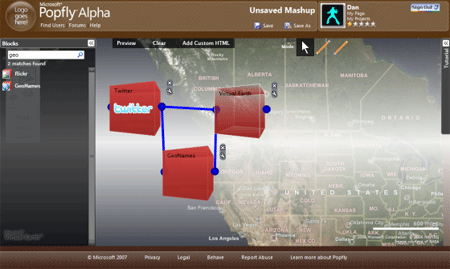
Microsoft Popfly

WIthin this social network Popfly users can share, rate, comment and even remix creations from other users, Microsoft says.

Due to load constraints, however, not everyone can take part in building applications online using Popfly at this point. The alpha test is private and only those invited can sign up. Microsoft plans to distribute invitations in phases, and is accepting requests on the Popfly homepage. Existing users will also receive invitations to distribute virally.

Comments

View comments by with a score of at least

slt

Score: 0

|

Yet another MS Basher... *cough*

Score: 0

|

I was unimpressed before I even got started. What the heck is with the "invitation" thing. If I can click a button to get an invitation, then I don't really need an "invitation," do I? That's a pretty lame attempt at using "invitations" to generate buzz, in fact, it's a time-wasting and useless attempt. I hope the actual program shows greater innovation.

Oh wait, maybe they just wanted me to check my spam-catcher hotmail account?

Score: 0

|

you do realize this is ALPHA and of course is going to have problems, its by invite due to the load contraints and is private (did you even read the article)

Not sure about your hotmail acct but mine has zero spam, go figure.

Score: 0

|

Yeah, I read the article. The "invite" is a stupid PR trick and not very well executed, except for those easily impressed.

As for the Hotmail account...again you missed the point. I use it for spam! Of course, it doesn't block it very well even then. Go figure.

Score: 0

|

The spam you get is usually proportional to how careful (or rather careless) you are to keep it away from spammers and address harvesters.

Score: 0

|

What the internets need is more sh*t infested websites (flash). Thank good Microsoft, as usual, has noticed this "void" and Popfly (WTF?) is there along with Silverlight to make it all better.

Score: 0

|

It is a pretty cool-looking product. Maybe they really were excited about it...?

Score: 0

|

"But Popfly doesn't stop with the creation of mashups or gadgets or Web pages; Microsoft has included a social aspect as well."

But we don't stop there... it slices, it dices, it juliennes...

I really wish BN wouldn't copy/paste marketing copy.

Score: 0

|

Right.

We don't really need to hear "Inside information on unreleased product", do we?

Yo do know what the purpose of this site is, don't you?

Score: 0

|

That subtitle has always bugged me. I really don't see why it's that rather than "Inside information; unreleased software".

/Goes off to read Politics and the English Language again

Score: 0

|

Google Chrome 4: Yes, it's fast, but is it usable?

As Betanews readers have responded to our stories about Chrome's JavaScript superiority...Does that mean we'd actually use this browser? Well...

Video: Netflix on PlayStation 3

Netflix has come to the PlayStation 3 via Blu-ray and BD-Live.

Verizon Wireless launches new Android, Chocolate, and ruggedized phones

The lower-priced Eris joins the Droid, while the Chocolate gets a touchscreen and more music playback.

Early sales figures for Windows 7 nicely high, but do we know why?

Fans of triple-digit surges in figures quoted by Betanews will love this one, as it appears Microsoft rediscovered how to pull off a software launch.

Myka announces its latest Linux-based 'net top box'

Myka's ION brings Boxee, XMBC, and much more to HDTVs.

What hath Mac wrought? A remembrance after a quarter-century

The reason there's a Macintosh today is not because of some brilliant flash of engineering genius, but because Apple had the audacity to learn from its mistakes.

Early build of Moblin 2.1 improves connectivity, but not device support

The Linux Foundation's Atom-centric OS yesterday received a major overhaul with the project release of Moblin 2.1 for netbooks and nettops.

The iPhone's China syndrome: Sales of 5,000 and climbing

There's actually a country where Apple's device is not a godsend, where sales can be measured in the dozens.

New European counterpart to FCC will ensure 'a more neutral net'

Late Thursday night, the ruling telecom administrators of the EU's member nations signed away their final authority to a new entity overseen by the EC.

Sophos study suggests Windows 7 UAC's default setting is self-defeating

Without any anti-virus installed, a Sophos test showed, User Account Control was only capable of thwarting just one malware package out of ten samples chosen.

Indiscreet tweet trips awareness of Web SSL vulnerability

A group of high-level security engineers had been making progress on thwarting a low-level threat to the Web, until somebody blurted it all out on Twitter.