Mono 2.2 may overtake .NET in some critical categories

By Scott M. Fulton, III | Published January 21, 2009, 10:21 AM

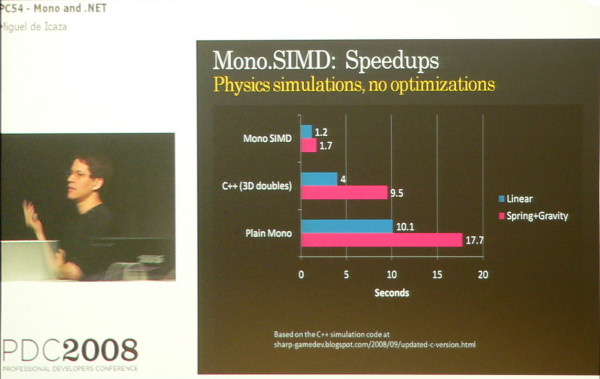
The Mono Project's Miguel de Icaza demonstrates Mono 2.0 at PDC 2008 in Los Angeles, October 29.

Meeting another milestone for the open source effort to extend Microsoft's .NET platform outside of Windows, the Mono Project -- backed by Novell, but with a little help from Microsoft too now and then -- is celebrating the release of version 2.2 this week.

Perhaps the most important addition to this latest release is full support for SIMD (Single Instruction / Multiple Data) extensions, which should provide orders of magnitude in performance improvements for developers who are building .NET games -- and there are more of these developers in high places than you might think -- to run cross-platform. "When the Mono runtime's SIMD optimization are active the operations on the structures defined in this namespace are mapped to hardware operations which can improve the performance of your graphics, multimedia or 3D operations significantly," reads a recent edition to Mono's online documentation.

An October 2008 demonstration at PDC by Mono's lead developer, Miguel de Icaza, demonstrates the speed explosion up-close. The graph depicts the standard Mono common language runtime's ability to do sophisticated 3D graphics, and when you're talking about time, you don't want to be the bar on the bottom of the chart. But there it is, and obviously, compiled C++ will be much faster. But look at the tiny little pair of bars at the top: That's Mono with SIMD extensions.

What's very, very interesting about this development is that it places Mono in a class that's conceivably above even .NET itself. Game developers may even consider writing for Mono for Windows instead of .NET for this very reason. As InfoQ's Jonathan Allen put it, "Mono is outgrowing the standard. Mono is not just playing catch-up any more, it is trying to move past the CLR in many areas. And as an open source project, they can slip in new libraries at a much faster clip than Microsoft."

Comments

View comments by with a score of at least

But when it's compared with C++ using a SIMD library, which one is the winner?

Score: 0

|

The one really interesting missing bar is native, C++, code using SIMD. That one is probably way below mono again.

Score: 0

|

Google Chrome 4: Yes, it's fast, but is it usable?

As Betanews readers have responded to our stories about Chrome's JavaScript superiority...Does that mean we'd actually use this browser? Well...

Video: Netflix on PlayStation 3

Netflix has come to the PlayStation 3 via Blu-ray and BD-Live.

Verizon Wireless launches new Android, Chocolate, and ruggedized phones

The lower-priced Eris joins the Droid, while the Chocolate gets a touchscreen and more music playback.

Early sales figures for Windows 7 nicely high, but do we know why?

Fans of triple-digit surges in figures quoted by Betanews will love this one, as it appears Microsoft rediscovered how to pull off a software launch.

Myka announces its latest Linux-based 'net top box'

Myka's ION brings Boxee, XMBC, and much more to HDTVs.

What hath Mac wrought? A remembrance after a quarter-century

The reason there's a Macintosh today is not because of some brilliant flash of engineering genius, but because Apple had the audacity to learn from its mistakes.

Early build of Moblin 2.1 improves connectivity, but not device support

The Linux Foundation's Atom-centric OS yesterday received a major overhaul with the project release of Moblin 2.1 for netbooks and nettops.

The iPhone's China syndrome: Sales of 5,000 and climbing

There's actually a country where Apple's device is not a godsend, where sales can be measured in the dozens.

New European counterpart to FCC will ensure 'a more neutral net'

Late Thursday night, the ruling telecom administrators of the EU's member nations signed away their final authority to a new entity overseen by the EC.

Sophos study suggests Windows 7 UAC's default setting is self-defeating

Without any anti-virus installed, a Sophos test showed, User Account Control was only capable of thwarting just one malware package out of ten samples chosen.

Indiscreet tweet trips awareness of Web SSL vulnerability

A group of high-level security engineers had been making progress on thwarting a low-level threat to the Web, until somebody blurted it all out on Twitter.