Mozilla updates its Fennec mobile browser alpha


By Scott M. Fulton, III | Published December 29, 2008, 11:27 AM


Download Mozilla Fennec Alpha 2 for Windows from FileForum now.

Hands-on Review banner

Apple's Safari for iPhone truly did raise the bar for the Web browsing experience for mobile devices, though it may not have redefined the way browsing should work there. Mozilla Fennec continues its work on that goal.

While Opera continues to make incremental inroads as an ever more reliable, serious Web browser for multiple platforms, Mozilla's approach to a mobile version of Firefox is to take a more deliberate, calculated, innovative big step forward. The organization wants to create a rational, sensible new model for using a Web browser on a small form factor, and its unorthodox tactic for achieving that goal is to perfect the concept on a simpler test platform first -- ordinary PCs -- before moving it to multiple mobile platforms and conquering the implementation problem.

Last week, Mozilla released its so-called Alpha 2 of Fennec, its mobile browser experiment; and yes, it does remain available for one mobile platform in particular: Nokia's N810. Besides that, you'll find its test edition available for Windows, Mac OS X, and Linux.

As was the case when we tested Alpha 1 last October on a Windows XP Professional-based virtual machine, you have to pretend that your mouse pointer is your finger on a touch-screen device, which for Fennec is turned sideways in landscape mode. While we expected to see some further experimentation in the usage model with Alpha 2, what we found instead was improved performance -- albeit not on the browser's future native platform -- using pretty much the same usage model that Alpha 1 introduced.

Fennec's gamble is that mobile users won't mind having to scoot the page over in order to find the functionality he needs -- a bit like spreading one's papers out over a bistro coffee table in an attempt to get work done. You have to get used to the idea that the address bar can be beneath whatever's on the top edge, a history of saved pages is outside whatever's on the left, and the Back and Forward buttons, and your typical menu bar categories, is outside whatever's on the right.

In earlier builds -- at least in our tests -- scrolling the Web page down covered up the address bar (by design), but pulling it back up meant scrolling all the way to the top. That can be a kind of rowing motion, like flipping down a Rolodex wheel. With Alpha 2, the address bar flips back on whenever you scoot the page to the left or the right to see the saved pages or menu commands, respectively -- and that's much more convenient. Here in Fennec, the address bar doubles as the title bar.

We're still having trouble with the notion that a thumbnail of a page represents that page along the left side bookmarks panel; on a small device, thumbnails are not reliably unique identifiers. Of course, the problem for now is finding a place for text that would otherwise identify the page -- beneath the address along the top? Along a new and thus far undefined status bar along the bottom? Alpha 2 hasn't resolved this question just yet.
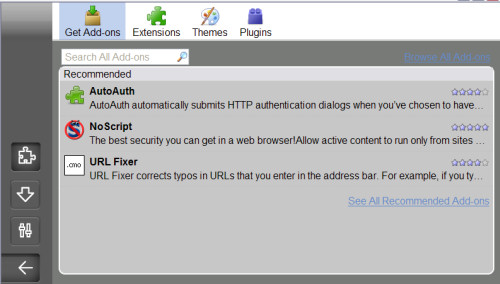
Mozilla Fennec Alpha 2's Options screen looks a little more like Firefox

The Options screen (obtained by tapping the cog icon in the right panel) gives a clearer indication of Fennec's heritage as an extension of Firefox. Here you can find extensions, plug-ins, and themes (though none for Fennec are ready just yet), in an arrangement that Firefox users will be familiar with.

Indeed, rendering with Alpha 2 has improved significantly, which at the very least makes this a more viable experiment. Double-tapping the screen zooms in every time -- this was a problem with Alpha 1. And right-click double-tapping the screen zooms back out...Now, you think that might be a problem. Exactly how will this mobile browser be expected to interpret a right-click? Different finger? A separate finger being held down over a control key? If Mozilla's interest is truly in making mobile browsers functional with one hand (the other one, after all, may be busy holding the phone), why would it assume in this particular case that this functionality problem could be resolved with a control key?

Along those same lines, Mozilla may need to start thinking -- for an Alpha 3, let's say -- about the whole problem of typing. Many mobile devices that don't have their own built-in keyboards instead have their own on-screen implementations, which may or may not interfere with how Fennec would work. Assuming the phone was capable of deferring to Fennec for its on-screen keyboard, where would it go and how should it work? Right now, entering a URL into the address bar also brings up a history panel where users can choose pages the browser has already seen -- a nice shortcut that works well and is very handy. But if the user is typing on an on-screen keyboard, there might not be room for such a panel. And if the handset brings up an on-screen keyboard that overlays the address bar, how will the user see what he's typing?

These remain serious questions, though we're happy that Fennec continues to demonstrate itself as a serious effort at resolving them, through community involvement.

Download Mozilla Fennec Alpha 2 for Mac OS X from FileForum now.

Comments

View comments by with a score of at least

How long will Google continue to provide the current level of support for Mozilla? They have their own browser and their market cap is getting killed. Mozilla needs to quit messing around with this crap and get their house in order before Google does it for them.

Score: 0

|

"We're still having trouble with the notion that a thumbnail of a page represents that page along the left side bookmarks panel; on a small device, thumbnails are not reliably unique identifiers. Of course, the problem for now is finding a place for text that would otherwise identify the page -- beneath the address along the top? Along a new and thus far undefined status bar along the bottom? Alpha 2 hasn't resolved this question just yet."

I think it has. The screen real estate you gain by NOT having a status bar or extra tab bar on a mobile device far outweighs the loss of information, IMO. If you want to see more about what a tab has in it, you can SWITCH TO IT. The Fennec team has been working on performance improvements so hopefully this will be a viable way... besides, you wouldn't want to do heavy-duty browsing on a mobile device anyway, so chances are you wouldn't have too much trouble remembering what your tabs are in the first place. I think the thumbnail is a good way of doing it.

Score: 0

|

"Apple's Safari for iPhone truly did raise the bar for the Web browsing experience for mobile devices"

Apple products, especially the Mac constantly raise the bar. Without Apple, Windows users would still be using DOS.

Score: 0

|

Umm... You mean without Xerox, they invented the GUI and the mouse. Yet another Apple fan boy giving Apple credit for everything that came after sliced bread.

Score: 0

|

I second that.

Virtually no innovation comes from Apple. All they do is buy tiny start-ups with great ideas and then mass-market them as their own. Shame all their fan-base doesn't know much about their beloved company.

Score: 0

|

"Yet another Apple fan boy giving Apple credit for everything that came after sliced bread."

Not any worse than Apple bashers trying to say that Apple hasn't had some pretty damned clever ideas over the years.

Windows 95 = Macintosh 87

Score: 0

|

Xerox PARC invented many great things, but profited from very few of them.

Score: 0

|

"And right-click double-tapping the screen zooms back out...Now, you think that might be a problem. Exactly how will this mobile browser be expected to interpret a right-click? Different finger?"

It will be implemented in the most convenient way for each platform. In the case of the version you ran on windows, that was a double right click. In the case of the N810, it's the buttons on the top of the device labeled "+" and "-".

Score: 0

|

Right-click can be simply "clicking" and holding down your finger or stylus on a link or object - similar to that of Windows mobile 6.x (maybe 5 and earlier, but I only have 6.1)...
And remember, it is still alpha .... alphas are just enough to be running and get an "idea" of how the software could work. Betas are distributed en mass (or announced specifically) for "product testing" purposes. Once feedback is obtained from said betas, then final code is announced after bugs are hammered out, etc.
So you really can't judge an alpha just yet. I think they are making tremendous headway so far, especially w/ touch screen support.

Score: 0

|

I do like what I read about Mozilla Fennec. Let's give the Mozilla org a chance and see what develops down the line. IMHO, can't come soon enough. I am not knocking other good mobile browsers which are out there but it is only by high profile competition they will also get better.

Score: 0

|

PDC 2009: What have we learned this week?

There was the freebie that no one will forget, the heebie-jeebies courtesy of Scott Guthrie, and a teensy bit clearer picture of how this cloud thingie should work.

Live report: Will Google Chrome OS change Linux?

The mysteries of just what Chrome OS is, and how much of an operating system it truly is, may be resolved today.

PDC 2009: Microsoft cares about Web browser performance

The effort to give users of the world's dominant Web browser the impression of quality, is a personal one for the man who leads that battle.

Nokia re-affirms its commitment to Symbian, sort of

Maemo won't necessarily be replacing Symbian in the Nokia N-Series, but that's definitely a place where it will be found.

E-book readers will be in short supply this holiday season

E-readers are hot this year, and a lot of compelling new products have been released, but are there enough electrophoretic displays to go around?

Sony looks to finally open a single storefront for downloads

Sony has had many different download portals for movies, music, e-books, and games, and now it's looking to make a single shop for all of it.

Tuning out the tablet: Time to give the endless speculation a rest

Wide Angle Zoom: Wishing and hoping and thinking and praying....won't put an iTablet on the market.

Five improvements for IT managers in 2010

If businesses are to improve their efficiency for next year, they need to stop and reassess the basic tenets of their job.

AOL's spinoff from Time Warner to shed 2,500 jobs

As AOL moves toward become an independent company again, it will cut nearly a third of its workforce.

Gartner: SMS-based money transfer will be bigger than mobile browsing, search

Gartner issues its predictions for the 10 things our phones will be doing in 2012.

Don't forget to upgrade to Firefox 3.6 beta 3 today

Mozilla has released the latest beta its Firefox 3.6 browser software, just over one week after beta 2.