New FCC chief draws a line in the sand on net neutrality

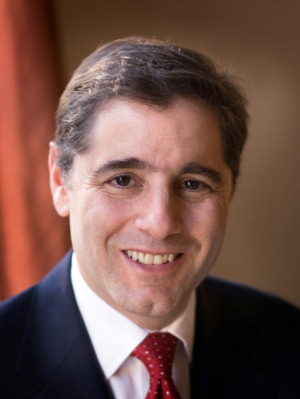 On the eve of easily the most important Federal Communications Commission open hearing since being sworn in as its chairman, Julius Genachowski is taking the strong personal stand he was expected to take, in favor of equal and open access to Internet services. Returning to the heart of the original debate from which the term "net neutrality" was coined, Genachowski told the Capitol Hill daily The Hill yesterday that he remains committed to enforcing net neutrality principles, assuming they actually become law.
"One thing I would say so that there is no confusion out there is that this FCC will support net neutrality and will enforce any violation of net neutrality principles," the FCC Chairman told The Hill.
The Chairman is choosing his words very carefully. The "principles" to which he refers are basically a set of guidelines crafted in 2005 (PDF available here), the extent of which has been to prevent the FCC from adopting rules that would encroach upon Americans' right to an unencumbered and neutral Internet, and to encourage the further development of the Net in that direction. Net neutrality, both as it was originally conceived and as it has been sculpted by public debaters to become, is not exactly yet the law of the land.
That fact probably weighs heavily on Genachowski's mind as he prepares for Thursday morning's open hearing, the stated goal of which is to launch regulatory procedures for the creation of a National Broadband Plan. For such a plan to be embraced by Republican lawmakers and adopted into law, it will probably need to give credence and legitimacy to Republican concerns and goals, including those that spawned the net neutrality debate three years ago.
One of those goals has been the creation of a national franchise body for broadband service providers -- a way for telcos and ISPs such as Verizon and Comcast to bypass the municipal authorities that currently grant them licenses to do limited business over limited territories, and provide service to the whole country. In 2006, Republicans led by Rep. Joe Barton (R - Texas) crafted legislation that would create such a franchise authority, presumably to be overseen by the FCC. The Commission's leadership at that time was believed to be in favor of that proposal.
The benefits of such a franchise system, Rep. Barton and others argued, included the creation of competition, especially in rural areas where zero or one provider offered service. Often those rural areas were being served by smaller telcos, serving customers in areas that larger providers had thus far overlooked.
Opponents of the Barton Bill noted that it lacked the typical provisions prohibiting a franchisee from granting favorite status to selected content providers; in fact, it actually contained a provision encouraging national franchisees to charge extra for premium carriage, perhaps as a way to offset fees franchisees would eventually owe the government. This opposition was responsible for coining the phrase net neutrality. But supporters of the bill commandeered the new phrase for themselves, claiming that the "poison" amendment Democrats inserted into the Barton Bill would effectively cement into place the rural monopolies that smaller providers were enjoying at the time, along with municipal monopolies granted to the bigger CATV and telco providers, blocking out competition and ensuring high prices for the consumer.
Suffice it to say that the Barton Bill ran head-first into a maelstrom of red tape, and never became law. In the intervening time, the Democratic party increased its majority in Congress and reclaimed the White House. President Obama appointed to the FCC chairmanship the man believed responsible for overseeing, if not completely writing word-for-word, then-candidate Obama's campaign policy regarding net neutrality -- the first-ever such policy for a presidential candidate.
"Because most Americans only have a choice of only one or two broadband carriers, carriers are tempted to impose a toll charge on content and services, discriminating against Web sites that are unwilling to pay for equal treatment," then-Sen. Obama's campaign policy stated (PDF available here). "This could create a two-tier Internet in which Web sites with the best relationships with network providers can get the fastest access to consumers, while all competing Web sites remain in a slower lane. Such a result would threaten innovation, the open tradition and architecture of the Internet, and competition among content and backbone providers. It would also threaten the equality of speech through which the Internet has begun to transform American political and cultural discourse."
The "fast lane/slow lane" metaphor comes directly from Democratic opposition to the Barton Bill, led at the time by Sen. Ron Wyden (D - Ore.). The problem is, that metaphor recalls to mind sour memories among Republican lawmakers who recall their opposition's unwillingness to come to any compromise, instead raising the question of the national franchise authority to the level of a civil rights issue.
"Obama will protect the Internet's traditional openness to innovation and creativity and ensure that it remains a platform for free speech and innovation that will benefit consumers and our democracy," the candidate's policy read.
Today, Chairman Genachowski is looking for legislative help from Rep. Ed Markey (D - Mass.), the author of the latest net neutrality legislation currently under debate. Arguably, Democrats may have the super-majority they need to pass such legislation in Congress now without Republican support. But if that's the card they choose to play, they may ensure that opposition to that legislation, if not completely effective, is at least as loud as it was in 2006.
The FCC open hearing is scheduled for 10:00 a.m. EDT tomorrow morning. Later that afternoon, the Commission is scheduled to conduct another session in its week-long workshop on the National Broadband Plan, this time with participation by representatives from Microsoft and Google.