Owner of Office.com trades its URL to Microsoft, perhaps for Outlook features

By Scott M. Fulton, III | Published August 7, 2009, 10:53 AM

Since at least 1999, the lucrative Web URL Office.com has been registered to someone other than Microsoft, the company most closely associated with that term with regards to software. Most recently, Office.com wasn't owned by any cybersquatter, but by ContactOffice Group -- a very legitimate Belgian company which used the URL to establish a virtual e-mail client accessible through desktop and mobile Web browsers.

Late last June, Office.com's clients received e-mails from ContactOffice notifying them that their accounts will be moved to the contactoffice.com domain at the end of July. There's only one really good reason why a company would move from a ubiquitous trademark to an arguably more obscure one; and today, the logic behind that reason was confirmed by the Internet's string of WHOIS databases: Microsoft is now the official owner of the Office.com domain.

The most likely purpose Microsoft has in mind for Office.com is as a hosting platform for Office Web Apps ("Office.com Web Apps?"), the Web-accessible versions of Office applications that Microsoft plans to make available to registered Office 2010 users next year. Testing for that platform is expected to begin soon.

The common presumption is that Microsoft paid ContactOffice a tidy sum for the URL, which neither company is likely to confirm. But as Betanews noticed this morning, a demo of the beta for the next edition of ContactOffice.com suggests the Belgian firm may have gotten something else out of the deal besides money: The new AJAX-based interface for the messaging service looks a lot more like Microsoft Outlook than its current stable edition.
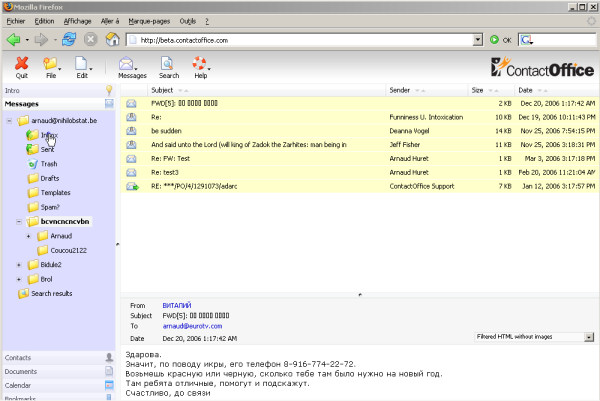
Screenshot of the beta of the next version of ContactOffice, which looks a lot more like Microsoft Outlook than it ever did before.

Product information for the current edition suggests a simpler layout for on-screen menus, more similar to Zoho Apps. But the new ContactOffice features departments that have their own sliding menu panels, like the left pane of Outlook, and new folder arrangements (for ContactOffice) that also resemble Outlook's layout. With AJAX enabled, users can now right-click on both tools and list entries, such as messages, to get a context menu; previously, since Office.com ran in a browser without AJAX, those entries had to be made visible on the main screen, so an Outlook-like layout was not feasible.

It's curious that ContactOffice should begin implementing an Outlook look- and work-alike at the same time it cedes control of its Office.com domain to Microsoft.

Comments

View comments by with a score of at least

I think ContactOffice's new UI is more natural evolution and the timing is somewhat coincidental. Sure, there are elements which look Outlook-inspired but the same is true of many similar apps, and there are clearly some key differences as well. For instance, Zimbra's web client (which has been AJAX-enabled for a years) has the same basic layout as ContactOffice's beta. But don't forget that this layout hasn't been Microsoft's default look since 2002. In 2003, Outlook's default view replaced the bottom Preview Pane with the Reading Pane on the right. And ContactOffice's toolbar isn't nearly as Outlook-similar as Zimbra's which matches Outlook's default icons, labels, and positioning much more closely.

Undoubtedly, ContactOffice received compensation, but I just don't see any real evidence to suggest that they were granted special rights or access to Outlook features.

Score: 0

|

Even if they did, who cares? There's nothing wrong with it if they did get help, code and tools from MS for their service. I like the url "contactoffice" anyway, since it better describes their service than simply "office" did.

Score: 0

|

Report: Microsoft to randomize Europe's browser screen choices

The fact that "A" is for "Apple" was apparently at the heart of browser vendor objections to Microsoft's alternative to listing IE first.

Acer eclipses Dell for #2 spot in global PC shipments, says iSuppli data

It literally does look like a 360-degree turnaround in Dell's fortunes, as the bells of bad tidings now toll solely for Dell.

Microsoft, don't hang up on Windows Mobile, but do call for help

Only a Manhattan Project can save Microsoft's phone strategy now.

See ya later, WinMo: Microsoft's mobile strategy needs a reboot

Carmi Levy | Wide Angle Zoom: Hands up if you're considering upgrading to a Windows phone for the holidays...Anybody?

Playing catch-up in 2010: Windows Mobile, BlackBerry, and Symbian

Microsoft, RIM, and Nokia are each working on improved mobile operating systems. But could these efforts add up to too little, too late?

Will Nokia's plans further alienate American consumers?

A look at Nokia's plans for the coming years does little to shine up the company's increasingly dull image.

Bing bonked by service outage Thursday, Microsoft configured the wrong server

It's always nice to have a backup, but it's even nicer to remember which one is the backup. That's the lesson Bing's admins learned yesterday evening.

Survey reveals there are more women then men, including on social networks

If you think you can market your products and services online as though you're selling car batteries in the middle of halftime, think again. And again.

Android team updates 'Donut' and 'Eclair' SDKs

The Android SDK includes components which optimize app development for each version of the mobile operating system. Today, the 1.6 and 2.0 components got updates.

The Black Screen Syndrome, or, Tech news in search of the apocalypse

Scott Fulton On Point: This is a story about something that should not have been a story, about something that at one time was a story.

Online advertising evolves away from display, toward interactive software

Marketing departments and agencies are increasingly establishing positions for "creative technologists" who can steer designers and developers toward platforms that enable direct connections with consumers.