Plastic Logic displays newest e-book reader

By Tim Conneally | Published September 8, 2008, 12:43 PM

More than two years after debuting the concept, Plastic Logic will premiere its first demo model e-book reader at DEMOfall in San Diego. Plastic Logic's Reader
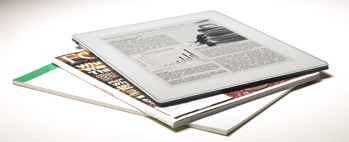
Like most other E-books, Plastic Logic's Reader is built around E-Ink's VizPlex imaging film. This Electronic Paper Display (EPD) technology can be found in the Amazon Kindle, Phillips spinoff iRex's Iliad, the Sony Reader, and the soon-to-be-available Readius from Polymer Vision.

Until recently, Plastic Logic had only shown early prototypes, such as the one pictured in the video below, but the company is now showing off more complete working models. Plastic Logic's un-named reading device is about the same size as a sheet of 8.5" x 11" paper, with a display over twice the size of the Amazon Kindle, the device analysts have referred to as the "iPod of the book world." As the company's name suggests, the major difference it hopes to provide is in the screen's plastic substrate. making it lighter, more durable, and 100% more flexible than glass displays.

A demo of Plastic Logic's first e-newspaper reader device.

Founded by Cambridge University researchers, Plastic Logic has been working on its EPD reader for nearly ten years. After receiving $100 million in funding last year, the company will open its flagship manufacturing facility in Dresden, Germany in just over a week. Plastic Logic expects to be able to begin shipping its first EPD product in the second quarter of 2009, when it will also receive an official price. The company has thus far only said it will be "competitively priced," which would place it between $399 and $599.

Comments

View comments by with a score of at least

8-O

WOW

Score: 0

|

Very Cool - can you imagine how it will help the construction industry? My building company will be able to use these for plan reading, change order reading, and eventually could replace paper plans. Is it possible to make this technology able to receive input?

Score: 0

|

Plastic Logic has a great future, and this shows the kind of restrained design that Phillipe Starck was looking for when he trashed the Kindle last year. A good start.

When they begin to show products exhibiting the real potential of the flexible substrate (which this one clearly doesn't) PL will be a company to be reckoned with.

Score: 0

|

Google Chrome 4: Yes, it's fast, but is it usable?

As Betanews readers have responded to our stories about Chrome's JavaScript superiority...Does that mean we'd actually use this browser? Well...

Video: Netflix on PlayStation 3

Netflix has come to the PlayStation 3 via Blu-ray and BD-Live.

Verizon Wireless launches new Android, Chocolate, and ruggedized phones

The lower-priced Eris joins the Droid, while the Chocolate gets a touchscreen and more music playback.

Early sales figures for Windows 7 nicely high, but do we know why?

Fans of triple-digit surges in figures quoted by Betanews will love this one, as it appears Microsoft rediscovered how to pull off a software launch.

Myka announces its latest Linux-based 'net top box'

Myka's ION brings Boxee, XMBC, and much more to HDTVs.

What hath Mac wrought? A remembrance after a quarter-century

The reason there's a Macintosh today is not because of some brilliant flash of engineering genius, but because Apple had the audacity to learn from its mistakes.

Early build of Moblin 2.1 improves connectivity, but not device support

The Linux Foundation's Atom-centric OS yesterday received a major overhaul with the project release of Moblin 2.1 for netbooks and nettops.

The iPhone's China syndrome: Sales of 5,000 and climbing

There's actually a country where Apple's device is not a godsend, where sales can be measured in the dozens.

New European counterpart to FCC will ensure 'a more neutral net'

Late Thursday night, the ruling telecom administrators of the EU's member nations signed away their final authority to a new entity overseen by the EC.

Sophos study suggests Windows 7 UAC's default setting is self-defeating

Without any anti-virus installed, a Sophos test showed, User Account Control was only capable of thwarting just one malware package out of ten samples chosen.

Indiscreet tweet trips awareness of Web SSL vulnerability

A group of high-level security engineers had been making progress on thwarting a low-level threat to the Web, until somebody blurted it all out on Twitter.