Rumors gel around a possible BlackBerry Storm sequel
By Tim Conneally | Published April 9, 2009, 7:30 AM
As Research In Motion's first all-touchscreen BlackBerry, and one of the "Big Four" in the touchphone market that has dominated smartphone sales, the BlackBerry Storm is a formidable device.
Director of Research at ChangeWave, Paul Carton, said in a Web conference yesterday, "This market is overwhelmingly dominated by two companies: Apple and RIM." Nearly all of ChangeWave's consumer smartphone survey statistics were dominated by the iPhone and the Storm, and by proxy their US carriers, AT&T and Verizon.
One figure from the company definitely stood out, though: Most people said their next phone purchase is likely to be a BlackBerry. Some 37% of those surveyed said they were either "very likely" or "likely" to buy a BlackBerry, while only 30% said the same of iPhone.
While these figures do not address the Storm directly by name, it is interesting that BlackBerry remains such a strong draw after the Storm was so emphatically panned by the media, and the Bold repeatedly pulled from stores for overheating. Maybe the public is holding out for the Storm to improve in its second generation.
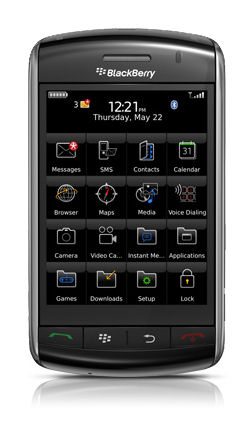
On Monday, SlashGear cited "a source very close to the issue" in saying that the second generation BlackBerry Storm will be released in September 2009, complete with Wi-Fi and an improved touchscreen.
Today, Dutch site Tweakers said the as-of-yet-unnamed "Storm 2" will include, among other things, "a new way of entering text," attributing the information to RIM sales Manager Alain Segond von Banchet.
Both of these refer to the device's clickable touchscreen, which works well for big onscreen buttons, but poorly for a small virtual keyboard. The latter of the two rumors includes the additional claim that the "Storm 2" will be sold through Dutch mobile carrier KPN in addition to Vodafone, the current Storm's exclusive carrier.
The Dutch report did not, however, speculate upon whether this will simply be an incremental upgrade or a fully new handset.

Storm 2 with Wifi? It definitely won't be on Verizon, or the Wifi will be crippled if it is.
Score: 0
|Some perspective:
ABI research Worldwide Market Share #'s for 2008:
Nokia: 38.6%
Samsung: 16.2%
Motorola & LG tied @: 8.3%
Sony Ericsson: 8%
RIM: 1.9%
Apple: just over 1%
Source: http://www.mobileburn.com/news.jsp?Id=6191
To be fair, Apple *just* got into the business and has only *one* offering, in the high-end market. The other manufacturers have flooded both the high and low-end market for years.
Funny comparing RIM and Apple, though....the two lowest rungs on the ladder here.
Heh... I had totally forgotten about Sony Ericsson. Can't remember the last time I saw one of those...(Weren't they the one's used by the characters in The Matrix?)
Score: 0
|Here's the problem with your market perspective. While the worldwide market is interesting, it understates the sale-through value. I'm sure in total phones, Nokia is way out ahead.. because every service virtually gives away those phones, at like $40 a pop or free if you just signup.
The reason why RIM/Apple have serious impact on the marketplace is because they are more valuable to their carriers. Monthly fees are greater, and their adoption within the workplace in the US market is considerably higher. So, for a cellphone carrier, those phones have a lot more value and set the tone of the marketplace.
No one really gives a c(&( what a teenager on a free phone is using, probably a Nokia or a Motorola Razr type thing.. but none of those phones let a cell provider sell additional or workplace services.
Score: 0
|Thanks PC_Tool, and you are correct. ChangeWave, like many other market research companies, is focused on the s*** toward smartphones being the market drivers, despite the fact that there are 10 general-purpose/feature phones to every smartphone in circulation. The data from which I was drawing those stats was actually a survey testing the waters for the Palm Pre.
ChangeWave's data set was 4,292 "senior technology and business executives in leading companies of select industries, where 56% have advanced degrees (Master's or Ph.D) and 93% have bachelor's degrees."
so yeah, that tells you who's deciding the smartphone market.
Score: 0
|Nokia has fallen a lot over the past two years and is rarely the brand chosen for smartphones. Certainly it's even more rare in the U.S.A. as the N95/N96 is something like US$800. The charts on smartphone sales seem to look a lot different than those of the whole spectrum of phones.
RIM have been working to make their back end quite a bit better but seem to be faltering on handsets. Quick engineering never really worked anywhere and they're learning their lesson. It's certainly interesting to watch the developments, as every phone will eventually be a smartphone.
Score: 0
|@tmservo:
"Here's the problem with your market perspective....because every service virtually gives away those phones, at like $40 a pop or free if you just signup."
How did I not cover that with:
"The other manufacturers have flooded both the high and low-end market for years."
Matter of fact, I believe I pretty much covered the whole high-low end thing. Did you actually read my comment?
@TIM:
Yeah. RIM is definitely ahead with the executive crowd, no doubt. Apple & RIM are both "high-end" only manufacturers, though they target different segments of the market. And yes, it explains the lack of market share (nothing for the herds).
I wasn't saying any of them were bad or good, just supplying some stats. (...and I thought I tried to explain the high vs. low end bit, but it seems no-one paid any attention to that part....meh, I guess context is boring.)
;-)
Score: 0
|

