Safari 4.0.3 speed gains hobbled by unexplained poor AJAX performance
By Scott M. Fulton, III | Published August 12, 2009, 4:29 PM
![]()
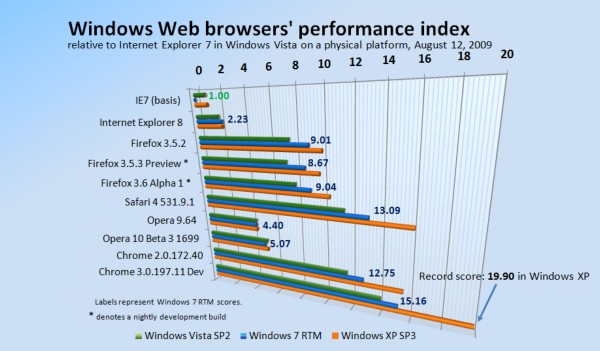
The latest security update to Apple's Safari 4 browser for Windows includes impressive speed gains in many departments, including page rendering -- gains the one-time speed champion desperately needs to remain competitive against Google Chrome 3. But a surprisingly poor performance score in one department -- declarations of AJAX objects on one of the tests in Betanews' benchmark suite -- is preventing the latest production version of Apple's browser from decidedly overpowering the latest production edition of Google's.
The third round of bug and security fixes and performance enhancements to the Mac work-alike browser slowed its performance index score on Windows XP Service Pack 3 to 16.01 from 16.16. But on Windows 7 RTM, Safari posted solid gains from 12.58 for build 530.19 to 13.09 for build 531.9.1, reflecting a nearly 5% gain on speed alone.
But the new Safari posted a particularly poor score -- much slower even than our index browser, Internet Explorer 7 on Vista SP2 -- in the AJAX declarations heat. That's a test from the Celtic Kane battery that does nothing more than time how long it takes the browser to create an XMLHttpRequest object in JavaScript, the principal object used in establishing a virtual communications link between server and client. (Since the benchmark test does literally nothing else with the object, its validity as a test in itself has been called into question in the past.)
Specifically, a heat where Safari 4 build 530.19 was timed at 23 ms, for a score of 8.96 (almost nine times faster than IE7 on Vista), yielded a time of 371 ms (0.56) for build 531.9.1.
Though yesterday's security advisory from Apple does not list XMLHttpRequest as one of the topics of its security fixes for this round, a known issue regarding malicious crafting of the object's header was reported by Apple two months ago. The exploit involved injecting a carriage return/line feed sequence into the header in such a way that WebKit, the rendering engine for Safari, could pass a request object as valid without a proper header to authenticate it. The header should affiliate the request with the Web site from which the script originated; WebKit normally runs with a same-origin policy.
The very sudden slowdown of this one feature in Safari suggests that Apple may have employed a stopgap measure to prevent new culminations of the same exploit. Since we've seen Apple release two different versions of the same "build" in succession before, it's possible that a follow-up release within the next few days could resolve the issue.
Apple's release yesterday was followed up by the beginning of the Beta 3 cycle for the Opera 10 browser for Windows. Once again, performance results for Opera have been a mixed bag, with a lower score on the Windows 7 RTM platform for build 1699 (5.07) than for build 1691 (5.31). On Windows XP SP3, the index score remained flat at 5.28. Opera now has the dubious distinction of having the only browser whose stable and beta versions register lower performance on Windows 7 RTM (4.40 and 5.07, respectively) than for Vista SP1 (4.43 and 5.27).
This while the latest daily build of the private Mozilla Firefox 3.6 Alpha 1 preview, code-named "Minefield" ("Namoroka" is the public preview), posted an XP score solidly above the 10 mark for the first time, at 10.41. Mozilla can now say its latest development build is twice as fast as that of Opera, which at one time not long ago boasted the fastest browser in the field.

KingMotley
Aug 7, 2009 - 11:24 PM
The sunspider javascript benchmark isn't a valid test. It attempts to do commands that aren't valid (according to the javascript specification), that the mozilla based browsers have incorrectly implemented. This causes the tests to do different things in other browsers (like IE), and invalidates the results. Not surprising that those portions of the test are written by Mozilla themselves, lol.
A better answer is that IE should pass, and others should "FAIL" for the benchmark, while IE passes.
Score: -2
|Lest we forget that using the HowToCreate.co.uk CSS rendering test gives false answers for Safari and Chrome as it says itself in BIG RED LETTERS when actually using it. Alas, it would seem they can't read or don't care.
Score: 1
|I wonder if Scott will ever address what the Acid test has to do with overall speed? You would think he would find it tough to defend the inclusion of it when defending his dissertation...
Score: 1
|Scott posted a response to one of my comments asking to include the acid 2 and acid 3 test scores of all the browsers but evidently the Microsoft marketting money proved too much to pass up. It would add another measure to show how horrible IE 8 is. Worst speed and worst standards compliance. Of course no one really expects Microsoft to actually support industry standards which they can not embrace, extend, and extinguish. Well, they are starting the dance again, while they push Silverturd as the future of the internet.
Score: -2
|Ummm... he only includes the acid 3 test and in hiw own words "The reason we included Acid3 -- a non-speed-oriented test -- in our composite score is because we believe it's important that a browser not only be fast, but do the job it's expected to do." So according to Scott, these tests have nothing to do with speed which is what the article is all about.
Score: 0
|Thanks for this comparison post. Google chrome is really the fastest browser & I use it now. I really need the fastest browser because I am in a country that the connection speed is slow. The result is real. Without those comparison, there should not have progress & Microsoft could be the monopol. Betanews should add other known IE : Lunascape 5.1.4, maxthon, FlashPeak SlimBrowser, Acoo Browser, Avant Browser, Flock, etc.. and other browser that could have good scores. thanks.
Score: 0
|Where's the option to:
Mod Article -1 (Redundant)
Score: 5
|lol that would be awesome if we could vote some articles off the front page :P
Score: 5
|perhaps the commentary ones?
Score: 2
|I could stand seeing a few less Joe Wilcox articles, that's for sure.
Score: 4
|That would be awesome, let the readers decide what they find useful and well written. :)
I'm all for the vote of news.
Score: 0
|Am I the only one tired of these speed comparisons? They hold no real value to anyone as they do not simulate real world conditions, take into account various areas which affect performance, or focus on anything people care about. Please betanews, I realize Scott is doing his dissertation on browser speed performance, but give it a rest already. I am sick of seeing one of these new speed comparisons every single day. I am not going to change browsers every day because one proves to be .0003 picoseconds faster than another.
Score: 1
|"Am I the only one tired of these speed comparisons? "
Nope, not by a long shot.
"Please betanews, I realize Scott is doing his dissertation on browser speed performance, but give it a rest already.
QFT!!!
Score: 2
|"Am I the only one tired of these speed comparisons?"
No, you're not the only one.
Perhaps the test might hold some interest at x.0 releases instead of every point to point.
Also: you mean .3 femtoseconds :)
Score: 0
|I'm waiting for testing of each nightly build. :-P
Score: 1
|Don't give him any ideas, man. Seriously... it's getting ridiculous enough already. ;)
Score: 0
|I like 'em, and so do you lot, we're a sad crowd who bore friends and family silly by incessantly prattling on about all things nerdy. Where else would we all meet up if it was not for a site like this ?Who else would read our stuff if it was not for the little gang who congregate here daily ? Accept it lads, only here can we bore without being told to push off by some big oaf who knows nothing about an Opera, or a Chrome.
Score: 0
|You're not alone (TM)
And the amount of such articles is really astonishing.
Score: 0
|Well, just Firefox and Safari and Chrome nightly builds. :-D
Score: 0
|


