Six-core Intel processors coming this year
By Scott M. Fulton, III | Published March 17, 2008, 5:51 PM
Advancing its architecture at what most independent observers would now agree is a breakneck pace, Intel offered further details today on how soon it would begin phasing out the Core Microarchitecture it introduced in the summer of 2006.
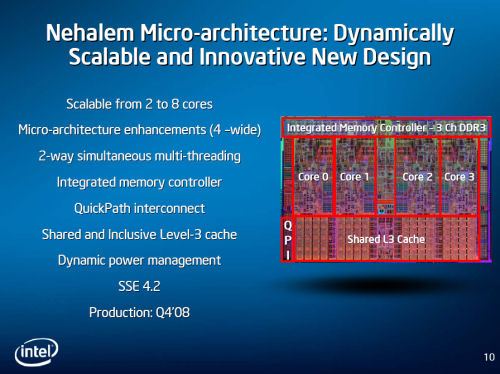
With the second phase of its 45 nm generation microprocessors -- what it calls "tock," using a metaphor that drives rival AMD mad -- Intel will move to a processor design that utilizes scalable cores, from two all the way to eight, it will introduce another new microarchitecture for processing instructions, and it will phase out the front-side bus as a component of its architecture. We've known these facts based on bits and pieces of information compiled from Intel hints over the past six months. Now we know this as absolute fact, confirmed by senior vice president Pat Gelsinger during a special presentation this morning.
Now we know when it will all happen for certain. The six-core Dunnington server CPU platform using Penryn architecture (the "tick" generation of 45 nm), with 16 MB of L3 cache, goes into production as soon as this summer. The 45 nm Nehalem architecture ("tock") enters production in the fourth quarter of this year. That will be the beginning of the end of the era of Intel x86 computers with a front-side bus (a separate circuit linking the CPU to memory, with a dedicated clock).
And Itanium lives on, as the company's new Tukwila architecture will carry the intrinsically multi-threaded instruction set into datacenters and mainframe replacements, with six cores sharing 30 MB of cache.
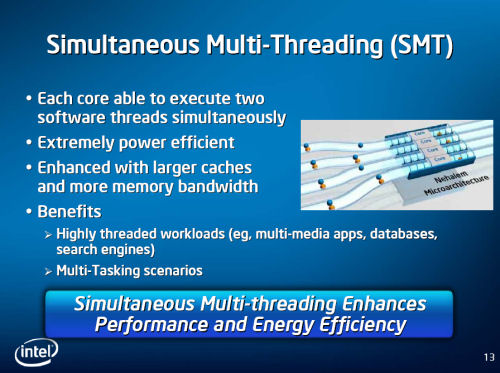
But it will be Nehalem that is expected to provide one very thunderous "tock." One key feature that literally creates an entirely new dimension to parallelism will be simultaneous multithreading (SMT): the ability for each core to process two threads at a time, not alternately like hyperthreading but truthfully at the same time.
An updated Nehalem white paper today (PDF available here) describes SMT as "a more energy efficient means of increasing performance for multi-threaded workloads. The next generation microarchitecture's SMT capability enables running two simultaneous threads per core -- an amazing eight simultaneous threads per quad-core processor and 16 simultaneous threads for dual-processor quad-core designs."
So a four-way quad-core Nehalem system may have to be quantified as "4 x 4 x 2," in a designation that is sure to give a new source of headaches for AMD. A few weeks ago, that company began gathering support for its first 45 nm generation, even though it won't yet feature AMD's version of the high-k-plus-metal-gate manufacturing technology it developed with IBM; that's being reserved for a future generation.
Meanwhile, one of AMD's remaining design "edges" against Intel -- its Direct Connect memory bus -- will no longer be an edge once Intel inaugurates its QuickConnect architecture. Replacing the front-side bus will be a more direct link that Intel now calls its "QuickPath Interconnect."
"A big advantage of the Intel QuickPath Interconnect is that it is point-to-point," reads a new white paper on the subject (PDF available here). "There is no single bus that all the processors must use and contend with each other to reach memory and I/O. It also improves scalability, eliminating the competition between processors for bus bandwidth. Coupled with Intel's great cache memory, this technological achievement will enable the performance of servers and workstations to take another leap forward."
The first TPC benchmarks for the "tick" generation of Penryn architecture actually delivered a bit more performance than even independent observers were expecting. No explicit performance data or projections for Nehalem were released today, though the early word on the street is to plan not to use the word "astounding" too many times in one paragraph.
Now this is ridiculous, these processors are NOT aimed at you regular joe blow computer FFS.
These are targeted to SERVER markets.
Score: 0
|All this Power in the CPU is pointless unless you start speeding up the harddrives. This chip would be ideal for people like me who want to host a website / DB server, while at the same rendering a HD video, and playing counter strike with your clan, all while using 4 monitors at the same time.
-WhiteSites
Score: 0
|Please help me... Thank you...
Score: 0
|Which is better Intel® Core™2 Extreme Processor QX9775, Intel® Core™2 Quad Processor Q9550, Intel® Core™2 Duo Processor E8500, Intel® Pentium® Processor Extreme Edition 965 and Intel® Pentium® Dual-Core Processor E2220..? And which is better a core 2 or a Pentium processor..? Can you explains why each item you pick is better..? Because I'm getting a new desktop for gaming and editing videos...
Score: 0
|Which is better Intel® Core™2 Extreme Processor QX9775, Intel® Core™2 Quad Processor Q9550, Intel® Core™2 Duo Processor E8500, Intel® Pentium® Processor Extreme Edition 965 and Intel® Pentium® Dual-Core Processor E2220..? And which is better a core 2 or a Pentium processor..? Can you explains why each item you pick is better..? Because I'm getting a new desktop for gaming and editing videos...
Score: 0
|Which is better Intel® Core™2 Extreme Processor QX9775, Intel® Core™2 Quad Processor Q9550, Intel® Core™2 Duo Processor E8500, Intel® Pentium® Processor Extreme Edition 965 and Intel® Pentium® Dual-Core Processor E2220..? And which is better a core 2 or a Pentium processor..? Can you explains why each item you pick is better..? Because I'm getting a new desktop for gaming and editing videos...
Score: 0
|All I know is that Core 2 beats up pentium and throws it out the door. hope that helps.
Score: 0
|Screw this, I'm waiting for the 24 core processors.
What happened to the old days when you knew how fast the processor you were buying was? By the way, my current notebook is AMD 4 core and it's rock solid.
Score: 0
|OHOHOH OH OH NO NO NONONO !! !! !! !! !!
OH OH OH OH NONO NO NO NO !! !! !! !! !!
OH OH OH OH NO NO NO NO NO !! !! !! !! !!
OH OH OHOHOHOH NO NO NO NO NO !! !! !! !! !!
OH OH OH OH NO NO NO NO NO !! !! !! !! !!
OH OH OH OH NO NONO NO NO
OHOHOH OH OH NO NO NONONO !! !! !! !! !!
That is, I thought AMD had a chance, until now, anyway.
*sigh*, now there's no chance of competiton.
Score: 0
|Well, according to cats, anyway.
AMD is still lower-power. They may not have the best performance right now, but price/power they've got stone cold.
Give 'em time. Intel is racing now because AMD woke the Beast. AMD simply needs to realize it now also needs to race for it's life.
Once that starts...then the real fun begins.
Score: 0
|"AMD is still lower-power. They may not have the best performance right now, but price/power they've got stone cold." And that's what I like, too.
Score: 0
|Cause 4 Cores for running your Fantasy Football League just wasn't enough!
I can see a use for this in the Corp. / Server World, but realistically, unless you are running a Crysis Server of some sort, it does not really have a Home Desktop Use. Media Editing and Graphics Applications.
Bravo on the 6 cores! I am sure like Vista, most will run out to get it just to say they have it.
Score: 0
|there's very little room to improve CPU performance without increasing the number of cores and threads. silicon is reaching the end of its lifespan. the easiest and most effective method now is to add cores.
Score: 0
|Most of you whining about 6-cores being too much miss the point.
And yes, there is OS and software that can utilize this. (You just won't run it on your Microsoft desktop!) :-P
I see it for database workloads, real-time video editing, animation and data-mining.
Sure little Johnny won't need that gear, but the actual server foot-prints do.
I am more interested in the SMT and QPI. This will make a massive boost to through-put and will be required with a dual CPU, 6-core machine.
To utilise this well, expect to be based on a 64-bit architecture, it just won't cut it under a 32-bit OS.
In all honesty, I think beyond the core game the next step is for the majority to by-pass 64-bit and move straight to 128-bit processors.
Realistically, you won't see the potential of these processors with the current crusty OS that is Windows (including Vista) or any of the so called 'corporate apps' that come from Corel, Adobe, etc.
Gaming on Windows unfortunately is ham-strung by the underlying OS. Whilst some improvements can be made, you're only as good as the foundation under you.
Score: 0
|Again, if we won't see it, what is the point. Is intel just building workstation class machines now?
Score: 0
|The fact is money is buying you allot of processor these days. Clearly the way to go is for parallel processing, as a means to making the chip process faster.
I think its great faster CPU's are available and are in excess for most software. It will encourage software developers to create multi threaded applications, and move the industry forward.
It has to start somewhere, why not here with this design.
Score: 0
|"(You just won't run it on your Microsoft desktop!) :-P" heh heh heh...
Score: 0
|Windows Vista can handle multi-core computing just fine. Go try it out. Put it on a 2x4 workstation and see what happens. Yup everything runs just fine and you can get as many threads running simultaneously as you have cores to process em. The MS hating is ridiculous. At least hate on a valid point. Like the added "user-friendliness" adds so many extra steps to get stuff done compared to XP, hate on that.
Score: 0
|I'd rather see some sweet respin (like a brand new architecture) in 4-core processors rather than a rather... redundant 6-core that no OS or software will know WHAT TO DO WITH.
Oh, that wouldn' make Intel advance in the cores # race so i sadly don't seriosuly expect my idea to happen...
FORTUNATELY the arrival of six cores will make high end 4-core processors more affordable!
Score: 0
|"redundant 6-core that no OS or software will know WHAT TO DO WITH."
I don't know...our ESX boxes can def take advantage of as many cores as I can throw at it.
Score: 0
|What is ESX?
Is it Windows? Is it Crysis of World in Conflict? Is it Photoshop? Is it DVD ripping software?
Score: 0
|VMWARE ESX Server.
Score: 0
|Nobody will ever need more than 6x4 c0res
yeah yeah, I couldn't come up with a better way to twist that old quote. :-D
Score: 0
|Someone on Ars made a comment earlier about how he'd never pay money for an OS that required 2GB of RAm.
Of course my response was:
Cuz, like..640K should be enough for anyone, right?
:p
I'm so mean...
Score: 0
|I'm still of the firm belief that 64K is plenty!
*returns to stroke his Commodore* :)
Score: 0
|I probably wouldn't, at least not in 2008. Maybe in 2015 or 2030, I like to have all my memory available for virtual machines (or cache like I said the other day), not gui effects. :-D
I guess what I'm saying is that I don't care if it "uses" 2GB I suppose as long as it's released when necessary, and it's not just eating it for OS fluff.
I was good with 64K for a long time, well 48K technically (C64). Shoot, I was even good with 2K back in the day (VIC-20) and 16K (TRaSh-80).
meh
Score: 0
|well i hope AMD don't react to quick to this,
usually they don't AMD has limited resources compared to INTEL, which is a good thing as i believe that makes a company more cautious, and careful in the design process,
but i have to say INTEL has always been famous for there advertisement, there PR campaigns are pumped to high heveans, and yet so many times they've killed there self by not delivering,
and i also have to agree with some poeple here with some added worries, that for the average workstation (home PC) how many cores do we really need,
more important for a company will it be worth the money invested into the technology given the turn around, i mean how many of us actually needs 4 cores, or 6 cores ect..
people that video encode perhaps, and....
well that's me done there's not many of us that need that extra power,
and no gamers do not need that extra power, because PhysX cards are the furture, and at most high intense strategy games will need 4 cores max, and even that i feel is overkill, if a game needs that many cores, then i would have to question the efficiency of the game itself,
the other thing i was wondering heat issues, seriously can cores continue to get thicker and thicker, and yet sufficient cooling can be achieved i wonder????
all i can say is, i hope for INTELS sake they are not pushing the envelope to soon to quick, because technology needs to come with the right balance, state of the art tech, does not mean the best, far from it in fact, as a consumer, i don't feel i need such power, about a year ago, i spend out £400 for a big upgrade duel core, good graphics card, new memory and of course extras that one needs,
well for me that's me done right, imagine if tech moved so quick we would have to pay out £400 every single year for new upgrades, how many of us can afford that,
ultimately my point is, i feel tech is moving to quick, by the time my motherboard breaks, technology has moved so quick, i probaby will not be able to get another board that's compatible with my system,
kind of scary a little,
Score: 0
|Intel never dumps it's new processors on people fast and drops the price of the old ones much. Especially at the position they're in now, rocking AMD, it doesn't need to. Don't worry, they'll most likely start them out as extreme processors since their current architecture is pretty damn good already. These will be a luxury for a while, high priced, most likely as the new gen of Xeons. They will be meant for servers and power graphics/video workstations. Then they will trickle down into the consumer PCs slowly.
AMD is the company that needs to dump new processors on it's customers FAST just to keep up with intel.
Score: 0
|More = better for sure. However I think they should really look more into other areas of computing. We can get as many "cores" as we want if we build a computer to hold all the processors. I want qbit consumer chips.
Score: 0
|MORE CORES! MORE CORES! ;)
Score: 0
|What would you think if they said 262,144 cores?
Score: 0
|I don't understand why they sound so surprised. Moore's Law works like a clock, and it has been since it was originated. Tick-tock...
Score: 0
|thats funny i have the intel Q6600 with 2GB of ram and get no stuttering or lockups at all on vista no matter how many apps i have open. But i think 6 cores is getting to the point of overkill for a consumer PC maybe ever for a gamer PC. yes the megahertz or gigahertz race has just turned into the multi core race. i wonder how long it will be till they release a 10 core CPU
Score: 0
|Even quad-core is pointless for 99% of applications at the moment. There are basically NO games that properly use 4 cores - hell, most can't even balance load between two cores. The same goes for your everyday apps.
Until a method is implemented to make all programs multi-threaded, or until programmers write software to utilise multi-core PCs they're mostly a wank factor. TBH, kholdstare, you would have been better off buying a dual-core CPU clocked faster than the quad-core you have - if you were after performance and not bragging rights, that is. The dual-cores (for now) are still the better choice because they're cooler, cheaper, require less energy and overclock much, much, MUCH higher than the quads.
Score: 0
|Quad-Core is truly pointless for many "Windows" applications, however Linux Desktops and Servers of all flavors benefit greatly from the added power in many areas including Rendering, Calculations, and crunching the human gnome. Just because your high-end oh so expensive box doesn't have any applications that can utilize more than one processor at a time doesn't mean that many people in specialized computing areas wont benefit from 2 to 8 cores.
Score: 0
|I dont know about anybody else...but i sure as hell would love to play that "crunching the human gnome" game :)
Latz, SB
Score: 0
|Additional cores are damn near pointless for any *single* application.
The point to Multi-core ATM is multi-tasking. More cores = more apps get full access to one of the cores.
In the past, unzipping multiple large archives was an enormous chore, regardless of the CPU. Now you can do 2 or more without a single hiccup at full speed depending on the number of cores.
Score: 0
|Oooh..
That does sound like fun.
Score: 0
|Why think so linear? With this processor technology AI will start making inroads.
Score: 0
|Positronic!
Score: 0
|Not if it's multithreaded.
Score: 0
|The funny thing aobut intel processors is that they don't multitask worth a damn. They go VERY fast for single, straight ahead apps like gaming but run multiple apps on the box simultaneously and they stutter and bork. The crowning glory was when a co-worker of mine who bought a quad core Extreme for gaming came in the next day and said:
"My old Sempron 2600+ multitasks better than this. if I game, it's great but if I un-PAR a DVD while encoding mp3s, un-RARing another DVD and downloading with NewsLeecher, it stutters and execution gets all jerky where the Sempron, while slow, would just keep on cruising smoothly."
He felt cheated - as well he might.
Funny thing: my 6000+ AM2 never stutters. My wife's Core Duo laptop does.
That's what happens when you have a real memory architecture on die instead of a pumped up P3 architecture on steroids - which is basically all intel has had for the last five or six years in various incarnations.
Everything old is new again. We're back to premium priced intel products with a lesser architecture, lesser memory management and performance that in real world situations doesn't really justify their price. The benchmarks look real cool though and empty posturing and bragging rights yet abound. now explain to me why I'd be interested in more of the same again? I got over this at the beginning of this decade...
Funny how things never change in this business:
AMD is still the technical innovator and Intel is still the technologically bankrupt golden boy, with the perception of being "hot" kept alive by virtue of great PR and brute force "engineering". And in the end, the quad core is completely pointless (and useless) in a desktop environment.
Score: 0
|the overclocking community isn't dumb. If "AMD is still the technical innovator" and if AM2 is really that much better compared to intel's current offering, it'll be all over the forums and stuff.
Learn to admit AMD is having issues innovating enough to push out a real competitive product.
And before you say i'm an Intel fanboy (it's obvious that you're an AMD fanboy), let me tell you that I have had only 1 intel based computer in the last 7 years and in the recent years, before C2D came out I would always recommend friends to go the AMD route
Score: 0
|The Intel Core 2 E6420 CPU (2.13GHz with 4MB L2 Cache) I have now is blistering fast compared to my previous AMD Athlon64 X2 processor. I can be watching a streaming movie from Netflix's Instant Play service while ripping an audio CD to the Windows Media lossless format in the background and have absolutely no stuttering. My current motherboard uses the Intel P35 northbridge and Intel ICH 9R southbridge chipset. The Socket AM2 motherboard I was using had an Nvidia Nforce 430 chipset and no I was not using the integrated graphics. I had a PCIe Nvidia GeForce 7600GS graphics card w/256MB DDR2 video memory.
Score: 0
|"the overclocking community isn't dumb"
Um, THAT is too funny.
By definition, if they overclock they're dumb. The whole juvenile concept of "let my push my processor and components beyond reasonable design limits just to get a few FPS extra without which I won't be able to sustain an erection and have bragging rights" is ridiculous beyond compare, especially in an era where hardware is cheaper than it has ever been.
To the l33t widdle boi gamerz who overclock, all I have to say is "get out of your basements and into the real world where, if you want faster, it's really easy to do something completely unheard of and novel, namely BUY faster".
And yes, you'll still be able to get a woody from Zoey 101..
OverCrockers.
Oh please.
Now to a less ridiculously testosterone poisoned topic:
Regarding me being an AMD fanboi, I've bought AMD for about a decade now. If Intel actually gave me price performance for what I want to do, I'd go there. They don't and haven't for... a decade. There is actually an Intel processor in the house - my wife's Core Duo laptop. For the money and what it was meant for, it was good deal. I tend to buy middle of the road with the emphasis on bang for the buck and stability. Again, Intel has failed in at least one of those categories for...
...ten years.
All that aside, it still doesn't change the fact that when you look at the engineering behind both families of processors, the on-die memory manager and other decisions do put AMD ahead in terms of technology. Intel has long since taken the brute force approach to design and it has won them some gains but has never been an elegant design. it's kind of like the old "there's no replacement for displacement" nonsense that American automakers clung to desperately for years - while Japan and Europe tabled much more efficient and smaller displacement engines.
I'm certainly not trying to change your mind; you're as much an Intel fanboi as I am an admitted AMD fan. However, if you have a shred of objectivity behind the brand loyalty, you'll have to admit my comments are on base, especially in light of the last ten years of history in the biz.
Also, do note that I'm not the only one who has noted the poor multitasking performance behind Intel's latest offerings. I've even had that noted by MS OS kernel engineers, off the record of course. In fact, it was one of THEM who brought it to my attention and suggested ways in which I could verify his claims (I was skeptical initially - it's a rather odd design oversight). Oddly enough, there's a precedent for this. IBM mainframes were notorious for being able to turn in blazing performance - until you loaded them down with jobs. Then they lost headway rapidly. Honeywell machines on the other hand, were slower than IBM mainframes until you loaded them down - then they soared. Their architecture, coupled with an OS solution called Multics, easily gave them the edge over IBM solutions of their day. Better engineering and design will out.
As I said, everything old is new again in this biz - scary, no?
Score: 0
|it's apparent you dont work in an industry where they test semiconductor devices then.
"if they overclock they're dumb" is simply not true. Pushing past the envelope is dumb yes i'll agree with that, but overclocking a moderate amount is fine (even though it voids your warranty). The reason is that to be able to sell a product, they will need to 1. Test for all specs, and 2. Guardband. These two points alone allow overclocking semiconductor devices due to the fact that for most people, the conditions they run their computers at will not vary that much.
As for your long post saying AMD beats the crap out of intel for a long long time, i'll let the general public prove you wrong..that's enough.
Score: 0
|I didn't say it beat the crap out of Intel. I said it beat the crap out of Intel with qualifications.
FACT: Intel has not been a price performance champion for a decade.
FACT: Intel has had significant design and stability issues that AMD has never had (the Spider mess notwithstanding)
FACT: Intel has relied more on overclocking its processors (yes, I did say overclocking) rather than designing a core that was scalable. Essentially, the current architecture is multiple P3s on massive steroids.
If you want to test the veracity of my claims refer back to my original post and do the tasks iterated there simultaneously. It won't take long to see the difference. Better yet, add burning a DVD to the mix. Pretty simple and pretty public. I will guarantee you that the process will run smoother on a modern AMD box.
And when last did you see a rabid gamer "moderately overclock"? The closest I've come to seeing that is my son's BFG 8800 OC2 which is overclcoked by the vendor - and warrantied as such. Even then, the vendor admits that the chips will have a shortened lifespan. Physics doesn't let you get something for nothing.
All that being said, we'll just have to agree to disagree. Anyone can run the tests I've iterated and if they have an open and impartial mind they'll see what I'm talking about.
It's no loss to me if they choose not to see it - I already have the system that works best for the way I work, namely running multiple heavy tasks simultaneously.
Cheers...
Score: 0
|good points.
Score: 0
|"Essentially, the current architecture is multiple P3s on massive steroids."
Good point.
Score: 0
|Whisper: not many apps even take advantage of 4 cores yet....
Score: 0
|nor 2 cores
Score: 0
|Very true. There are not nearly enough multi-threaded applications available... for dual-core, let alone quad-core and above.
In spite of that, I was amazed at the difference in performance running multiple applications (ones not designed for SMP) simultaneously on a dual-core versus a single-core CPU.
At first glance it seems like overkill, but the payoffs in performance really do stack up, even when not running multi-threaded applications.
Bring it on Intel. It's good to finally see you pushing the envelope after so long. I do not realistically see AMD catching up to Intel this time around (forget surpassing)... but I still hope for the best. I attribute Intel's renewed enthusiasm to AMD's success over the past few years.
Score: 0
|The most interesting things here are the binning of FSB, SMT, larger cache and more bandwidth.
The first two are the important and interesting two. Having an extra 2 cores is just a bonus as far as I'm concerned.
Score: 0
|Intel has had such a huge revival over the last 3 or so years. There is just no keeping up with their fantastic new developments.
Score: 0
|When you think it can't get any worse for AMD it just does. The company has already lost its credibility. Also calling the competitor (Intel) a monopoly. The company needs to realize the technology industry is something that advances 24/7 365 days a year. You can't just make a good product and sit back and relax, you have to keep on developing.
Like this? find more at www.talkprice.net
Score: 0
|I guess I might skip building a Penryn box this year and wait for affordable Nehalem next year. Seems like a huge technology step, though I'm suffering on an old P4 right now. :)
Score: 0
|get a new box now, and then sit on it till the Nehalem is being replaced.
you wont regret the upgrade from a P4 (even if it is a dual core P4) to a core2duo or Core2quad
Score: 0
|Go for a cheap upgrade now, even an Allendale Core E6320 or an E4400 would be better than your old P4 system. Get a cheap but quality motherboard like the Gigabyte G33M-DS2R mini-ATX and 2GB XMS2 Corsair DDR2-800. Then either you could get a cheap PCI-E graphic card from ATI or Nvidia like an ATI HD3450 or a Nvidia 8500GT and then change everything when Nehalem gets released..or use the cheap Core2Duo system as a 2nd PC. Otherwise you could buy a faster and more expensive graphic card like an ATI 3870 or a Nvidia 8800GT that you could keep even after upgrading to Nehalem later on...
The best Nehalem system to upgrade to is expected by Q1 '09 anyway..the so called "Nehalem EX" which should be an 8-core physical/16-core virtual CPU to be used on highend Dual Socket motherboards and it should feature a 4-channels DDR3 controller instead of the standard 3-channels one.
Score: 0
|Intel really is red hot these days, and it is going to be quite a while before AMD can hope to catch up to a determined Intel.
Score: 0
|This is a really interesting article;
I see there have been several posts about "hanging up" of processors. I personally haven't seen any cpus hang up, but I do want to clarify that the effect or "feel" that AMD has to it is the direct connect memory bus. AMD processors have a much larger FSB than Intel processors, which allows more data to get to them, more quickly. Even if the processor itself is a lower clockspeed, it can still outperform an intel cpu by far in intensive calculations. Intel cpus with multiple cores, and very high clock speeds don't really make full use of all that power with their lack of front side bus. Sure, if you go to open the calculator program or something, it will open it lightning fast, but if you try to reincode a video, install a program, or do something else thats data intensive, that small front side bus will limit what goes to the processor, and all of that additional processing power becomes useless. That being said, there is a very wide variety of Intel and AMD processors, and i'm talking about the average processors, sure a very expensive intel will definitely outperform a cheap AMD, and vice versa. Personally i've only used Intel cpus, and I wish I had an AMD right now. However, with this new technology intel says it developed that phases out the front side bus, and increases the rate memory can get to the processor, AMD might not have any advantage over Intel cpus anymore. It will be interesting to see if Intel's new technology really hold up to its pumped up advertising, and if it does, it will be interesting to see if AMD can somehow get another advantage over intel. Wonder how they will shape out in a year or two.
Score: 0
|Intel's marketing department are having a field day. Gone are the days of AMD poking a stick in the lions cage daring for a benchmarking duel they know they would win.
I have 2 AMD rigs, and they work very well, as you say, when it comes to games and using that bus. But it needs something big to sway the masses like the Athlon64 did, not even a 'real' quad core cuts it anymore ... not marketing wise anyway.
If AMD could summon up a AMD128 ... That would do it .........
Score: 0
|