Sweeping content security enhancements tested on Firefox 3.7

By Scott M. Fulton, III | Published October 2, 2009, 11:59 AM

Initial development is nearly complete on an entirely new kind of Web browser code execution policy management system, which may yet become part of Firefox 3.7 (the point release following the next one in line), a Mozilla spokesperson informed Betanews. When implemented, browsers such as Firefox will be capable of restricting certain classes of embedded code from execution, and Web sites can advertise to browsers in advance which classes of code its pages contain.

The end result, the developers of Mozilla's Content Security Policy (CSP) hope, is that policy-enhanced browsers will be completely immune from cross-site scripting (XSS) attacks from malicious sources, by virtue of restricting themselves to either only executing inline code from trusted, certified sites, or not executing any such code at all.

"The main goal of Content Security Policy is to prevent malicious code from being injected into a Web site and executed within the context of that site," reads the most recent text of Mozilla's CSP specification. "Hence, a recurring theme in CSP is to prevent the creation of script code from potentially tainted strings. It should be made clear that it is not the intent of CSP to prevent navigation to arbitrary sites, but rather to restrict the types of script, media, and other resources that may be used on a Web page."

In any kind of modern software administration, policy is a term for settings, restrictions, and permissions in a system that can be grouped together and represented explicitly, in common language (like English), for the admin to comprehend. For instance, one of CSP's policies is a setting disabling any kind of executable code from being created from a JavaScript string variable, through the use of the keyword eval(). There are several settings involved in establishing that policy, but from the admin's standpoint, the policy is quite clearly stated: "Code will not be created from strings."

The wide implementation of CSP, though, will not be easy. First of all, Mozilla's intention is for CSP to be non-proprietary, but that doesn't mean other manufacturers are chomping at the bit to adopt it. Mozilla may need support from its own competitors, including Google, Apple, and Opera, for Web site developers to feel the impetus to include policy directives -- methods of telling browsers what classes of content it may include. Microsoft is certainly aware of CSP's development, but opted to steer clear of it for Internet Explorer 8; and IE9 is still probably years away.

In a public discussion last January that included Mozilla contributors working on the CSP spec, Microsoft IE program manager Eric Law stated that his team would not be interested in considering adoption of CSP until it was done. "The problem in targeting a moving spec is that if we ship something that isn't compatible with the future evolution of that spec, we're inevitably pilloried for hurting adoption of that spec." Defending Microsoft's use of a private technology called the XDomainRequest object, he added, "Until we're ready to support a stable CSP spec, we're surgically addressing this vector."

But getting other manufacturers on board isn't the biggest hurdle CSP faces. Although the CSP specification clearly states its goal is to present an alternative from preventing browsers from navigating to sites whose layout techniques may be exploitable, that alternative would effectively mandate that developers build bypass routes for browsers that advertise their own restrictions. The most widespread example will likely be inline scripts -- pieces of JavaScript that are passed as parameters to event-driven objects such as on-screen gadgets and hyperlinks. JavaScript was designed to enable this -- it's a feature, to embed snippets of code as responses to events, instead of pointers to named functions residing in enclosed <SCRIPT> elements. It's shorthand for the developer, and makes many functions of site development much easier.

One sure-fire way to prevent inline scripts from injecting malicious code into the JavaScript stream is to prevent any inline scripts from executing at all -- and that's one of the available policies in CSP. A more Draconian measure would be to prevent navigation to a site that uses inline code (for example...Betanews). While CSP's alternative seems fairer, it's left to the site developer how to handle a situation where the site's been informed the browser can't execute inline scripts.

In the opinion of Mozilla security program manager Brandon Sterne, that's just fine with him: If CSP promotes a more secure, if more difficult, programming method, that may only mean sites are more protected from exploitation to begin with. And if developers get the loosely veiled message, then he hopes they'll simply take heed of it.

On Sterne's Mozilla blog yesterday, he posted a download link to a custom preview build of Firefox 3.7 "Minefield" with Content Security Policy included. He also posted a test page demonstrating how certain code samples can be effectively excluded using CSP, and how other browsers loading that test page let them right through.
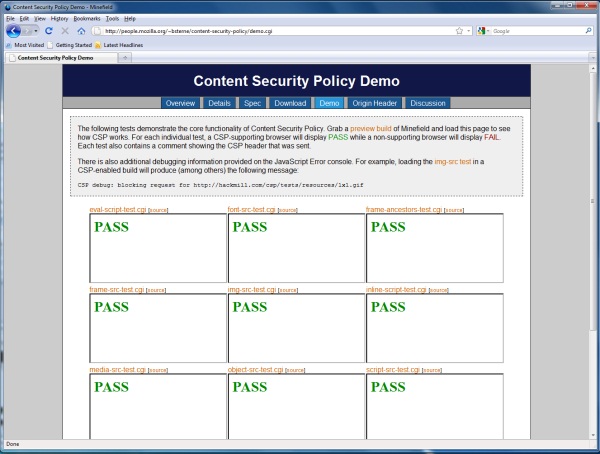
Mozilla Minefield 3.7 custom build with Content Security Policy attachment

"We have looked at HTML/JavaScript samples from a wide variety of Web sites ranging in complexity and have yet to see an example which could not be modified to support CSP," Sterne wrote last June. "We'll provide documentation regarding best practices for migrating a site to use CSP. Content Security Policy is also consistent with the programming paradigm 'don't mix code with content,' so there may be additional functional benefits to be gained by implementing such separation."

Even if Web site developers concur with the paradigm engineers such as Sterne are promoting, they may still have to contend with advertisers, especially those who contribute by way of ad distribution services. Outside of these developers' control, more often, advertisers are using dynamic JavaScript tweaks themselves, sometimes to expand the reach of their ads beyond the borders set for them on the page. A site may not be able to vouch for the inline content its advertisers supply, so while they may advertise themselves as compliant, from time to time, through no fault of their own, they may not be.

Brandon Sterne's custom build of "Minefield" is not one of the daily preview builds of Firefox 3.7, so testers who download the latest private alpha build will notice that it, too, fails Sterne's CSP test. CSP has yet to be officially announced as a component of Firefox 3.7, or any future release.

Comments

View comments by with a score of at least

Of course 3.7 crashes, anyone expecting it to be stable is just kidding themselves. We're currently on Firefox 3.5.3, the next release being 3.6. 3.7 has quite some way before its ready for release. THERE IS A REASON why is hasn't been released without thorough testing, like with any other programme or OS!

Score: 0

|

This one is not stable with plugins, keep crashing all the time.

Score: -2

|

Were you expecting something barely into the testing phase to be as stable as the current production version of 3.5.x?

Score: 0

|

One of the purposes of NoScript built in by a better implementation.

Score: 0

|

I'd like to get rid of noscript once and for all. On one hand I do not want scripting from many sites, on the other, noscript breaks a lot of legit sites and it requires a lot [too much] manual upkeep. Far more false positives than are necessary. I'd rather run the browser in a sandbox/VM environment, or work with browsers where the risk of XSS is miniscule/tested safe.

Score: 2

|

I find using the 'Temporarily Allow' function of NoScript to be much more effective than trying to manually upkeep my white-list all the time (although I do have a white list for all the main sites I visit). After I'm done with the site in question, I just revoke all temporary permissions given and I'm on my way. I don't think it is a case of too many false positives as it is a case of the fact that it blocks *everything* and lets you be in control. For now, it's one add-on I can't be without. I do agree though that with NoScript blocking pretty much everything, it does take a bit more 'work' to browse, but for the functionality it adds I'm willing to compromise.

About my user name: It means I am one of the minority *Objective* Mac users out there (the are some, but hard to find). Usually we see comments from people like fatty, and internetworld7 - quite embarrassing to say the least. No Kool-Aid for me. I simply prefer OS X - simple as that. I absolutely despise their vendor lock-down tactics (e.g. iPod & iPhone), but I don't own either of these. I am actually quite interested in checking out Win7, and if you have ever seen the BumpTop interface add-on http://www.bumptop.com/ I think that it *trumps* OS X's UI hands down. It's actually quite amazing. I'm thinking of buying a low-cost Win7 laptop just so I can check out BumpTop - it looks that good.

Score: 0

|

If you were "objective" you wouldn't have a need for putting an operating system in your username. There are large groups of people who don't give a s*** what OS or company other people think is better. The argumenting is futile, nobody is going to convince anyone otherwise.

Score: 0

|

Thanks for the warm welcome. If you were indeed objective, you would not be so presumptuous. Mac is not an OS name. Although, admittedly it does imply OS X, just as PC implies (for the most part) Windows. If you read my post as intended, you will see that I agree with you that the argument about which OS is better is futile (No Kool-Aid for me). I don't engage in those types of arguments either. Because I put Mac in my user name does this mean that PC_Tool is not objective when he posts because he has PC in his handle? I think he's objective. It's *just* my user name. No hidden agendas or conspiracy theories apply. Again, thanks for the warm welcome.

Score: 1

|

uh, what makes you think I was welcoming you, or that anyone deserves a committee welcoming them? This isn't a party room.

PC_Tool isn't claiming to be objective. We aren't the journalists you think we are... I simply observe the humor in calling yourself objective with [and you are right, not the OS but the company] name in your username. Can you imagine if journalists went around calling themselves by their company of choice and then claimed objectivity?

Score: -1

|

Your replies are illogical and absurd. You take obvious sarcasm such as 'Thanks for the warm welcome' literally? Be my guest. Yet again you are off the mark - Mac is not a company name but is a 'slang' or short version derived from the original Macintosh name.

"Can you imagine if journalists went around calling themselves by their company of choice and then claimed objectivity?"

Do you really believe that all journalists are objective just because they don't?

Your responses remind me of an old Internet related quote: "Normal Person + Anonymity + Audience = Total F**kwad"

That is all. Transmission complete...

Score: 1

|

http://www.merriam-webst.../dictionary/penultimate
"A team of Mozilla engineers may have the penultimate solution to cross-site scripting attacks. Now if only everyone else in the world supported them." Um, that lead in from the side column doesn't make sense:

1 : next to the last
2 : of or relating to a penult

Score: 1

|

I think they mean "Microsoft" when they say "everyone else." ;)

Score: -3

|
Below viewing threshold. Show

Regardless how poorly an internet browser is designed, they still count it ... for example, Google Chrome.

Score: -4

|

Apparently nobody understands what you're talking about: BetaNews just used the word "penultimate" (meaning: next to last) where it makes absolutely *no* sense, presumably because it sounds cool.

Score: 0

|

PDC 2009: What have we learned this week?

There was the freebie that no one will forget, the heebie-jeebies courtesy of Scott Guthrie, and a teensy bit clearer picture of how this cloud thingie should work.

Live report: Will Google Chrome OS change Linux?

The mysteries of just what Chrome OS is, and how much of an operating system it truly is, may be resolved today.

PDC 2009: Microsoft cares about Web browser performance

The effort to give users of the world's dominant Web browser the impression of quality, is a personal one for the man who leads that battle.

Nokia re-affirms its commitment to Symbian, sort of

Maemo won't necessarily be replacing Symbian in the Nokia N-Series, but that's definitely a place where it will be found.

E-book readers will be in short supply this holiday season

E-readers are hot this year, and a lot of compelling new products have been released, but are there enough electrophoretic displays to go around?

Sony looks to finally open a single storefront for downloads

Sony has had many different download portals for movies, music, e-books, and games, and now it's looking to make a single shop for all of it.

Tuning out the tablet: Time to give the endless speculation a rest

Wide Angle Zoom: Wishing and hoping and thinking and praying....won't put an iTablet on the market.

Five improvements for IT managers in 2010

If businesses are to improve their efficiency for next year, they need to stop and reassess the basic tenets of their job.

AOL's spinoff from Time Warner to shed 2,500 jobs

As AOL moves toward become an independent company again, it will cut nearly a third of its workforce.

Gartner: SMS-based money transfer will be bigger than mobile browsing, search

Gartner issues its predictions for the 10 things our phones will be doing in 2012.

Don't forget to upgrade to Firefox 3.6 beta 3 today

Mozilla has released the latest beta its Firefox 3.6 browser software, just over one week after beta 2.

