TechEd 2007: .NET Micro Framework Demonstrated for Embedded Devices

By Scott M. Fulton, III | Published June 5, 2007, 5:22 PM

ORLANDO - During an invitation-only demonstration here at TechEd, small device developer EmbeddedFusion demonstrated a prototype programmable small device - actually a circuit board with a 2x3 color LCD display - that is capable of being programmed using Microsoft's .NET Micro Framework. It's a managed code system with which developers can rapidly build programs for embedded devices, and embedded device drivers.

Within the first 20 minutes of programming the card using C# in Visual Studio 2005 (after re-installing the EmbeddedFusion SDK), we were able to construct a simple application that...[drum roll]...blinked an LED on and off.

From a technical perspective, this is more difficult than it seems under the hood. As we learned, embedded devices employ signals on pinouts that are time-specific, while .NET functions are asynchronously sequential.

In other words, they tend to run one after the other, the way things typically do on a PC. So there's already a bit of incompatibility: An event scheme has to be worked up when you connect the programmable device to the PC via a USB cable, in which you have to force the PC to run on a clock.

The skeleton code for doing this is part of the EmbeddedFusion SDK for .NET Micro Framework. We then embellished that skeleton code with test code that samples the inputs every second (or, by our count, every 1000 milliseconds), and that pushes a pin - in the digital sense - every second to flip on and off the LED.

A much more complex sample involves the built-in two-axis accelerometer, and was demonstrated for us. There, a test .NET Micro application was pushed via USB cable into the embedded prototype card, which triggers it to run a ball-in-a-maze game.

On the surface, it looks like a fairly low-order game...that is, until you pick up the card itself and move it around. The active accelerometers scoot the ball around, just like a real steel ball inside one of those cheap plastic mazes you get in a happy meal.
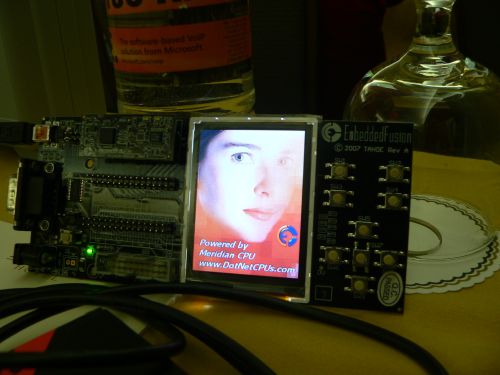
An EmbeddedFusion prototype card connected to our test laptop, as it boots up.The analogy seems cheap, but the implications are fantastic. What has appeared to embedded developers to be extremely time consuming projects, taking on the order of months to complete, can be finished in a matter of no more than a few days - about as much time as you'd think a programmer should consume to accomplish a similar task on a PC.

During the demo, Rob Miles, who teaches at the University of Hull and is a Microsoft MVP for C# development, professed that with the aid of .NET Micro Framework, he had experienced his finest hour: In a matter of days, he used it to program the lasers that etch date stamps in the labels of Budweiser beer bottles.

Home controls manufacturer Leviton, we learned, uses .NET Micro Framework currently to develop security and energy efficiency devices for homes and offices.

As other guests shared with us, the implications of simple C# programming in the evolution of robotics could be staggering.

Comments

View comments by with a score of at least

Then again .... 1 second is 1000 miLiseconds, not 1000 miLLiseconds .... :D

Score: 0

|

umm... 1 second is 1000 miliseconds. not 1000 microseconds.

Score: 0

|

Thanks for uploading this, it gave me something to read on my lunch break.

http://www.zuneconverter.net

Score: -1

|

shut up you spamming tart.

Score: 0

|

Google Chrome 4: Yes, it's fast, but is it usable?

As Betanews readers have responded to our stories about Chrome's JavaScript superiority...Does that mean we'd actually use this browser? Well...

Video: Netflix on PlayStation 3

Netflix has come to the PlayStation 3 via Blu-ray and BD-Live.

Verizon Wireless launches new Android, Chocolate, and ruggedized phones

The lower-priced Eris joins the Droid, while the Chocolate gets a touchscreen and more music playback.

Early sales figures for Windows 7 nicely high, but do we know why?

Fans of triple-digit surges in figures quoted by Betanews will love this one, as it appears Microsoft rediscovered how to pull off a software launch.

Myka announces its latest Linux-based 'net top box'

Myka's ION brings Boxee, XMBC, and much more to HDTVs.

What hath Mac wrought? A remembrance after a quarter-century

The reason there's a Macintosh today is not because of some brilliant flash of engineering genius, but because Apple had the audacity to learn from its mistakes.

Early build of Moblin 2.1 improves connectivity, but not device support

The Linux Foundation's Atom-centric OS yesterday received a major overhaul with the project release of Moblin 2.1 for netbooks and nettops.

The iPhone's China syndrome: Sales of 5,000 and climbing

There's actually a country where Apple's device is not a godsend, where sales can be measured in the dozens.

New European counterpart to FCC will ensure 'a more neutral net'

Late Thursday night, the ruling telecom administrators of the EU's member nations signed away their final authority to a new entity overseen by the EC.

Sophos study suggests Windows 7 UAC's default setting is self-defeating

Without any anti-virus installed, a Sophos test showed, User Account Control was only capable of thwarting just one malware package out of ten samples chosen.

Indiscreet tweet trips awareness of Web SSL vulnerability

A group of high-level security engineers had been making progress on thwarting a low-level threat to the Web, until somebody blurted it all out on Twitter.