The latest in big small things from Asus and MSI

By Tim Conneally | Published January 9, 2009, 8:46 PM

The headquarters of AsusTek Computer Inc., and Micro-Star International (MSI) are a mere 21 kilometers apart in Taiwan, and they seem as close as ever in the South hall of the Las Vegas Convention Center.
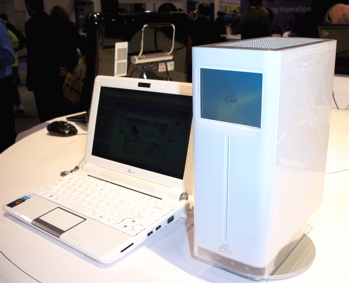
Eee D200

Both companies are known for their motherboards, and both are bringing the consumer electronics market a product line with a heavy emphasis on a tiny physical and environmental footprint, Asus with Eee and MSI with Wind.

Asus debuted today a totally unique product in its now expansive Eee brand, the netbook of servers, the D200. The D200 is about the size of a desktop computer (10.8" x 3.85" x 8.11"), with a net weight of 9.5 pounds (4.3 kg).

The "Sku 4" model is equipped with an Intel Atom N270 processor, has 2GB of Samsung DDR2 800 RAM, dual Seagate 500 GB HDDs, and a slot-loading TSST DVD-RW drive. The device also acts as an 802.11n MIMO AP router, and has a 3.5" LCD touch panel on the front to handle network connections and file management. Part router, part server, the D200 is expected to cost $600 and be released in the first quarter of this year. At that price point, it's affordable enough to become a first media server for many who have not yet taken that plunge in their home networks.

MSI, meanwhile, has launched its X-slim 320, a super-thin notebook computer in the new Macbook Air-styled form factor that the venerable Dell entered this morning with its Adamo. With a 13.4", 16:9 display and a thickness of of 0.79" at its thinnest, the X320 weighs in at a scant 2.86 pounds (1.3 kg) when equipped with a 4-cell battery. The X320 uses an Intel Atom Z530 processor running at 1.6 GHz.
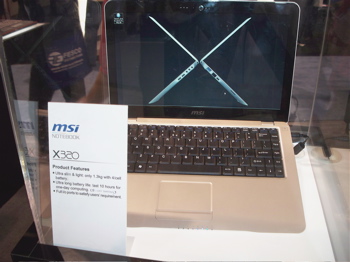
MSI's answer to the Air

Comments

View comments by with a score of at least

A Linux version of the D200, pre-configured, could be huge with small businesses (say under 10 employees) who could use a simple server/router but don't have the in-house technical expertise to set something up. I suggest Linux over Windows because overall it will require less day-to-day management (no Windows Update).

Score: 0

|

why do i want a laptop that i need a magifying glass to see it, i might as well get a blackberry.

Score: -1

|

Google Chrome 4: Yes, it's fast, but is it usable?

As Betanews readers have responded to our stories about Chrome's JavaScript superiority...Does that mean we'd actually use this browser? Well...

Video: Netflix on PlayStation 3

Netflix has come to the PlayStation 3 via Blu-ray and BD-Live.

Verizon Wireless launches new Android, Chocolate, and ruggedized phones

The lower-priced Eris joins the Droid, while the Chocolate gets a touchscreen and more music playback.

Early sales figures for Windows 7 nicely high, but do we know why?

Fans of triple-digit surges in figures quoted by Betanews will love this one, as it appears Microsoft rediscovered how to pull off a software launch.

Myka announces its latest Linux-based 'net top box'

Myka's ION brings Boxee, XMBC, and much more to HDTVs.

What hath Mac wrought? A remembrance after a quarter-century

The reason there's a Macintosh today is not because of some brilliant flash of engineering genius, but because Apple had the audacity to learn from its mistakes.

Early build of Moblin 2.1 improves connectivity, but not device support

The Linux Foundation's Atom-centric OS yesterday received a major overhaul with the project release of Moblin 2.1 for netbooks and nettops.

The iPhone's China syndrome: Sales of 5,000 and climbing

There's actually a country where Apple's device is not a godsend, where sales can be measured in the dozens.

New European counterpart to FCC will ensure 'a more neutral net'

Late Thursday night, the ruling telecom administrators of the EU's member nations signed away their final authority to a new entity overseen by the EC.

Sophos study suggests Windows 7 UAC's default setting is self-defeating

Without any anti-virus installed, a Sophos test showed, User Account Control was only capable of thwarting just one malware package out of ten samples chosen.

Indiscreet tweet trips awareness of Web SSL vulnerability

A group of high-level security engineers had been making progress on thwarting a low-level threat to the Web, until somebody blurted it all out on Twitter.