The new Nehalem-based Apple Xserves promise a price advantage

By Scott M. Fulton, III | Published April 7, 2009, 12:52 PM

This morning's announcement of the first Apple servers to use Intel's Nehalem-series Xeon processors may be a bit more tentative at the core than it seems on the surface. What could be the best performers in Apple's new rack-mount lineup are actually not available yet, although this morning's announcement made it appear -- and some sources are actually reporting -- that the high-end models are available now.

What data centers can get now are Xserve models based on the new 2.26 GHz Intel Xeon E5520. But the performance and power-saving tests Apple cites this morning are focused on the 2.93 GHz X5570, and we don't yet have prices or availability data for those models. Betanews has contacted Apple in an effort to get further details.

Yet purchasers may be intrigued, for once, by the prices Apple has revealed today. A basic, 1P E5520-based system starts at about $3,000. Granted, Xserve comes with unlimited client access licenses for Mac OS X, but since you need Macs to run them on, that "un-limitation" may be almost comical. Still, when we matched configurations as closely as possible between a new Xserve and a Xeon E5520-based Dell PowerEdge R710 (with 3-year licenses for Red Hat Enterprise Linux), the Dell price tag came up to $5,781, while the Apple stayed down there at $3,149. Take out the Linux licenses, and the Dell server still commands a $4,682 price tag.

Xserves are built to run Mac OS X, which is, after all, a UNIX variant. Whether they'd perform well running Linux instead depends on whether Mac OS is somehow "locked in;" but if it proves feasible, a data center may actually save some money up front by going with Apple.
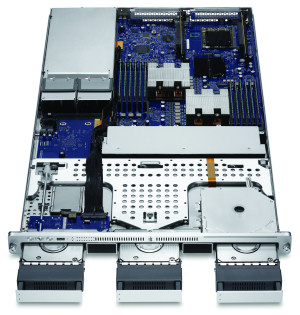
Apple's Nehalem-generation Xserve unitWhether it saves money over time depends on the server's energy performance, and that may actually prove to be the downside of Apple's argument. The company today touted its thus-far-unavailable 2.93 GHz Xserve as cranking out 227,974 operations at 100% target load, in the SPECpower_ssj 2008 benchmark. That's almost 61% better performance, by Apple's measurements, over the company's similarly equipped Xserves using Intel's previous generation Xeons at 3.0 GHz. And the new Xserve's score of 464 ssj_ops per watt at target load is about 39% more energy efficient than the old model, setting a performance-to-power ratio score of 683.

Here's where Dell rakes in the points. In officially recorded scores, a similarly equipped PowerEdge R710 with a 2.93 GHz Xeon X5570 CPU cranked out 541,345 operations at 100% target load, with an ssj_ops per watt score of 1,746 and a performance-to-power ratio of 2,287. That means Dell can tout its PowerEdge as being 335% more efficient than Apple...which is the typical case when you're competing against a discount brand.

Comments

View comments by with a score of at least

"Xserves are built to run Mac OS X, which is, after all, a UNIX variant."

Exactly what I have been trying to get the fanbois to learn... *sigh*

It would be interesting to see if "normal" distro of linux (especially the 64bit distros) could really expand the hardware to get better scores (albeit at higher power consumption).

Score: 0

|

While you could eventually find a Linux distro (normal?) to work on an Xserve and the throughput would be better, it's the point-and-click administration on Mac OS X Server that separate it from Linux and FreeBSD and the unlimited licenses that separate it from Windows.

When an organization has no IT staff, they don't want someone delving into manuals to figure out how to do something and they don't want to count seats. It won't be the best offering for most but then, they don't sell to most.

Score: 0

|

by normal, I mean one where the kernel is in a non-modified state (no kernel level optimizations or modifications).

I agree with you on the point and click interface... if there is one thing Apple does well, it's simple UI elements for those of us that aren't quite as comfortable behind the keyboard. lol

Score: 0

|

Not only does it have point and click capabilities, but it also has a more robust commandline environment as well.

Not to mention its full blown UNIX in the terminal session commandline, and also able to 'natively' communicate both with Windows and all of the UNIX variants without terminal emulation as well as the ability to perform the complete remote administration of a heterogeneous (mixed) OS environment of desktops and backend servers.

Score: -1

|

And on OSX Server, VMWare can mount multiple OSX virtual machines, as well as ALL other x86 compliance OSes.

If they only has a slot for a high end video card!

This is Mac done right.
Now, if they would only do the same for the laptops. ;-)

Score: -2

|

Google Buzz: Another attempt to harness the content firehose

Similar to how Google successfully remolded RSS into a Google tool, the company now wants to remold Gmail into one big Google party

Success: Google's Nexus One shipping support line takes tech support questions

UPDATED Though the support line had been set up for shipping, it now appears Google personnel are happy to hear technical concerns.

Goodnight, moon: What I learned from a space shuttle

Carmi Levy | Wide Angle Zoom: Can the tech sector learn a few lessons from the space program? Certainly, if you believe in learning from someone else's mistakes.

Netflix to FCC: NBCU + Comcast could bypass net neutrality

Weaning itself from the post office as its main means of video transfer, Netflix would like someone to ensure the Internet remains just as unencumbered.

Rhapsody to become an independent company

RealNetworks and Viacom subsidiary MTV Networks have begun the process of spinning off music service Rhapsody into an independent company.

Nvidia debuts new dynamically-switched graphics card technology

Today, Nvidia announced that its Optimus technology for GPU switching will soon be available in a handful of Asus notebooks.

Google lowers 'unusually high' early termination fee on Nexus One

Google has lowered the Nexus One's early termination fees which were twice as high as the norm.

Netgear and Ericsson introduce a mobile broadband hotspot with a twist

It's a mobile broadband hotspot, but it's for use in the home.

Report: Streaming video drove 72% global increase in mobile data consumption

A new study says streaming video is "the single most influential factor driving the need for increased mobile network capacity."

Stymied by continuing Nexus One 3G issues, Google blames the environment

If you're still afflicted with the 3G flip-flop trouble, then you might consider moving. That appears to be the only suggestion Google can give for now.

Wolfram|Alpha makes a strong argument for virtual keyboards

"Answer engine" Wolfram|Alpha has updated its iPhone/iPod Touch app, harnessing the strength of the virtual keyboard.