Login:
Password:

WD premieres ultra-fast VelociRaptor 10,000 rpm HDD

By Scott M. Fulton, III, BetaNews

April 21, 2008, 12:07 PM

Making an AMD-like play for the cost-conscious computer enthusiast, Western Digital has found a way to release what should be a laptop drive, but repackaged for the desktop builder at what could be perceived as a respectable price.

Typically the notion that smaller is faster applies to the microprocessor realm, but today, hard drive manufacturer Western Digital is demonstrating that notion applies to storage as well. This week, WD is premiering its first 10,000 rpm enthusiast-class hard drive; and to accomplish its transfer speed, rather than try to rev up a conventional 3.5" form factor, it's taking a 2.5" HDD and encasing it in a 3.5" form factor heat sink.

The VelociRaptor 300 is a 300 GB device that plans to make better use of its 3.0 Gbps SATA II interface, which nearly all enthusiast-class drives have today but never really utilize. This morning, WD is claiming the VelociRaptor can withstand a sustained transfer speed of 120 MB/s, which would indeed set new standards at the high end.
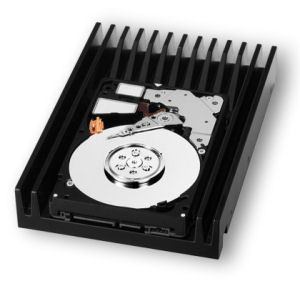
Western Digital's 10,000 rpm VelociRaptor 300Whether it's actually reached 120 MB/s is a matter for independent testers to determine. This morning, AnandTech's Gary Key is reporting that in his team's tests, the drive's average sustained transfer rate only hit 98.4 MB/s. That could be due to what his team believes to be a drop in transfer rate on the platters' outer perimeter, clearly visible in the screenshot Key provides.

A similar pit is visible on a chart posted this morning by Tom's Hardware's Patrick Schmid and Achim Roos, though they don't say much about it. In fact, their tests show that even with the performance pitfall -- which WD explained to AnandTech's Key was due to a problem in the early drives' firmware -- the VelociRaptor still outperforms Seagate's competitive, enterprise-class Savvio 15K.1, by a score of 102 MB/s to 91.7 MB/s. That's important, because the Savvio is a 73 GB drive rotating at 15,000 rpm, and smaller drives are typically faster -- the Savvio does have a faster access time than the VelociRaptor's 7.0 ms, in Tom's tests, by 1.4 ms.

Another reason that's important is because the Savvio currently sells for a street price of about $330, while WD is positioning its drive with 411% the size at $300. Seagate is selling its 15,000 rpm drives for enterprises that need rapid transfer times for servers, while WD is making an obvious play for gamers in the consumer market. That said, it could actually make a dent in the enterprise market -- especially if it's fixed its firmware problems and can demonstrate even better performance -- when the first units begin shipping next month.

Add a Comment (25 Comments)

BetaNews reserves the right to remove any comment at any time for any reason. Please keep your responses appropriate and on topic. Foul language and personal attacks will not be tolerated.

Name (required):

E-mail (required):

Enter Your Comment:

By yourcat

posted Apr 22, 2008 - 1:22 PM

WOW!!! Great! Hmmm... if only I could under-power it down to 7200rpm for the noise and reliability...

Score: 0

By PC_Tool

posted Apr 22, 2008 - 3:30 PM

Bah...

If you need it quieter, just drill a few holes in the wall and run the KVM/Audio cables through it. Won't hear a thing, trust me. :p

Score: 0

By Jim

posted Apr 22, 2008 - 3:17 AM

Crap, and I just started using my Stripped pair of 150gb raptors on Saturday.

These will probably be a lot quieter too, I have to keep turning my computer off at night so it doesn't keep waking me up.

Score: 0

By Second Shadow

edited Apr 22, 2008 - 10:53 AM

Why would anyone buy a 150 GB Raptor these days?
There are already a number of 7,200 RPM drives with similar of even better performance at a fraction of the price.

http://www.tomshardware....er-performance,658.html

(Yes, I know the Raptors have better random access times, but is it worth paying double the price for 1/3 the capacity to get maybe a 3% real life increase in performance?)

Just buy a pair of Barracudas 7200.11 , set them up in a RAID 0 and fasten your seatbelt ...

Score: 0

By yourcat

posted Apr 22, 2008 - 1:22 PM

Thats what I would do.

Score: 0

By PC_Tool

posted Apr 22, 2008 - 10:44 AM

Heh...

No doubt. ~53MB/sec is quite nice.

Will definitely be getting a few of these shortly after they come out though.

Score: 0

By Tenoq

posted Apr 21, 2008 - 9:40 PM

I'd still prefer to have a play with the new OCZ SSD. 64GB with 0.1ms seek time would make an awesome OS drive. :D

Score: 0

By wincement

posted Apr 22, 2008 - 1:56 AM

I guess you're entitled to if you want. I'd rather buy this drive at a fifth of the price, almost five times the storage space, and faster throughput.

Score: 0

By Hellcat_M

posted Apr 21, 2008 - 3:07 PM

$300 is expensive since you can buy a 1TB drive for under $300 at 7200rpm. Hopefully the price will drop and sizes get higher then maybe it will replace 7200rpm. Until them I think most people will buy the bigger storage at cheaper prices.

Score: 0

By Sexbarril

posted Apr 21, 2008 - 3:37 PM

That is why it is targeted for gamers wanting the extra speed, not "most" people.

However I did only read the article to understand this.

Latz, SB

Score: 0

By GS5

posted Apr 21, 2008 - 2:40 PM

I can't wait to get my hands on one. 10,000rpm drives could eventually replace 7200rpm drive. Just as the 7200rpm drive replaced 5400rpm drives. And since it's a 2.5" drive, with just some modification a lot more platters could be added making it thicker possibly yet still fit into that 3.5" heat sink. Its speed, capacity and price give is great promise for future generations.

Score: 0

By Second Shadow

posted Apr 21, 2008 - 1:00 PM

Wouldn't surprise me if this was the last generation of Raptors ever. As 7,200 RPM drives' speed keeps going up, and SSD's prices keep going down, the niche for Raptors will become increasingly smaller ... and smaller ... and ... well, you know, the dodo and all that

Score: 0

By mjm01010101

posted Apr 21, 2008 - 2:56 PM

Flash will need 5+ years to reach parity with regards to capacity to match HDD's.

Let's not even get into cost of the tech:
http://www.storagesearch.com/semico-art1.html

Score: 0

By yourcat

posted Apr 22, 2008 - 1:24 PM

But it WILL catch up, and then HDDs are dead.

Score: 0

By Tenoq

posted Apr 21, 2008 - 9:39 PM

Well it's been 5 years since the first generation of Raptors... and you'll have to admit, the subsequent ones have just been re-hashes of the old idea.

Score: 0

By Second Shadow

edited Apr 22, 2008 - 10:23 AM

I'm not saying that SSD's will replace ALL HDD's in the short term (< 5 years). But I wonder how long it will take for either SSD's to become big enough and cheap enough to compete with the new VelociRaptors or for 7,200 RPM HDD's to become fast enough to compete with them.
By the time the next generation of Raptors would be due (say, in 2-3 years), the niche between "normal" 7,200 RPM HDD's and SSD's may be too small.

Score: 0

By PC_Tool

edited Apr 21, 2008 - 1:57 PM

I don't think that point is going to be reached for a year or two yet at least.

Hopefully these will be out and readily available by June.

Score: 0

By wincement

posted Apr 21, 2008 - 3:35 PM

Yeah. I hope that "available to retailers in May" clause doesn't turn into September.

Score: 0

By Galway

posted Apr 21, 2008 - 12:29 PM

Seeing as though HD manufacturers often 'round down' when using capacity measurments, I wouldn't be surprised if they did the same with their interpretation of a MB.

Score: 0

By Paul Skinner

posted Apr 22, 2008 - 5:11 AM

They don't round down as such, they use the other measuring scale (the SI scale) and Windows (incorrectly) uses the IEC scale.

Officially, a Windows Gigabyte is a Gibibyte.

Score: 0

By PC_Tool

posted Apr 22, 2008 - 8:55 AM

Can you even imagine the backlash if MSFT started referring to it that way, though?

It's not *just* windows, btw, in case you were trying to troll there a bit. :)

Score: 0

By Banquo

posted Apr 22, 2008 - 1:32 AM

They aren't "rounding down", they're using the correct definition of kilo which is 1000.

Score: 0

By daq

posted Apr 21, 2008 - 4:24 PM

I REALLY hope you're not talking about drives having less space formatted and that you know that 1GB = 1024MB

Score: 0

By yourcat

posted Apr 22, 2008 - 1:26 PM

1 KiloByte= 1024, but 1 Kilo= 1000.

Score: 0

By Galway

posted Apr 21, 2008 - 7:34 PM

http://en.wikipedia.org/wiki/Gigabyte

Score: 0