Wolfram|Alpha makes a strong argument for virtual keyboards
By Tim Conneally | Published February 5, 2010, 7:01 PM
I don't keep my personal preference for mobile devices with physical keyboards a secret; the sensation of hitting real keys is an indivisible part of the text entry experience for me, and it's not likely to change any time soon.
But there is one area where physical keyboards are woefully inferior to virtual ones: adaptability. A virtual keyboard can represent any alphabet or be arranged in any configuration the user or software needs, and a physical keyboard simply can't keep up with that.
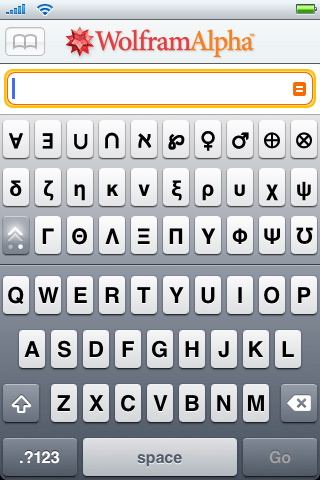
There is no better example than Wolfram|Alpha's iPhone/iPod Touch app, which now has four full-screen keyboards to accommodate all the various mathematical symbols that it includes in its searches and computations.
Today, Wolfram Research pushed out the 1.1 update to its $49.99 application in the iTunes App Store, which has been redesigned to provide a more useful interface with the "answer engine."
"To determine the optimal keyboard layout, we scoured Wolfram|Alpha's server logs for the most commonly entered phrases that have characters with meaning in Wolfram|Alpha," the team's blog says today. "Given that Wolfram|Alpha is built on Mathematica, one of its core strengths is advanced mathematics. True to form most of the commonly typed characters are related to math."
In addition to the standard keyboard, Wolfram|Alpha includes specialized ones labeled "Math," "Greek," and "Symbol" to simplify the act of querying the app.
"Whether people are converting currency, locating positions of planets, or performing advanced mathematical computations far beyond the capabilities of scientific and graphing calculators, this new functionality provides a natural mobile computation experience," the team said this evening.

not good for the blind though
Score: 0
|I agree but that is why "text to speech" is a part of most OSs since the 90's
Score: 1
|"the sensation of hitting real keys is an indivisible part of the text entry experience for me, and it's not likely to change any time soon. "
Hear, hear!
Score: 0
|Same here. Oh how I miss my Blackberry.
Score: 0
|I guess i never had the luck to be a Crackberry junkie. I went from a Razr to a iphone. So the iphone keyboard works just fine for me. Sure i guess some people may have issue but it gets alot easier in a matter of days. Plus i dont have some ugly keyboard on my phone. And more room for a screen unlike tradtional blackberries. Such i guess people like what they like and some will just prefer a actual keyboard. If apple changed to a physical keyboard i would really not like it at all.
Score: 0
|I'm still under the spell of using physical keyboards. Maybe the revolution of digital keyboards have come too soon.
http://www.workathometomakemoney.com/
http://jermainelovepoemsandlovequotes.blogspot.com/
Score: 0
|"A virtual keyboard can represent any alphabet"
So can an physical keyboard with e-ink (Samsung Alias 2) or OLED (Optimus Maximus) keys.
"or be arranged in any configuration the user or software needs"
True, but in practice there are only two configurations: portrait and landscape.
Score: 0
|A terrific idea that they've made their search engine capable of querying these symbols from the get-go. I'm impressed. This goes a little further to justifying that large $50 price tag.
Score: 0
|Those types of physical keyboard cannot change the number of keys, or add actions to the key.
For example a software keyboard could enter an uppercase character whenever you swipe up on a key. Or the entire keyboard could be replaced by stenotype keys.
Score: 0
|"Those types of physical keyboard cannot change the number of keys, or add actions to the key."
Um, they can actually. They are just expensive to do at the moment. Imagine how the brail readers work, expect on a screen interface, the keys become physical keys that respond like a real key. (This will be the convergence between the two and the best of both worlds.)
Score: 1
|