2001: An Apple Odyssey
By Joe Wilcox | Published September 21, 2009, 8:03 PM
It's not uncommon for bloggers and journalists to get hung up on the present. For Apple, there's big noise about soaring stock price, even considering economic recession, and increasing demand for iPhone. But the past defines the present. For Apple, products or services launched in a single calendar year -- and the consistent execution that followed -- define current successes, including iPhone.
I contend that next to 1984, when Apple launched Macintosh, 2001 was the most important year in the company's history.
Apple is on a remarkable role that even its strongest critics cannot reasonably deny. The stock closed at $184.02 today -- about a buck off its 52-week high. Apple's market capitalization is $164.85 billion, which is -- get this -- higher than Google, which valuation is $157.34 billion.
Apple's brand is sizzingly hot, with iPhone being important factor. But none of this present would be anything if not for decisions made in the past. So, please, enter the Wayback machine for a trip to 2001:
- In January 2001, Apple unveiled the iTunes music player
- In March, Apple launched troubled Mac OS X 10.0 and relaunched as 10.1 in September
- In May, the company opened Apple Store, in two locations -- California and Virginia
- In October, the first iPod debuted
At the time, Apple Store, iPod, iTunes and Mac OS X seemed innocuous launches, but they would later be the four pillars raising Apple's brand from obscurity to mass popularity. In June 2002, Apple's "Switchers" marketing campaign kicked off the first of many successful campaigns, including "Get a Mac," supporting Apple's "2001 Four."
All other Apple products that followed depend in some way on the 2001 Four:
- If not iTunes and Mac OS X, no iLife
- If not iTunes and iPod, no iTunes Music Store
- If not iPod, iTunes and Mac OS X, no iPhone
- If not Mac OS X, no iMac, MacBook/Mac Pro
- If not iTunes and Mac OS X, no Apple TV
- If not Apple Store, none of the above
Some people will call my approach simplistic, wondering why I ignore, say, iMovie, which also contributed to iLife. Yes, but music and photos proved more important. That last bullet in the list is perhaps the most important and controversial assertion. I don't believe that Apple could have achieved its current level of success without the retail stores. Apple Store is the supporting pillar.
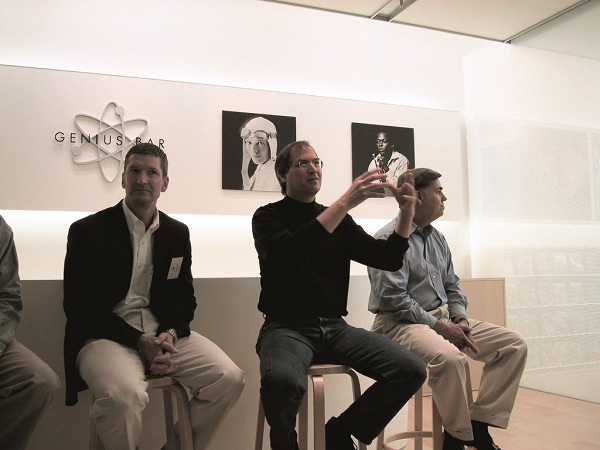
The first Apple Store opened in McLean, Va., in May 2001. I was there for the official news media unveiling and launch days later. Timing struck most analysts I interviewed as strange: Gateway was looking to get out of retail just as Apple wanted in. But the stores increased exposure to Apple's brand and provided a place to foster mac community and lifestyle, around digital activities like listening to music and watching, making or sharing videos.
In 2000, Apple CEO Steve Jobs started consistently talking about the Mac as digital lifestyle hub. But the company also later extended the Apple lifestyle to Windows PCs, through AirPort Extreme, Apple TV, iPhone, iPod, iTunes, iTunes Music Store, MobileMe and Time Capsule. Most of these products are sold through Apple Store.
But that's not to diminish the importance of the other three. The 2001 Four all contribute to the Apple lifestyle, culminating in iPhone, which adds a mobile lifestyle component, extending from the others but more connected through the applications and the Web.
The question now: What next? The past first:
- In 2002, Apple launches iLife and the aforementioned Switchers marketing campaign
- In 2003, iTunes Music Store opens
- In 2004, iLife `04 launches with great marketing
- In 2005, iPod nano makes stunning debut
- In 2006, first Intel-based Macs ship; "Get a Mac" ads air
- In 2007, iPhone launches
- In 2008, App Store opens; unibody Mac laptops ship
- In 2009, Apple products defy economic recession's gravity
Granted, the last bullet isn't a product or service launch, but it's the rightful culmination of all the others. Is there another year important to Apple's success? Absolutely. But not just one:
- 2006, for the move to Intel processors
- 2007, for the launch of iPhone
- 2008, for App Store's debut
The move to Intel processor opened the Mac sales spigot. Launch of iPhone and, more importantly, the supporting App Store opened up a new mobile platform. But none of this would really have been possible if not for the 2001 Four.
Before I move onto the topic of Microsoft's most important year, I'd like to ask Betanews readers: What do you think it was -- and why? I'll incorporate feedback in the follow-up post on Microsoft's most important year.
[Photo Credit: Joe Wilcox.]

It's amazing what Apple has done since 2001. Seriously, I wish I could go back and get in on that stock. Did anyone here?
Score: -1
|I could swear you posted this exact article 1-for-1 on your other blog weeks ago. The only thing changed is the stock prices - and now I can't find that previous copy, or at least it doesn't appear when searching for "odyssey" - what gives?
Also, Apple's valuation has been higher than Google for some months now... however it's only the last week or two that Apple's valuation is higher than IBM, which is more significant if you can call valuations with companies like these significant...
Score: 0
|Deciding what Microsoft's best year was is difficult. Apple is essentially a mid-size business with limited resources; Research & Development are essentially a single department. Projects at Apple have to fit somewhere, they have to have a marketable profitable niche; if they don't the project gets killed.
Microsoft on the other hand has separate Research and Development departments. A project may works it's way through MS without having a marketable niche. MS produces all sorts of stuff that they just don't sell, stuff that instead they give away. Sure it may end up packaged with one of their products but it is just as likely to be given away (developement tools and programming languages for example).
The thing is that Apple is predominantly a manufacturer of computers and computer accessories. Microsoft on the other hand is a software company.
Apple's big product right now is iTunes and it's plethora of devices slaved to iTunes.
Microsoft's big product is .Net and it's collection of .Net enabled languages and development tools.
But MS has a problem with .Net, it's called "Mono", it's the open source cross platform implementation of .Net. It enables Apple users to benefit from MS's labors, it brings value to OS X.
But why is .Net so valuable you ask?
Some background: When software libraries are written, the limitations of the system they are to be run on encroach on the design; they make themselves felt during their use. Any bugs, any quirks in the design, as time passes become harder to fix, at least not without breaking software that depend on that library (this is the root of DLL Hell).
* Sometimes it's easier to tear down and start all over again then it is to try and fix what is broken and not break or confuse things. .Net was almost a complete tear down, it allowed for the removal of a large amount of dead wood.
* .Net handles library versioning. .Net software can bind to specific versions of a library and the .Net framework can make sure that it doesn't use a different version.
* A plethora of languages support .net (the number is kind of hard to get a hold of, do you count flavors/compilers or languages; there are more than 100 CLI compilers but only about 50 language groups; this is a non-trivial number). With so many languages all using the same libraries, it makes interoperability between them so much easier. It also means that libraries built in one .Net language can be compiled and later used in another language without having to worry about compatibility.
(I'm bored of writing this so I'm just going to post it as it is)
Score: -2
|The Apple strategy is pay-to-play, if you want Apple software, you need Apple hardware; there are exceptions to this, Quicktime, Safari and iTunes all run on windows. Apple may sell an operating system but it can only be legally run on Apple hardware. Apple doesn't even want Palm devices syncing with iTunes. Apple is only in the software business to sell hardware. This means their products tend to be physical. When a product is released it either is a success or a flop, it's easy to see how a product effects the companies bottom line.
Microsoft on the other hand is in the software business. When they release a piece of software for free, they are doing so to increase the value of Windows. That value increase is often impossible to measure. Nobody says "I'm going to buy Windows because the latest version of the System Internals Suite is the bomb" they might however say "I'm going to buy Windows because it is easy to maintain." The System Internals Suite might be the cause of making maintenance easier but it's not going to be credited.
All I'm really saying is that because of MS's business strategy of increasing the value of Windows and it's other products, we can't really say what year was the best for MS because we can't evaluate the value of these product tweaks.
Score: -2
|.NET is nothing more than an attempt to kill Java. It is a big mess. I don't know who got the bright idea to clone what Sun was doing and put desktop software on a virtual machine, but all they succeeded in doing was creating opportunities for performance problems in software. After years of existence, it still isn't used for commercial software development. I point out that the new "ribbon" interface used in MS Office was done in C++ using MFC....not .NET. If .NET is go great, why is Office still based on C++ & MFC?
that said.... .NET will be the death of MS just like Java was for Sun. While it isn't used for commercial development, it is heavily used for Enterprise development. One day all those enterprise customers are going to decide they really don't need to pay through the nose for Windows when their .NET code runs just as well on a free copy of Linux.
Score: -2
|melkor: I have read all your posts, and it is unbelievable how misinformed you are and how you express so much error. I cannot even begin to address each and every of your sentences. I will at least begin with one.
>>The thing is that Apple is predominantly a manufacturer of computers and computer accessories. Microsoft on the other hand is a software company.
This alone shows how you do not even have a bit of understanding about Apple. Even at the D Conference during the famed interview with both Steve Jobs and Bill Gates, Steve Jobs said, "You know, Apple is a software company."
In 1984, the Macintosh was BOTH a hardware marvel, but also a software marvel. The iPhone is BOTH a hardware marvel, but also a software marvel.
The fact that you begin your diatribes with the fallacy that Apple is primarily a hardware company sets us up properly for the spewing of your drivel thereafter.
You were at least closer to the truth with this: Microsoft is a software company. For Microsoft has proven that it cannot make hardware and succeed, nor at the least produce hardware and turn a profit. Zune is a hardware footnote and the Xbox has been riddled with hardware mishaps and financial failure.
But even with that being closer to the truth, you are wrong. For Microsoft is primarily a marketing company, who just happens to sell software. And not very good software at that. They are most adept at the creative use of contracts and monopolistic practices in order to succeed in the marketplace. Not because they make the best products.
Score: 0
|>> Apple doesn't even want Palm devices syncing with iTunes.
God melkor, do you ever say anything that you have actually researched and haven't just pulled out of your arse?
Palm is very welcome to sync with iTunes IF THEY WRITE THEIR OWN SYNC SOFTWARE. What Palm has been doing is taking the lazy mans' way out, the cheap, parasite's way out by masking the Palm Pre and simply stating it is an iPod in order to sync.
Apple shouldn't have to allow leechers to piggyback off of its success and not do their own work. All Palm has to do is write a driver to sync to iTunes. But they won't do that. They instead change their device's name so that it appears to iTunes that it is an iPod.
Who honestly should want to buy a device from a company that doesn't even care enough about it customers that it writes its own driver to make sure that it works?
melkor, I am dismayed that I have only responded to only one more of a multitude of your misinformations. There is so much more drivel from you but only so few hours in a day to respond ...
Score: 0
|WallyWorld Sep 22, 2009 - 5:16 PM
melkor: I have read all your posts, and it is unbelievable how misinformed you are and how you express so much error. I cannot even begin to address each and every of your sentences. I will at least begin with one.
>>The thing is that Apple is predominantly a manufacturer of computers and computer accessories. Microsoft on the other hand is a software company.
This alone shows how you do not even have a bit of understanding about Apple. Even at the D Conference during the famed interview with both Steve Jobs and Bill Gates, Steve Jobs said, "You know, Apple is a software company."
In 1984, the Macintosh was BOTH a hardware marvel, but also a software marvel. The iPhone is BOTH a hardware marvel, but also a software marvel.
The fact that you begin your diatribes with the fallacy that Apple is primarily a hardware company sets us up properly for the spewing of your drivel thereafter.
You were at least closer to the truth with this: Microsoft is a software company. For Microsoft has proven that it cannot make hardware and succeed, nor at the least produce hardware and turn a profit. Zune is a hardware footnote and the Xbox has been riddled with hardware mishaps and financial failure.
But even with that being closer to the truth, you are wrong. For Microsoft is primarily a marketing company, who just happens to sell software. And not very good software at that. They are most adept at the creative use of contracts and monopolistic practices in order to succeed in the marketplace. Not because they make the best products.
Score: 0
|melkor, read "From Win32 to Cocoa_ a Windows user's conversion to Mac OS X"
http://tinyurl.com/cxgevw
This guy was an avid Apple hater. Then after years of frustration developing in Windows, he turned to try the Mac. Now he informs you how utterly poorly conceived .net is and how the developing tools on the Mac for OS X are so much better AND FREE. And how it has rejuvenated him as a developer to where he enjoys developing software again.
A love he had lost on Windows. Again, this is from a former Apple hater.
Score: -1
|I would say Microsoft's biggest year was when they convinced that sucker to sell them DOS. Or maybe when the dips***s at IBM signed them up to do OS/2. Or maybe last year when they bribed and stuffed committees to get their horrible, proprietary, MSOOXML format to become an ISO standard.
Score: -6
|At least they bought DOS. Apple stole the GUI from PARC!
Score: -1
|My goodness Bogunch, do you ever try to learn the truth before you speak? This is so well documented, and yet you and your ilk love to espouse misinformation to support your cause. "Apple stole the GUI from PARC!" Simpleton.
Before Steve Jobs visited PARC, he informed Xerox that Apple was intending to build its own computer with a GUI interface and requested a tour. IN RETURN, Apple gave Xerox a very profitable amount of Apple stock, which Xerox was happy to receive in return.
In addition, we are talking about a 1-1/2 hour tour at PARC to watch a DEMO. Apple still developed the Macintosh from scratch, wrote all original code, added many additional features that were not even in the imperfect PARC demo, while also creating a miniature computer for all this (versus the monstrosity-sized computer at PARC).
To say Apple stole the GUI from PARC shows your ignorance.
Microsoft, however, can be accused of stealing GUI code and, even in later years, QuickTime code in attempts to make its Windows media player match the speed of QuickTime. Microsoft has a history of stealing code. Apple, not so much.
Oh, and MS may have bought DOS, but as you should know, that was a scam. That one event would set the stage for Microsoft's underhanded practices and methods to succeed for the rest of its existence. It's corporate policy at Microsoft.
Score: -1
|Joe Wil "sucks" C0ck-
Nice copy and paste, reformat job.
Score: -7
|-If not Mac OS X, no iMac, MacBook/Mac Pro
I'm no uber-mac-Geek, but the original iMacs (with the fruity colors) shipped with OS 8, and were still really quite successful. I'm not sure how that particular bullet factors into your progression.
Score: 0
|1995 - Windows 95.
That's an obvious one, surely?
Score: -1
|isn't this like the second or third article posted to betanews on this very same bs?
ask yourself this, how many times has this very same article been printed on various blogs over the past years...
its getting tired, real fast...
Score: -2
|About 2001? I don't know of any. Let's see some links. You want to offer up Microsoft's best year?
Score: 0
|what im saying is, the same stuff comes up time and time again, except you are pointing out 2001 ;P
i could barely watch Engadgets recent 'show' due to the fact that they rehashed Apples whole history when it was supposed to be about Palm, what a joke ;)
Score: -2
|There is increasing Mac fascination--some would say bias--in the media. Some journalism schools require Macs and even iPod touches or iPhones. I agree that a show about Palm should be about Palm. Not Apple.
Score: 0
|Microsoft's best year is 2009 when Windows 7 ships.
Score: 1
|My disenchanted with Apple has taken place over several years. In the 80's and 90's Apple's PR was all about over throwing the giants (IBM) and thinking differently, to some it up: empowering the people. In the last 10 years Apple's course has changed. The continued FairPlay DRM wars and App Store software censorship have taken their toll on me. They have gone from being a pillar of the community, to the thought police, kicking in peoples skulls with C&D orders. I use to think Apple's true color was something like bondi blue, but now it know it's black: the black of riot police uniforms, the black of soul of storm trooper boots.
I'm sorry, I can't turn a blind eye to it. They have no more integrity to hide behind.
Apple you have changed, you have changed.
It's been 25 years since the release of the 1984 Apple commercial and I watch it now and I wonder "Who is that woman? Who will she be? Will she be in time to throw the hammer before Apple catches her?
Score: -1
|It is with sorrow that I write this.
Apple was a great and beautiful hero. Now it is nothing more than a monster, a beast. We are in need again of a hero, a great hero, someone to pickup the dropped swords of truth and justice, and slay the beast.
----
Ok ok maybe I'm getting a bit melodramatic & fanciful but the point is clear, Apple has fallen victim to it's own advertising. By hoisting them selves up upon a pedestal proclaiming their morality, they filled peoples hearts with a belief in that morality. The problem is, stock holders tend to have the collective morality of a ... fish - that is to say, none. Even if Apple wanted to fulfill their moral obligations, they could never convince their stock holders that it would be profitable (while on the other hand immorality has a proven history of profitability).
Now this isn't a new advertising strategy, it's how revolutions work. The problem is, that when push comes to shove, revolutionaries tend to make terrible statesmen, the resulting state ends being a mess (the French Revolution is a good example of this; successful governments that have formed out of revolutions tend to be led by experienced statesmen; The American Revolution is a good example of this). One could draw the parallel between Apple and a dictatorship trying to maintain power by any means necessary. And just like any state, it's got fanatical believers who refuse to take a critical look at the banner they carry and what they do in it's name.
Score: -2
|God, melkor, you are so ignorant.
"The continued FairPlay DRM wars..."
Apple set up FairPlay DRM to appease the music cartels. Apple was and always has been against DRM. Steve Jobs was the only prominent player to post an open letter to the music industry to end DRM http://www.apple.com/hotnews/thoughtsonmusic/ (read it melkor, and inform yourself for once), meanwhile - I remember - shortly after it was posted, Microsoft stated that the Steve Jobs' open letter was "irresponsible of Apple". Why did Microsoft state that? Because it has been Microsoft that has been historically up the music and movie industries' arses offering DRM for the industries but to lock everything to Microsoft.
It was Microsoft who introduced new DRM in Windows Vista, disabling movies it deemed were pirated. And of course, we know the DRM which is in Windows itself, disabling Windows if it deems your copy is not valid. Apple meanwhile has never had DRM in its O.S.
Because of your limited understanding, you cannot see why it is in Apple's best interest not to have DRM. For the whole purpose of the iTunes Music Store is not to make money on music, but to make sure that there is always playable content that can play on an iPod. Microsoft has wanted a world where all music requires a Windows box to play. And Apple has fought to make products in a world that Microsoft wants to own. This is why and iPod cannot play a wmv file.
But this is why Apple is for open systems where there is (pardon the pun) fair play. Because in a world with fair competition, Apple will always succeed and Microsoft risks being doomed to failure. Microsoft depends upon their monopoly.
This is why the Safari browser is based on open source WebKit (which Apple developed and submitted as open source and now many browsers are based on), why OS X is based on open source code that Apple regularly submits back to the open source community, and why the preferred audio format in the iTunes / iPod ecosystem is AAC, which is basically MP4 audio, the much more efficient successor to mp3
Score: -2
|