Android and iPhone smack down Windows Mobile
By Joe Wilcox | Published February 23, 2010, 12:12 PM
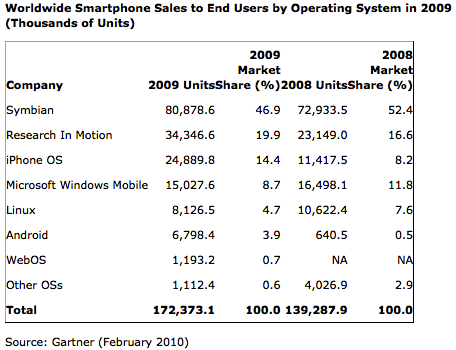
Worldwide, Windows Mobile smartphone operating system market share declined in 2009 to 8.7 percent from 11.8 percent a year later. Windows Phone 7 Series couldn't come soon enough -- if holiday 2009 could even be enough to hold back Apple's iPhone OS and Google Android.
The smartphone data comes from Gartner, which measures actual sales to customers rather than to carriers or dealers. By that reckoning, Windows Mobile sales only declined by 1.47 million units to around 15 million units year over year. By comparison, iPhone OS sales more than doubled -- to nearly 25 million units -- with share rise to 14.4 percent from 8.2 percent year over year. Android made significant gains -- and at the expense of other Linux-based smartphone operating systems, too -- with share rising from 0.5 percent in 2008 to 3.9 percent in 2009 on 6.8 million units shipped. Android made its biggest gains of the year during fourth quarter.
"Android's success experienced in the fourth quarter of 2009 should continue into 2010 as more manufacturers launch Android products," Roberta Cozza, Gartner principal research analyst, said in a statement.
Between 2008 and 2009, Android's smartphone market share increased by 680 percent, while unit sales rose by 961.4 percent. By comparison, Windows Mobile market share decreased by 26.27 percent and units sales fell by 8.9 percent. iPhone OS: 75.6 percent increase for share and 118 percent increase for unit sales. BlackBerry OS: 19.9 increase in market share and 48.4 percent for unit sales. Symbian: Market share declined by 10.5 percent, while unit sales rose by 10.9 percent.
Mobile phone sales reached 1.21 billion last year, 380 million during fourth quarter. Device sales were strongest at at the fringes -- smartphones and lower-cost handsets. Apple, Google and Research in Motion benefited from smartphone sales, while Nokia gained from cheaper and mid-tier handsets, particularly those selling into emerging markets.
"Smartphone sales to end users continued their strong growth in the fourth quarter of 2009, totaling 53.8 million units, up 41.1 per cent from the same period in 2008," Carolina Milanesi, Gartner research director, said in a statment. "In 2009, smartphone sales reached 172.4 million units, a 23.8 per cent increase from 2008." Milanesi noted that "smartphone-focused vendors" captured "market share from other larger device producers."
The only really good news for Microsoft is that Windows Mobile share stank but sales didn't reek. As aforementioned, Windows Mobile dramatically lost more market share than number of units shipped. Windows Mobile fell to No. 4 position from No. 3, replaced by iPhone, for smartphone OS share. Microsoft still has some footing for recovery, particularly as it up to Windows Phone 7 Series device releases. That said, Android and iPhone OS are rapidly rise stars, even as Windows Mobile's shine dims.
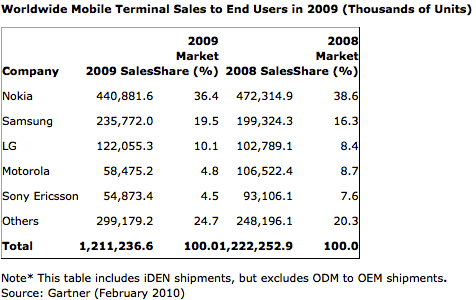
Nokia remains the market share force for all other handset competitors to reckon with. While Nokia lost market share in 2009, prospects are much better for 2010. Symbian OS smartphone share dropped from 52.4 percent to 46.9 percent on an increase of about 8 million more handsets sold than 2008.
"Symbian had become uncompetitive in recent years, but its market share, particularly on Nokia devices, is still strong," Cozza said in a statement. "If Symbian can use this momentum, it could return to positive growth." Much depends on the operating system's first, truly open-source version, Symbian^3, which the Symbian Foundation announced during Mobile World Congress.
"Nokia will face a tough first half of 2010 as improvement to Symbian and new products based on the Meego platform will not reach the market well before the second half of 2010," Milanesi warned. "Its very strong mid-tier portfolio will help it hold market share, but its ongoing weakness at the high end of the portfolio will hurt its share of market value."
Nokia stood out from nearly all other handset manufacturers during Mobile World Congress by not announcing a slew of new handsets. Still, Symbian^4 is expected to release by end of year. Both new Symbian versions will add functionality as much to mid-tier handsets as smartphones. Nokia sales may be weak in the United States, but they're strong in nearly every other region and across nearly every handset category.
I take a moment to focus on Nokia because of American blogger and journalist obsession with smartphones, particularly iPhone. In many regions of the wolrd, the cell phone is the first connected device that people own -- not a PC. In emerging markets, services like mobile money (and mobile banking) are transforming peoples' lives in meaningful ways. Application stores and touch-feely touchscreen features American bloggers and journalists coo so much about matter much less to people in emerging markets with more basic needs that a Symbian -- or even Android or Windows Mobile -- handset might better serve.
[Editor's Note: Paragraph inserted with percent change in smartphone OS market share and unit sales.]

You need to acknowledge that even though no devices exist, WP7 has captured the industry's mindshare. iPhone and Android is old school now.
As was Android this year, expect WP7 to be the fastest growing Smartphone OS in 2011.
Score: 0
|LOL, you made may day!
MS should not even be named in smartphones. It is included because it has a dominant position in other segments but they continue losing market share each day. And you say that a product which do not even exist from that company captured the industry mindshare? Sure...
They had to change its system name in order to continue selling some units due its terrible reliability and performance : Windows CE, Pocket PC, Windows Mobile (several versions each name), and now they want to use its 7 name (with good reputation on desktops) just trying to figure.
I like competition, I hope MS really make a decent product, but I will not hold my breath.
Score: 0
|App Stores and touchy-feely touchscreens matter less - hence even the touch-only Android handsets might serve them better. What?
The way i see it, feature phones and base handsets sold by Nokia and others might as well be snack sausages, fixed line phone handsets or romance novels - they are not in the same product category as the mobile computers a la N-series, RIM, iPhone, Windows Phone, etc...
These bloggers you refer to are presumably computer/gadget bloggers. Irrespective of of the country of residence, i'm not surprised they're about as excited about the volume of nokia 6000 series as they are about the sales volumes of snack sausages. (except when used as smartphone input devices)
Score: 0
|Count me in with that statistic. WM7-->Droid in November. It is unlikely I will go back to WM again.
Score: 0
|Poor old Motorola. At one time they were the #1 producer of TVs, then they blew that market by not moving from tubes to transistors fast enough. Now it looks like they've completely blown it in mobile phones as well. Wonder if the next set of market numbers will help them with their new Android phones, or if they will just be second fiddle to the Nexus One.
Score: 1
|The figures for Q1 2010 are going to be interesting when they are released in a few months. There has been a plethora of Android handsets coming onto the market, which will inflate Q1 sales. At the same time, it would not surprise me if sales of Windows Mobile phones crash dive, because of the showcasing of Microsoft's next mobile platform. A classic Osborne effect.
Score: 3
|@IT advisor I updated the post with percent change for market share and unit sales. Android share is up 680 percent. Take a look at paragraph four for whopping change in Android unit sales.
Score: 1
|Thanks Joe. I think you're the first one to publish the figures as a percentage change in market share, which is really the most important figure of all, as it shows how a platform is faring against the competition.
For me, the quarterly Gartner / Canalys smartphone figures are like football scores are to other people. It's always fascinating to see which platform is gaining, and which is losing. Pity it takes 3 months between updates (unless you pay to get the full Gartner stats).
Pity also about the negative reactions from people who's team (or smartphone platform) is declining. The story above is basically raw statistics, so people should not be offended, even if it presents undeniable evidence that their favorite platform is dying. The statistics present the reality of the situation, and should not be criticized.
Score: 0
|Geez, Joe,
This all looks like old news to us.
Personally, I was hoping you received a beta and had done some actual testing. At least you'd be reporting on news.
The fact that WP7 did not launch within your expected (or wanted) time frame is not terribly noteworthy. We all think we know how you feel about MS.
Long story short, it looks like Microsoft is not terribly worried about your opinion.
Score: 0
|Another market-share-by unit-sales-article? Ugh. Any chance someone has the smarts to figure out market share by revenue?
Also, if Gartner is looking at smartphone OS figures, what do they do with the iPod touch's 20+ million units sold in 2009? Wouldn't that put Apple in 2nd place?
Score: 0
|Hmm.. I thought this article was about "smartphone OS" figures. I didn't realize the iPod touch was a smartphone.
Score: 1
|I'm pretty sure the touch uses the iPhone OS, plus you can make phone calls on it. So that's why I'm wondering if it should count.
Score: -1
|"I'm pretty sure the touch uses the iPhone OS, plus you can make phone calls on it. So that's why I'm wondering if it should count"
LOL really? Is that a joke? I can make phone calls from my windows PC, should that count? My netbook can make phone calls, lets count that also...hm, now I'm wondering if all windows PCs should count, since hey, I'm pretty sure they run Windows, and you can make phone calls from them.
Score: 2
|Given that the iPhone OS is tied to Apple-only products, I can't see its star rising any further than it has without opening itself up to other carriers (as some have predicted, but has not yet happened). Even so, it's limited by the fact only Apple (or their rigorously licensed subsidiaries) can make Apple products and the iPhone OS can only go on an iPhone.
MS Mobile 7 and Android both are not tied to a particular phone or manufacturer, therefore have a much higher potential for acquiring market share. To predict a decline in the use of either is neither warranted or logical without actually having hands-on the OS to see what improvements have been (or not been) made. The MS Mobile OS line hasn't changed much in a year or two. Neither has the iPhone OS, which has given all the mobile OS developers and manufacturers time to look at what the market has and what it needs.
Android came out as the "latest thing" first. iPhones are still iPhones. The latest from MS is an unknown quality, but one can expect a boost in MS M7 OS-enabled phone sales since, at the very least, it will replace Mobile 6.5 as the only MS smartphone OS available. The same for Android - it's new, it's sexy and people want the new and sexy. MS M7 may not be the first choice of many users based on their past experiences with Microsoft Mobile OS's, but the dynamics of the marketplace dictate the sales.
My predictions: Apple OS will only grow as long as there are people buying more iPhones than not. MS Mobile 7 will grow, simply because it's new and potentially can be found on more carrier's phones. Android will grow for the same reason. Symbian will remain flat. In no case, despite the implications of the author in the article, will any of them just fade away for the foreseeable future.
Score: 0
|Apple is the only smartphone marker to win on interface. Because it was revolutionary compared to what went before.
It's a bit like the change in aircraft flight decks from thousands of buttons and gauges, to the 'glass c***pit' of a fly-by-wire aircraft, where there are only a couple of computer screens in front of the pilot, and most of the buttons have gone. The mega-button hardware phones were rendered obsolete by the iPhone, which was revolutionary when it debuted.
For other smartphone companies, creating a nice interface is not enough to win. Even if it matches iPhone. Look at Palm's webOS. Beautiful interface. But it's not winning. Many liked Zune's interface. But it did not win. Many liked the demo of Microsoft's Windows Phone 7 Series last week. But interface alone will not win it for them. They must compete on other fronts.
PS... can't believe the auto profanity censoring bot deleted the term most commonly used worldwide for an aircraft flight deck.
Score: 0
|The reasons the haters pile on WP7 is because Microsoft is so darn hateable, since their first reverse-engineered version of Windows, they've demonstrated that their only real skills are thievery, heavy-handed anti-competitive behavior, and simply being too damned rich to fail. If Windows Mobile had been the product of a start-up, that start up would have failed. Does anyone else roll their eyes when bloggers note that Mocrosoft is "taking cues" from the iPhone interface?
Score: -2
|Now that Windows 7 is a smashing success (with profit & numbers to show) Joe is on his newest blogging-for-dollars-spree... windows mobile bashing.
Check back late 2010 Joe as you will look pretty foolish when Windows Phone 7 ships on all carriers and sells well. Only a hater would fail to realize the potential WP7 has.
Discussing Nokia is both worthess and pointless in terms of developers and readers. That share has nowhere to go but down, down, down as more people use real smartphone.
Score: -1
|@chinch987 Actually, I've been harping on Microsoft's misguided mobile strategy for years.
Score: 0
|Well I do like android its already fragmented and confusing. Some phones only are going to go up to 1.6 and cannot use everything in the store. At this time there are 4 -5 different versions of Android out and its been out for a little over a year. This alone could frustrate buyers into trying other platforms rather then going with another version of android.
Score: 0
|I think the people who CARE will do the research to find out what phones will be upgradeable.
We all know that all it takes is a certain amt. of onboard memory for them to be practically forever upgradeable, until hardware changes drastically that is.
For now, it's safe to assume that as long as you stay away from the FIRST batch of Android devices, you'll be able to upgrade some way or another.
Primarily, the fragmentation right now is being caused by the Carriers and manufacturers, not Google. Manufacturers like Motorola and Samsung who add things to the Android UI and Carriers like Rogers who are lazy or probably want to be able to sell more recent and expensive android devices than say, the G1 which is aged but does take 1.6.
The Iphone, is the Iphone. You'll either love it, hate it or hack it and use it....which is pretty much what most users do.
WinMo may get the smackdown right now, but as soon as 7 comes and MS mobile division focuses on it, I think it will be as much of a contender as the others. Some people prefer the simplicity and transparency of WinMo and RIM phones - which don't as of right now REQUIRE internet connections to be even remotely usable. An Iphone or Android phone without a net' connection is cell phone, maybe mp3 player. A WinMo/RIM phone without a net' connection are still potent devices.
Score: 0
|@ Neoprimal
"The Iphone, is the Iphone. You'll either love it, hate it or hack it and use it....which is pretty much what most users do."
You don't really believe that do you?
Score: 0
|"You don't really believe that do you?"
Yes, except it SHOULD have read "which is pretty much what most user I know do"....so it probably threw it off a bit. And by that I mean I don't know a single person with a non-jailbroken IPhone, and I'm no social butterfly, but I do know quite a few people.
Score: 0
|

