Apple was NOT more profitable selling cell phones than Nokia in Q3
By Joe Wilcox | Published November 13, 2009, 10:35 PM
For days, I've read blogs and news stories misstating Apple's cell phone profitability compared to Nokia. Headlines range from the AppleBlog's "Apple Surpasses Nokia as Most Profitable Cell Phone Maker" to Reuters' "Apple tops phone chart as Nokia, Samsung step up" to Silicon Alley Insider's "Apple's iPhone Operating Profit Beats Nokia For The First Time," among, many, many others. As good as this feat sounds for Apple -- profit share beating market share -- every one of these stories is wrong. Right, everyone is wrong.
Three days ago, Strategy Analytics released report "Apple Becomes World's Most Profitable Handset Vendor in Q3 2009," written by Alexander Spektor. I contacted Spektor this morning for clarification on the report or for an actual copy. He hasn't yet responded. So I have to go by all the misreporting.
According to Telephony Online: "The firm estimates that Apple's iPhone operating profit came in at $1.6 billion in Q3, while Nokia recorded only $1.1 billion in operating profit." Reuters: "Apple does not unveil profits per business line, but Strategy Analytics estimated Apple's operating profit for its iPhone handset unit stood at $1.6 billion in the third quarter, compared with Nokia's $1.1 billion."
Well, hell, that sounds reasonable enough, right? Wrong. Apple and Nokia SEC filings tell a different story. Both companies announced third calendar quarter results a few days apart in mid October. For devices and services, Nokia reported profits of $785 million euros, which is about US $1.1 billion. Apple reported total profits -- that is for all products -- of $1.67 billion in its earnings press release, and later the 10-K filing. I searched the 10-K, and, as I expected, Apple doesn't breakout iPhone profits.
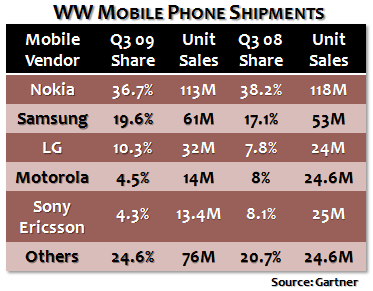
But it doesn't have to for purposes of this discussion. I don't doubt that Apple is more profitable per handset, since iPhone is a smartphone, than Nokia. But the numbers don't add up to Apple's overall handset profitability exceeding Nokia's during third quarter, unless someone is making the bold assumption that all, or nearly all, Apple profits came from iPhone. They surely do not. What? Apple made only $70 million on iPod, Macintosh, retail and software -- $1.6 billion -- on iPhone. No way.
The disturbing lack of fact checking seems to be a trend when it comes to Apple these days. One headline today about Gartner Q3 phone sales data claimed that Apple had closed in on Research in Motion. The reporter later changed the headline after I tweeted that the numbers show RIM extended its lead over Apple (see second chart).
Gartner reported that cell phone manufacturers sold 41 million smartphones during third quarter. Earlier this week, IDC reported that manufacturers shipped 43.3 million smartphones during the same time period. The nearly 2.4 million difference shows still historically low inventory levels -- even for Apple. Based on Gartner's numbers, Apple only had about 400,000 units unsold at the end of the quarter. During its October earnings call, Apple acknowledged that it couldn't ship enough iPhones to meet demand during third quarter.
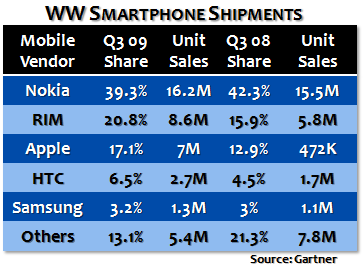
Gartner and IDC put Apple smartphone market share the same -- 17.1 percent -- but RIM's share was much higher based on actual sales: 20.8 percent compared to 19 percent as accounted by shipments. That made RIM's real-time market share even greater than Apple's during Q3.
As for Apple's overall phone profits being higher than Nokia's, don't believe it. Just because dozens of Websites report something as true doesn't make it so. Because of the extent of misreporting, I can't say where the fault lies. The Strategic Analytics report, which again I haven't seen, might have gone no further than present numbers showing that Apple makes more profit per phone than Nokia. That absolutely makes sense. But to assert that iPhone generated $1.6 billion profit during a quarter when all Apple products generated $1.67 billion is simple stupidity.
[Update:: That rascal (I'm being polite) John Gruber has flamed my analysis. Since Gruber doesn't take comments on his site, I'm put in position of defending the analysis here. Gruber uses Apple's non-GAAP (Generally Accepted Accounting Principles) like a club. I quite purposely did this analysis based on GAAP figures, because that's how Apple is required to report them. Of course, I was well aware of the non-GAAP figures, which would add more than $1 billion to Apple profit during third calendar quarter. But like it or not, that money is deferred over eight quarters.
I chose to use the GAAP figures because a) Again, that's what Apple is supposed to report; b) It made for a simpler analysis; c) Apple recognizes previously deferred revenue with the quarterly results; d) According to Apple SEC filings, deferred revenue is for more than just iPhone and Apple TV. The last two points are paramount.
The non-GAAP figure can include previously deferred revenue, which mixes monies taken in during the one quarter with revenue held back from an earlier time. Additionally, not all Apple's deferred revenue is from iPhone or Apple TV. For example, according to the October 2009 10-K filing: "For online sales to individuals, for some sales to education customers in the U.S., and for certain other sales, the Company defers recognition of revenue until the customer receives the product." The third quarter was a big one for Apple educational sales, which presumably includes accounting for rebates offered for iPod touch. Apple doesn't say how much non-iPhone revenue it deferred from third quarter, although that should become clearer when future results are announced.
The point, deferred revenue -- the non-GAAP results Gruber so gleefully trumpeted -- is not so cut-and-dried about iPhone or as explained by his simple math. Lots of companies defer subscription revenue, and that money is counted over time, whether or not Gruber or anyone else likes it. Contractual licensing accounts for 55 percent of Microsoft server software revenue, which must be deferred over 24 or 36 months. No reputable analyst firm compares Microsoft non-GAAP server profits to competitors' profits. But Mac enthusiasts and investors treat Apple differently, for reasons that should be obvious regarding the company's high-flying shares.
I stand by my GAAP analysis. It's the proper way to look at iPhone revenues/profits, for as long as Apple defers a portion of the product's revenue.]
[Update 2: On November 16th, I finally heard back from Strategy Analytics. As I expected, the figures stated for Apple were based on non-GAAP iPhone sales. Strategy Analytics calculated for operating profit, which would be higher than the net profit figures I used.]

@Joe
Your last post still doesn't mean anything, you're still dancing around the issue.
Saying Apple is not more profitable for handsets than Nokia is flat out wrong.
Take Apple's figures and compare then to Nokia's while showing Nokia's as 1/8th profit.
Compare Apples to Apples, not Nokia's FULL profit on handsets to Apple's 1/8th total of profits on handsets.
Really how hard is that to understand?
If I give you $10 cash in hand and I get $10 but put $8 in the bank leaving me with $2 cash in hand do you still have more money than me?
Score: 3
|Yah, these updates are an attempt to cover up with implausible "explanations", after the fact, that Joe just got it totally wrong.
A while back, Rob Enderle, got off this gem,
"It is interesting to note, that few seem to remember that Microsoft wrote the first MacOS under contract to Apple nearly two decades ago but, like most Apple partnerships, this one also ended badly." - Rob Enderle, September 26th, 2005
And then he posted multiple clarifications, each more hilarious than the last, "explaining" what he really meant. Didn't work, and he made himself look even worse.
The best thing to do when you get something howlingly, hilariously wrong, is to admit it and move on.
Joe, you should do what Rob failed to do; you'll ultimately be better for it.
Score: 1
|I notice that the most vehement attacks to this post come from readers who registered at Betanews over the past two days. Welcome! But may I ask? Are you regular readers of Daring Fireball, where John Gruber attacked this post, but provides no comments for rebuttal? Betanews provides place for your comments, in the spirit of the social Web. Many of you newcomers have used the comments to express a counter viewpoint. Thank you. Comments are here for you to do just that.
I've already stated in the two updates and in comments below my reasoning behind this post. Other than a gaffe over net and operating income -- which better supports the position stated in the post -- I stand by the GAAP interpretation of Apple's third calendar quarter iPhone sales. Apple defers iPhone profit over eight quarters plain, pure and simple.
One commenter said that "Joe doesn't like Apple." That's absolutely not true. I love Apple. I've used Apple products since carting an iMac out of a CompUSA in December 1998. But I don't like the seemingly one-sided tech blog and news site reporting about Apple. Apple is cut slack where few other tech companies are. The non-GAAP reporting of Apple iPhone profits as greater than Nokia handsets is but one of many, many examples. Strategy Analytics and John Gruber have taken a more generous non-GAAP interpretation. I deliberately chose the GAAP figures. To compare GAAP and non-GAAP is really to compare apples to oranges. Both forms of financial reporting offer insight into a company's financial performance. But only one, GAAP, measures actual profit taken in during any quarter. The standard during third calendar quarter was for Apple to defer revenue, and so profits, related to iPhone over eight quarters.
Apple isn't just successful because it develops/designs great products. Apple isn't just successful because CEO Steve Jobs has good taste, a rare quality. Apple is a well-run fiscal operation, too. Pricing is done in a way that preserves brand and margins over grabbing market share. It's a very conservative approach, actually. Fiscally conservative Apple also abides by other good accounting practices, and these include GAAP reporting. In the future, Apple will stop deferring revenue, in compliance with GAAP/non-GAAP accounting rule changes.
Apple's approach to the accounting change is conservative. During last month's earnings call, the CFO said the transition could take as much as a year. The approach makes clear that Apple's financial executives understand the risks, as well as the benefits, to changing the accounting methods. The new rules mean Apple can recognize all revenue/profits in any quarter; no deferral required. But today, I'll say yet again that Apple still measures profits by current GAAP rules, even when providing non-GAAP figures as another measurement of the company's performance. I took the same approach of looking at profits as they are actually reported.
By the way, Apple's conservative approach to accounting or offering any guidance to Wall Street analysts or the investment community is more than about being fiscally responsible or conservative. It reflects Apple's corporate culture of promising less and delivering more. It's a sound strategy.
Score: -2
|Hey Joe!
Good to hear that you like Apple - sorry if I misinterpreted your previous posts. But having said that, it seems to me that you are the one who is comparing GAAP (Apple) and non-GAAP (Nokia) numbers, not everyone else. You are comparing them to come to the conclusion that "Apple's (GAAP) iPhone profit is less than Nokia's (non-GAAP) profit".
Score: 1
|Still trying to dodge the criticism by moaning about Gruber's lack of comments? Anyone who reads Gruber knows and understands his policy about comment on DF. If you need to make a comment you have this site and the rest of the web, or you can, you know, call or email him.
Saying the same thing over and over and over, only more verbosely each time, isn't changing the fact that you are wrong.
Score: 1
|There's a reason why the GAAP rules have changed. Forcing companies to defer that revenue does not accurately reflect the profitability of the products or the state of the company's financial situation. In other words, this article intentionally obfuscates the matter using accounting that has been explicitly called into question as inaccurate in order to make its point. Yes, Apple is going to take a little bit of time to switch accounting-- it's a big deal to make that kind of change in a huge company. But to imply that Apple earned less profit last quarter than Nokia is just trying to split hairs. Yes, if you use out-dated GAAP accounting rules and ignore the real money flow, Apple was forced to report to the SEC that its quarterly profits were lower. But they ACTUALLY made more profit than Nokia, which is what the original report was trying to point out (if Apple's SEC report had said it, there would have bee no NEED for a separate report!) and why GAAP rules were changed.
In short, the money collected for iPhones minus the cost of development and manufacture is more for Apple than for Nokia. Which, regardless of the old GAAP rules that minimize the impact on this quarter's results, is a pretty stunning accomplishment for a company that's been in the cell phone business only a few years.
Score: 1
|This post is a very good example on how to lost credibility even with people that support you.
Score: 2
|OMFG. Stragey Analytics produces a report clearly stating that iPhone's OPERATING profits were greater than Nokia's operating profit, then Slow Joe contorts himself to point out how it's all wrong because Apple's GAAP revenues are less than its operating profits.
Then after the world laughs at his sheer jaw-dropping stupidity, he writes an update about how he was RIGHT THE WHOLE TIME because Strategy Analytics was reporting operating profits and not, ummm, operating profits like they said they were from the very beginning!
You could not make up how ludicrous the logic on display here. BetaNews is the laughing stock of the Internet for patronizing such sheer idiocy. Joe - please give us more! I want you to go on CNBC or Cramer and explain your idiotic theory of not comparing operating profit to operating profit and telling us how this is the right way to determine who made more money! Everyone loves to watch the class clown make a bigger fool of himself.
Go for it dude! Write Update 3 once again using the words, "I stand by my analysis!"
Score: 5
|Yes, as Alfiejr says, those updates are totally lame. The information that Strategy Analytics was calculating for operating profit, not net profit, was in the original news story on Reuters and a bazillion other places. That was not some secret information you had to contact Strategy Analytics to find out. Plenty of people have pointed it out (including in comments here), without needing any special access to Strategy Analytics.
Why don't you just admit you got it wrong and jumped the gun? Also, I notice you buried the update at the bottom of the post (rather than say in the headline--plenty of other sites do this when they make a mistake). Really, my respect and trust for Betanews has just disappeared. Not just because you made a very basic mistake and posted on a topic you don't really understand. But also because you're being dishonest and behaving like a child caught in a lie.
(By the way, I've never heard of John Gruber. It's easy to see the very basic mistake you made, without needing so called "Mac enthusiasts" to point it out, that's just another excuse on Betanews' part.)
Score: 4
|oh joe. if you had made clear in your initial post you understood the difference between GAPP and non-GAPP figures and discussed both, your update alibi might hold some water. but alas, it's a transparent dog-ate-my-non-GAPP-data post hoc attempt to weasel out of the fact you simply screwed up.
Score: 3
|The mere fact that the article title assertion was written is testimony to the force of nature the iPhone has become.
Score: 2
|Ok, so I looked through some of Joe's other posts and this all makes more sense — Joe just doesn't like Apple.
Moving on....
Score: 2
|Joe, let's make this VERY simple. If Apple could legally implement non-GAAP tomorrow or even simultaneously (which, of course, they are doing), and they used both methods of reporting, would one method show greater profits because they are not deferred? Yes. Would those profits be greater than Nokia's? Yes. Does how you write the math on paper change how many iPhone were sold or how much money Apple collected? No.
Can you agree to that?
Score: 3
|@Joe: To state that using GAAP vs. non-GAAP revenue numbers as the "proper" way to look at iPhone revenues vs. Nokia isn't necessarily true, and if anything it feels as though you continue to purposely avoid any sort of numbers which sway in AAPL's favor. I understand that you wanted to simplify the situation by using the GAAP revenue numbers vs. non-GAAP, however, most wall st. investors and analysts are more concerned about non-GAAP revenues rather than their GAAP counterparts as a fair measurement of "apples-to-apples" between different companies. I don't understand why you have such an inherent bias against AAPL but I feel as though this article (and most your previous ones regarding AAPL) carries the same stubborn, uninformed, and ignorant tone as the Fox New Network and it's affiliated shows (Bill O'Reily especially). All I'm saying is I think you should give credit when credit is due, and for AAPL, it's been long overdue from you.
Score: 3
|@Joe. This is becoming embarrassing now!
"That's not the analogy I would use. For tax purposes, the money isn't recorded UNTIL RECEIVED. If you DON'T HAVE THE MONEY, you DON'T HAVE THE MONEY." (emphasis mine!)
Who's got the money then Joe? AT&T? Or maybe O2 or Orange or T-Mobile? Or is it the taxman, or the government? Or maybe the CIA or Lehman Brothers?
Apple's got the money!
May be they have to chop it up into eight little pieces... for their spreadsheet, but they HAVE GOT the money.
In the words of the bard... "Show me the money.... Joe"
Score: 4
|So you want to compare Nokia numbers (which include full price of the phones for the quarter) to Apple's (only counting 1/8th of the full price of the phones for the quarter)
Why do you find it so hard to agree that Apple made more money off iPhones in Q3 that Nokia did?
Stubborn hater? just eat crow and be done with it...
Score: 4
|Simply because..he would admit that he made a big mistake.
The choice is simple:
1) JW continues to go after what he wrote. In that case it will be even more embarassing.
2) JW admits that he was wrong.
He doesn't want to admit it. I don't want to defend Apple at all but sometimes things are SO clear...
Score: 3
|Actually Joe,- there is no question of counting money twice. These are financial statements we are talking about, not back of the napkin maths. The non-GAAP numbers relate solely to sales made in the quarter. Income previously deferred from prior quarters is stripped out - otherwise Apple themselves would be double counting as they provide non-GAAP every quarter.
The footnotes of the numbers clearly state this:
"non-GAAP adjustment to net sales reflect (i) the reversal of the current periods amortization of deferred income derived from iPhone handsets and Apple TV units shipped in current or prior periods"
Given that they also quote non-GAAP earnings per share it's fairly obvious that these adjustments are provided to show a snapshot of the "real" performance of the business during the quarter, minus the subscription accounting..
As i've said from the start, there is a reason why Apple has an extra $20BN in the bank in cold hard cash since the launch of the iPhone just over 2 years ago. It's money from their iPhone business that has kind of gone under the radar due to their adoption of subscription accounting. They still earned this money. It isn't dependent on a user maintaining a contract - it's revenue. And as such it must be considered when trying to estimate how profitable the business is at selling phones.
Score: 3
|This discussion is moot. GAAP rules were just changed to allow Apple to account for all the iPhone money up front, so sometime soon the iPhone's true profitability will be able to be accounted for as simplistic analyses like Joe's expect. To wit, the money received under the "subscription" model is money in the bank, not subject to any risk, and simply doled out over time. It's profit that Apple has locked in but not granted themselves yet. So Apple is definitely making more profit from ongoing sales of its phones than Nokia, but it's deferring the profit. That's very different from not being as profitable.
Since many analysts take a simplistic view like Joe, though, I would expect a jump in stock price now that the GAAP rules have changed and Apple will soon be eliminating the subscription accounting.
Score: 3
|Right. It raises the question of whether the stock price has already factored in the princely sums of money the iPhone business is raking in right now. Given they have $35bn in the bank on a market cap of $185bn (so cash is about $40 of their stock price), and analysts/bloggers continually getting this stuff wrong i'd say almost certainly not. BUY.
Score: 2
|The fact that with two updates you STILL haven't fixed your bad math of 700,000 (when it's really $70 million) speaks volumes. Of course that number doesn't mean anything anyway, since you are trumpeting the difference between two numbers which are not comparable; apples and oranges, if you will.
To assert that Apple made less money than Nokia by ignoring the fact that Apple uses subscription accounting for the iPhone and does not put complete profits on paper when the phone is sold (even though they actually have all of that money in the bank), is simple stupidity.
Score: 2
|@ V-Train It's fixed and should have been earlier.
Score: -2
|but you have to fix all post.
Everyone (fanboys or not) here said that Gruber is right.
Score: 3
|@Joe
"I stand by my GAAP analysis. It's the proper way to look at iPhone revenues/profits, for as long as Apple defers a portion of the product's revenue."
That's all well and good, but the whole GAAP thing is still just an accounting technicality.There is, simply, nothing wrong with Strategy Analytics trying to estimate the REAL amount of money received by Apple and Nokia.
Apple still SOLD those iPhones. Their results might only show the revenue for (approximately) 4 million iPhones (sold prior to the quarter), but that leaves around 3.4 million phones in deferred dollars.
I hate analogies... but here goes!
Say one of your Beta News blogger colleagues gets paid $160 dollars for his work. He HAS that money, but must account for it over a 2 year period.
You Joe, get paid $110 dollars for your work and have to account for it in a similar way.
Who made the most money?
Score: 1
|@Piot That's not the analogy I would use. For tax purposes, the money isn't recorded until received. If you don't have the money, you don't have the money. Being paid $160 now is money in hand. That's profit now. Recognizing that money over 2 years is $6.66 a month.
You say that "there is, simply, nothing wrong with Strategy Analytics trying to estimate the REAL amount of money received by Apple and Nokia." But the report's title is: "Apple Becomes World's Most Profitable Handset Vendor in Q3 2009." That's simply not true, because on a GAAP basis Apple spreads the revenue -- and so profit -- over 24 months.
Score: -2
|The fact that Apple reports it over 2 years does not change the fact that in reality, Apple already has ALL of the profit. The money is in the bank, gathering interest. The profit is already made, it just isn't all accounted for in the quarterly earnings.
So yes, it is true that Apple is more profitable, because they have ALL of the profit in their possession.
Score: 2
|Dang it, why won't Apple get out of your way, Joe, so you can finally be right about something?
In your April 14 eWeek blog entry, your thesis was "Apple's success is more about perception than reality." And then you delineated your keen observations that other analysts missed:
- "Apple's Mac business in in trouble."
- "I can't fathom what [about the iPhone] Wall Street is excited about. "iPhone is an ant to Nokia."
- "Microsoft is advertising—and doing it right."
- " Where is Mac OS X Snow Leopard. The earliest Apple could now release it is concurrent with Windows 7."
- "Big Mac sales are no longer sustainable. The economy is too bad, Apple pricing is too high."
You've been off the mark on Apple for so long, and you've pushing Nokia (over iPhone) for so long, that this latest mess you've created seems inevitable.
Score: 2
|I love commenters who do research!
Score: 4
|Thank you Joe..!
I'm so glad there's people like you out there to set the record straight. These Apple fanboys think that the company can do no wrong.
I'm dumping all my AAPL stock right now. They've ridden this false story to an all-time stock price high. That can't last once the real financial powerhouses read your report, so I'm getting out now. They shouldn't be allowed to do that sneaky accounting trick of hiding some of their profits in the future. That's just not fair. If they're going to defer it, we should gladly ignore it. There's no way they're as profitable as they seem.
Score: -2
|Mr. Wilcox,
"I quite purposely did this analysis based on GAAP figures, because that's how Apple is required to report them."
This seems demonstrably defensive in attitude, with little regard to facts. Your statement of:
"Contractual licensing accounts for 55 percent of Microsoft server software revenue, which must be deferred over 24 or 36 months. No reputable analyst firm compares Microsoft non-GAAP server profits to competitors' profits."
is silly, as even your own reporting acknowledges and discusses this accounting model:
http://www.betanews.com/...ls-divisions/1248988195
Certainly you point it out, but it's very clear you did a strong disservice to not mention that you were looking at only GAAP figures for this article, without even a passing glance at the non-GAAP numbers. Assuming you're not lying, and you in fact did purposely ignore non-GAAP, comparing 2 companies profits that have highly different accounting models than each other is a horrible way to run a rant piece against one's profitability vs. the other--it's clear that it's more complicated than a simple "NOT" more profitable.
If you and me opened up lemonade stands and you accounted for all your sales immediately and I accounted for mine over 12 months, if you sold 100 cups of lemonade at $5 and I sold 10 cups of lemonade at $120, if we looked only at the initial taking in sales, you're absolutely right. You made $500, and I only made $100. But a year later, I'm pretty sure I'll be a lot happier with $1,200 in my pocket.
Score: 2
|@landoke I'll use a different analogy. If you buy 100 Apple shares at $100 one day and the stock rises to $150 the next day, on paper you technically made $5,000. But that's really money in the bank. It's an asset. You don't realize that money as a capital gain -- and thus pay taxes on it -- until you sell the shares. Likewise, Apple has increased its assets -- deferred revenue from iPhone sales -- for future profits. But they're not profits today. Something else: Looking at the non-GAAP results could mix current profit with deferred revenue. It's like counting the money twice, which isn't good accounting. I've gotten first response from Strategy Analytics, and I'm expecting another to clarify how it calculated iPhone profit.
Score: 0
|Of course they are profits today! Apple has been paid all of the money for the phones, they're not getting paid over time (anymore). Your analogy is not comparable. The person who buys Apple stock could lose everything the next day if the stock drops. Apple has all of the profit for the phone up front, they just don't put all of it on the financial reports right away.
Score: 3
|Joe, you analogy is invalid.
You say that you don't realize the money until it's sold with your Apple stock, which is true. In that case, the profit is not a profit until the stock is sold and the money is deposited in the bank.
However, in the deferred revenue case, the money is real and already sitting in the bank. Apple's deferred revenue is not money that will arrive some time in the future, and is subject to risk such as ATT going out of business before paying Apple. It's cold hard cash in a giant safe that SJ swims in.
Score: 3
|Mr. Wilcox,
I appreciate that you are using GAAP as a method for analysis and, by that measure, you are sticking to your assertion that Nokia earns more profit off of mobile devices than does Apple. You, too, are using GAAP as a club, but I understand why.
I assert that you, as an analyst and a technology writer, are doing your readers a disservice by "sticking to your guns" and trying to be "right" and, thereby, missing the amazing angle of this story.
You have gone for the "close reading" defense of your piece. What's more, your initial assessment did nothing to try to figure out what the real numbers would be according to GAAP. You simply backed out the Strategy Analytics-reported figure from the profit Apple reported and said that it wasn't feasible, while failing to mention the apparent difference (is there a difference?) in accounting reporting between the two companies.
Why, in this world where "disturbing lack of fact checking seems to be a trend when it comes to Apple these days" didn't you do some work and figure out an analysis based entirely on GAAP?
If the question was asked "without regard to finance reporting rules, who shoveled more cash into their coffers last quarter from the sale of mobile devices: Nokia or Apple?" -- you know what the answer would be. At least I have an assumption based on the reporting I've seen. Your reporting, however, did nothing to help anybody curious about the topic to learn anything.
Score: 6
|I argue that even the $1.6B is too low. It's closer to $2B. Here is a walk-thru of iPhone profitability analysis.
http://docs.google.com/D...gwM3M2emJ4Y2s&hl=en
Score: 6
|Impressive, thanks.
Score: 0
|Joe, by your own admission, you do not know how Strategic Analytics arrived at their claim. And apparently, you couldn’t wait more than a few hours for them to get back to you.
Still, you claim that their conclusion must be wrong. How to you come to that believe? By comparing two numbers that cannot be compared (presenting, as they do, the same reality in two different ways).
Furthermore, you seem to have difficulty with the facts underlying these numbers (it is at least misleading that Apple “is supposed to“, as you claim, use deferred accounting) as well as the numbers themselves (1.67 billion minus 1.6 billion is 70 million, not 700,000).
You ignore Gruber‘s plausibility check based on number of iPhones sold and average profitability (repeated by smartenupnas below) which arrives at the same conclusion as the Strategic Analytics report.
And yet, you urge us to believe you, because you must be right.
Regards
Score: 5
|Great article Joe, keep up the good work.
However, I do think it's a bit foolhardy to respond to someone like Gruber... I mean what's next, are you going to refute Dilger if he heaps you in with Enderle as "birds of a feather" again? :)
Those guys are an embarrassment to your average Apple fan / general IT enthusiast like myself; for god's sake please don't give them more air time!
Score: -5
|Sorry Joe, your update does nothing to change the fact you are wrong on this one.
The fact that you didn't even mention GAAP reporting in the original post yet tried to dismiss the analysts findings by saying "Apple made only $700,000 on iPod, Macintosh, retail and software -- $1.6 billion -- on iPhone. No way." shows you had no idea at the time that Apple uses subscription accounting for the iPhone. To come away now waving the "I knew all along" flag damages your credibility.
The numbers speak for themselves. 7.4M units sold with an average selling price according to Apple of "a little over $600". Combining this knowledge with the known margins for it's Mac and iPod lines, it is without question that their profit for the iPhone was around the $1.4-1.6bn region.
After looking at both Apples and Nokias latest filings in detail, I am certain that Apple was more profitable selling phones last quarter. No differences of accounting standards to hide or miss the point - put simply, Apple made more money after deducting costs from selling phones between July and September than Nokia.
I say this as an accountant who regularly prepares the financial statements using IFRS. So I hope my credentials are satisfactory.
Score: 6
|@smartenupnas I've written a number of stories about subscription accounting, as well as covered Apple earnings. Here's one:http://www.betanews.com/joewilcox/article/Accounting-rules-shouldnt-change-to-benefit-Apple-other-hightech-companies/1253649045. I'm well aware of the subscription accounting rules, which is the major reason I looked at the GAAP figures as reported. Looking at non-GAAP results can mix current quarter revenue with revenue deferred from previous quarters.It's one reason for Apple to not rush to adopting new accounting rules. The company has indicated the transition could take as much as a year.
Score: -3
|No no. You "choose the GAAP figures" simply because YOU ARE WRONG.
John Gruber DEMONSTRATES it (I use caps lock as you do). And he's rights, he report facts and real good numbers. You are only pushed to want describe Apple in a bad way. That's the true. iPhone is gonna embarassing you for how well its sells.
EPIC FAIL by Joe Wilcox.
Oh: written from my iPhone.
Score: 4
|Joe, what I don't understand is the purpose of all the hand waving. If you include deferred revenue, which Nokia doesn't do, it's probably accurate -- even if you don't, it's still pretty close. And, again, this is comparing a company that created the market and has 35% of the market and Apple who has been in the business a couple of years with 2.5% of the market.
So... is the point merely to dismiss other bloggers who more willingly accepted the numbers (unlikely considering your ponderous but thin examination of the numbers that actually make you look more laughable then bloggers who said "according to one analysts firm") or is your point that Apple isn't insanely profitable in the phone market and taking names? Because, in that case, when Apple does blow past Nokia next quarter, you'll likewise be looking pretty foolish.
And, sorry, but of course you have to account for deferred revenue. I have NEVER seen an analyst dismiss half of Microsoft's server revenue. You're just throwing that pathetic defense out there hoping no one checks up on it.
Score: 4
|Whilst use of GAAP "made for a simpler analysis", simplicity by omission is exactly what the author was arguing against.
In an article who's principle gripe is lack of fact checking by "reporters" and the paucity of definition of facts (shipped Vs sold), this author should have specifically highlighted his use of GAAP only numbers in the first place.
He now looks foolish and defensive.
Gr@wl!x.
Score: 5
|It's funny what people will argue about. Is there someone in this forum whose life will be impacted in the least by whether or not Apple or Nokia was more profitable in the cel market for the 3rd quarter of this year? It's not going to change which phone I use.
Meanwhile, Jobs and the CEO at Nokia are pulling gobs more G's down than anyone hangin around here, myself included.
Score: -4
|I do not care about the numbers, all I want is a reliable working phone.
Score: -1
|Hey Joe, this is by far the worst effort I have read so far at trying to discredit Apple and its success.
I even registered just so I could say so. Looks like you are the one that needs to do more fact checking chief.
Score: 2
|It still amazes me that people take this as an attack at Apple.
The reality is, no matter what you think of the iPhone, it is a very tiny fraction of the Cell Phone market.
Score: -2
|@Harry Taint Because?
I calculated numbers based on GAAP and IFRS basis, as they were reported.
Score: -4
|@joewilcox
Apple success, lies in this earth's life... and its inevitable!
iPhone will be the only phone, the ONLY phone. Becoz theres no phone that has a longer life than iPhone
You should get an iPhone Joey, then you wont be in the losing side! :)
http://store.apple.com/us
Score: -4
|Wow! that's amazing
gagandeep singh
site: http://www.get1stuff.com
Score: -5
|When choosing Prom Dresses, you would be best starting off with the style and color. It is very important to choose Prom Dresses you like. The style of the Prom Dresses you choose should suit your personality.
The prom is the biggest event in any teenager's life. It is the time of extravagance, which is exceeded only by a wedding ceremony. Most teenage girls would not hesitate to spend a fortune on Prom Dresses because they want to feel special and to leave a lifelong impression on their friends.
Prom Dresses are generally formal party gowns, long and delicately stunning. There is no conventional way to define the “best Prom Dress”. It is the one that would make you feel beautiful and convey the right image-sweet, innocent, sexy or simply stunning.
Planning for the prom starts weeks in advance with a search for the dress, taking into account material, color and of course, the shoes. The final effect has to be as stunning and even as sexy as possible. The most popular sexy prom dresses are satin, sequined, vintage and the little black Prom Dresses as well as the hanky hem, the short and spicy prom dress and the classic Cinderella ball gown.
As fashion and styles continually change, Prom Dresses likewise adapt to fit growing trends. A fast growing trend in dress fashion is modesty. For many, finding a modest Prom Dress has been difficult in the past.
Prom Dress are a much-anticipated indulgence. With all the importance given to glamour in prom parties, designers are vying to provide the hottest and most sought after designs for young women who want to make a splash.
For all formal and semi-formal occasions, a woman must wear a Wedding Dresses. But which c***tail Dresses to use? Prom Dresses
Plus Size Wedding Dresses
Wedding Dresses. c***tail Dresses
Score: -7
|Is that surprising? Apple benefits from a horde of zealots in the media to spread propaganda. And Apple doesn't even have to pay most of them because favorable stories about America's darling company attract page views and attention.
Remember that ridiculous stat about Apple having 91% of market for $1000+ PCs? Pretty much every media entities regurgitated this "news" without questioning the numbers, the context, the survey methodology, etc. A little inspection of the worldwide PC shipment and Macs shipment and it becomes clear the 91% is total BS. But sheeps don't care as long as they hear what they want to hear.
Score: -5
|Actually, that stat is accurate. It was you who was too lazy to read and see that the stat was for US RETAIL. Just because you foolishly skim over things doesn't make everyone else a fool.
Score: 3
|Joe, you're comparing Apple's total NET PROFIT for Q3 to Strategy Analytic's estimate of Apple's OPERATING PROFIT on the iPhone for Q3. Those are two different things. Maybe before you jump down other people's throats for make what you think is a mistake, you shouldn't make such a basic mistake yourself.
Score: 2
|Piot, the answer is no. The facts speak for themselves - Apple is the most profitable mobile phone manufacturer in the world right now.
Score: 3
|@Joe "Apple deferred the revenue, as did Nokia,"
Joe, do you know what revenue Nokia deferred? Do they defer, nearly 90% of the revenue from all of their handsets... like Apple does? It's really not very clear from their financial statements.
Score: 2
|I get it, you aren't big on Apple, that's fine, but at least have some kind of concrete facts before you go blabbing this kind of mindless crap. Apple actually made 3.85bn this quarter, the 1.6bn was subscription revenue. I have always thought of betanews as a reputable news source for tech, but this finally killed it for me. I am so sick of reading these kind of articles from this site. I have been a loyal betanews reader for years, and am now through, this idiocy is the straw that broke this camel's back.
Score: 7
|Joe, glad to see your unusual fact checking (and brilliantly simple - from reading your post one understands most it took is to look SEC filings). That you still are the lone voice on this makes one wonder if Nokia have any communications or PR department at all.
Score: -3
|at her date will have worn the same Prom Dresses is reduced. The probability can even be reduced further if you buy a corsage and the guy matching boutonnieres. Guys aren't that selective and tend to stick to a particular pattern. So make sure he matches you.
Score: -9
|The beads can be special shiny stone or crystals. Avoid the long [a/]http://www.promdressonsales.com]Prom Dresses[/a] with tail as these will negate what you have been trying to do: to look shorter.
Score: -10
|forward Prom Dresses than ever so you will have a fabulous time editing your prom selections.
Score: -9
|Nokia is going to become the Naked Empire!!
Score: -3
|Looks like Nokia is on their last leg, not surprisingly we will see the new champ crushes Nokia!
Nokia for making garbage, i've 3 Nokia in the past... all 3 phone very similar, just different shape/size and color
Nokia next step, making laptop... LOL!!!!!!!1
Score: -5
|No Joe, it's you who hasn't done their homework on this.
Apple's non-GAAP net profit for the quarter was 2.85BN. The 1.6BN is if you use the subscription model for their iPhone sales. That is, only 1/8th of their iPhone sales were recognised in this quarters filings. The other 7/8ths were deferred. Apple clearly provide both GAAP and non-GAAP numbers. The analyst was using the non-GAAP numbers, which are a much clearer reflection of how profitable Apple was in the quarter.
Apple's ASP for iPhones during the quarter was over $600, given the stated $4.5BN in revenue they made from iPhones. If we assume a 35% margin on those 7M+ units sold, then you have your 1.6BN that the analysts estimated.
Score: 8
|@smartenupas Right. Apple deferred the revenue, as did Nokia, which reports on a comparable IFRS and non-IFRS basis. I made an, ah apples to apples comparison.
Score: -2
|Ok then 3.05 Million Macs + 10.2 Million iPods only made them 1.2BN how that adds up? May be it makes sense but still overlery too Super ego seeking analyst I think.
Score: -1
|The same quarter 2 years ago, Apple sold 2m Macs and 10m iPods, yet *only* made 400m in profits. The numbers are all there in the filings. Read them. It's perfectly rational to assume iPhone profit is well over a billion given the evidence. There is a reason their cash piles have gone from 15bn to 35bn in 2 years. It is an enormous cash cow and the world won't fully realise until next FY when they move away from the subscription model for recognising iPhone revenue.
But let's break it down further:
ASP for iPods is only about $150. So 10M of those sold is far far less revenue than 7.4m @ $600. The Mac has an ASP of $1,300 but the margins on their computers are much less than those of the phone due to the hefty subsidy the carrier pays (the 32GB Touch sells for $299 and you can assume Apple makes a profit on that so the margins on the iPhone must be huge).
But it's easy to write all of this evidence off as Mac egos, fanboys and the like.
Score: 6
|Nokia didn't defer revenue as it doesn't use subscription accounting like Apple does.
Score: 7
|What is amazing is that you are trying to deflect the point that you entirely missed the point about Apple reporting GAAP and non-GAAP revenue and that virtually the entire difference is due to the subscription accounting method that currently requires them to defer iPhone revenue over 24 months. And this is not some aggressive form of non-GAAP accounting -- Apple has said they have to present their GAAP results in the future as mandated by FASB, by the latest as of Q1 FY11 (but then can drop the subscription method accounting method earlier if they wish).
So @smartenupas and @turleymuller were dead right. Nokia doesn't even list any deferred revenue on their balance sheet so its likely immaterial. The $1.6bn seems pretty accurate and hence Apple is hands more profitable than Nokia in phones.
You should at least just admit that you missed this and not attempt the lame deflection that you did. The whole article was about how Apple was not more profitable than Nokia in phones and they are and how other's hadn't done their fact checking, when in fact it was you who didn't.
You can of course just say nothing (or attempt another lame deflection) and let it be known that you don't have any integrity or credibility.
Score: 7
|So Apple report the whole value of iPhone that sells on 2 years contract in the quarter gone so will they expected to keep selling same levels every comming quarters. Also Main market is US I can't them selling at the same price in asia? I do like apple products and own itouch but their mobiles are far too expensive and not been available on my network. I thin when I had quick look each time they bring a new model their sales went so much in that Quarter then it drop back to Normal levels.
Score: 0
|What revenue did Nokia defer, Joe?
Score: 1
|good thinking joe. just one problem - apple reported net profit of 1.67 bln, number you compare with operating profit estimate of 1.6 bln.....
agree most news on web are wrong on this topic - apple has been more profitable phone maker than Nokia since mid-2007. their profit margin from phones (profitability) has always been higher due to focus on highend.
Score: 2
|For the Sake of Argument. Nokia dont earn 1.1 Billion solely on Mobile Phones as well. While the "news" Apple is more profitable handset maker then Nokia may not be true. Nokia Siemens Networks, a Join Venture makes over 30Billion Revenue / year. Even at 50/50 split for accounting purpose, that is 15 Billion Revenue / year. I dont have exact value, but even at 10% profit margin that would account to 400M per Quarter. Subtracting off, Nokia may be only making 700M from Mobile Phones.
Ofcoz, this is an estimate, if Apple manage to make 50% of profits from iPhone, they will still be the most profitable Handset maker.
Although i doubt it is as high as 50%, i guess 30%+ isn't far off.
Score: -2
|iwod, NSN made a loss of about 1,1Bn and Nokia made 785M on devices.
http://www.nokia.com/abo...ual-information/q3-2009
Score: 1
|@iwod I did an apples to apples comparison -- or handsets to handsets. Nokia devices and services is comparable Apple's iPhone and services.
Score: -1
|I have tried time and again to track down misinformation, propaganda and lies online...and maybe one out of ten times I actually hit pay dirt. Anyone with a domain name can say anything they want and call it news. When that's happening in real-time the temptation to be first with a story often outweighs the need to verify information. Unfortunately this isn't limited to the internet - TV news is nearly as bad these days, esp. since networks are competing with online journalism as well as each other. News sites and channels quote seemingly respectable sources who have gotten their facts from less trustworthy ones..and there may be a whole chain of them. Even in print media this seems to be a growing trend. I actually forced a local paper to post a retraction about something this past spring when I proved their facts were completely wrong. I have friends who've worked for local TV and print who tell me straight-faced that about half the stories include fabricated quotes and other information - " not being able to disprove something is as good as having it proven. Besides, its mostly entertainment anyway," as one such acquaintance told me. If this is the norm with traditional media I can only assume that the internet is ten times worse. In small towns its sometimes hard to get away with this kind of thing because everyone knows everyone. In big cites you have multiple media outlets in fierce competition who will call each other out. The real problem is in small to mid-size cities, esp. if they also happen to be state capitols (Columbus, OH for example). You tend to have a population just big enough that nobody ever runs into the editor of the local paper at 7-11 where they can tell him he got a story wrong. If such a town is a county seat or state capitol it can get really bad, with local media hand-in-hand with influential businesspeople or politicians.
Score: -1
|Nice work Joe. I commented about this stupidity on Twitter today. Not sure who listened.
Clearly Apple is hurting Nokia, NOKIA is hurting NOKIA. But Mot, Palm and Microsoft mobile are in far worst shape.
Score: -1
|Joe,
I'm sorry but Apple stated on it's earnings call that the sales value iPhones sold was over $4.5B. Apple uses subscription accounting and spreads revenue over 24 months. Therefore, what was reported in the SEC filings represents GAAP accounting and not actual cash accounting.
Without the subscription accounting, Apple's operating income was $3.8B.
I think you are the one who hasn't done his homework and is misreporting.
Score: 4
|Joe, you're comparing Apple's total NET PROFIT for Q3 to Strategy Analytic's estimate of Apple's OPERATING PROFIT on the iPhone for Q3. Those are two different things. Maybe before you jump down other people's throats for make what you think is a mistake, you shouldn't make such a basic mistake yourself.
Score: 5
|Hey Joe!
Subscription Accounting! (look it up)
Because Apple uses GAAP Subscription Accounting for the iPhone and Apple TV they spread the earnings from those two devices across 8 quarters. So the $1.6B of profit only includes 1/8th of the profit from their iPhones and Apple TVs.
Score: 3
|Wow, Joe. You're wrong, completely wrong, one hundred percent wrong. Several people posting here, Gruber over at DF, and several other web denizens have point out your obvious mistake regarding Apple's reporting.
Are you going to have some integrity now and correct it?
Apple is absolutely, positively more profitable than Nokia in just the way SA said they are.
Do the right thing, Joe. I'm disappointed that it has taken you this long.
Score: 3
|@mattjumbo I looked at the numbers as reported on a GAAP basis, which for third calendar quarter was how it's still done. Other companies defer revenue, too, and profitability also is measured based on what the company reports for the quarter. For example, Microsoft Office or Windows Server profitability is rightly measured based on current quarter, not what is deferred on a non-GAAP basis. For Microsoft Server products, as much as 55 percent of revenue comes from contractual licenses that must be deferred.
It's clean and simple that way, looking at GAAP. Mixing GAAP and non-GAAP also introduces revenue/profit previously reported and deferred. A portion of the iPhone revenue/profits realized by Apple in third quarter carried forward from previously deferred revenue. So the numbers aren't as cut and dried as Gruber claims. Previously deferred revenue realized as real revenue also affects calculations for average selling prices and such. I tried to keep the discussion simple, rather than add these complicated nuances.
Score: -4
|Joe - At this late date your best move would be to change your name and move to Cuba. Let your hair grow, let your beard grow, and get a very deep tan. Gain 40 or 50 pounds. Wear a hat at all times. Then you should be able to go incognito and avoid further embarrassment over this woefully error filled article. Also repeat after me 500 times: "I promise I will not spout off when I have absolutely no idea what I'm talking about."
Score: 4
|It's really very simple based on Apples Q4 report: they sold 7.4mm iphones at an average price of about $600 per unit. this means iphone rev=$4.4bn. Apply Apple's reported profit margin of 36%, you get $1.6bn net cash profit from iphones in Q4. You are wrong and you should correct yourself.
Score: 3
|If you want to make an analysis using non GAAP numbers and write an article explaining that GAAP exists for a reason, and that using non-GAAP numbers wrecks the whole system, that would have been a totally fair article.
But I don't see how you can reconcile these two claims:
"Because of the extent of misreporting, I can't say where the fault lies."
"Of course, I was well aware of the non-GAAP figures, which would add more than $1 billion to Apple profit during third calendar quarter"
Score: 2
|@jz Apple shipped 7.4 million phones, but, according to Gartner, sold 7 million. Also the gross margin was 36 percent for fiscal 2009 and 36.6 percent for fourth quarter. Just for clarification, the higher gross margin actually works better for your assertion.
I based the analysis on Apple's recognized revenue for the quarter -- that is on a GAAP basis. GAAP and non-GAAP really is an apples and oranges comparison. I deliberately chose to look at the figures on a GAAP basis. Apple didn't recognize the higher profit you assert in third calendar quarter. Maybe a year from now, Apple will no longer defer iPhone revenue, because the accounting rules are changing. But for now, that's not how Apple recognizes iPhone revenue. That's deferred revenue to be recognized in future quarters. You can't call profit something you can't recognize as profit on the books now.
Score: -3
|@davesmall Profit is what you can report as profit, which I explain in the update. There's nothing wrong with the analysis when looking at the numbers on a GAAP basis, which is how Apple must recognize profits from iPhone and other products. I'm not sweating the John Gruber attack, although his hit-and-run tactics without comments for defense is disturbing. He has one voice for which there is no rebuttal.
Score: -2
|@joewilcox: Your last rebuttal argument holds no weight at all. The rather glib comment "I tried to keep the discussion simple, rather than add these complicated nuances" makes no sense when these "nuances" can completely change the conclusion.
At the heart of the matter, the problem is that Nokia and Apple report their financial results in different ways, making it difficult to do a fair straightforward comparison. Now, you yourself have argued that apples should not be compared to oranges, implying like should be compared to like. Surely it follows from this logic that one should try to "correct" the headline financial figures provided by both Apple and Nokia, and normalize them to the same standard so that a fair comparison can be made. The question is not whether a correction should be made at all, but how to correct the figures to yield the fairest, most insightful comparison. In other words, the goal of Strategy Analytics was to derive a comparative yardstick of the profitability of Apple and Nokia as mobile telecommunications device manufacturers.
Now based on the links you yourself provided in your article (including Nokia's own balance sheet), it appears that Nokia does not defer revenue when reporting its financial results. On the other hand, Apple reports both GAAP and non-GAAP measures. If like is being compared to like, then it follows the closest comparison would be to compare Nokia's profit (which is effectively non-GAAP) with Apple's non-GAAP profit (see the caveat below however). On this comparison, there is little doubt that Apple is more profitable than Nokia by a significant margin.
I note in passing one of your earlier comments - Apple's calculated profit does depend on whether one uses the figure of 7.4 million iPhones shipped, or 7 million iPhones sold, or a gross margin of 36.6% or 36%. But in contradistinction to your earlier use of the word, these really are "nuances" and not important in the context of your analysis; the difference in profitability is so large that the qualitative conclusion is unchanged irrespective of the exact figures chosen.
Regarding your comment "you can't call profit something you can't recognise as profit on the books now", you would have a point except that since June 2008, Apple has received its cash payment from AT&T upfront; it no longer uses a monthly revenue sharing model. Thus, this deferred revenue is, in reality, "money in the bank". This further makes the point that Nokia's single profit figure should most closely be compared to Apple's non-GAAP profit. John Gruber has ably highlighted this by pointing out the huge growth in Apple's cash horde of $21 billion in the last three years; without the iPhone, this growth would not have been possible.
At this point, I'm really not sure whether your article is just a way to draw page hits. There are many things on which reasonable men and women hold differences of opinion, but I personally do not think this is one of them. Arguing your case further can only damage your credibility.
Score: 4
|It really doesn't matter what method Apple is required to or chooses to use. Your premise was discrediting the numbers of Strategy Analytics. Every single such comparison for an analysis firm -- even the half-baked ones -- I have ever seen has used public information combined with independent data they have gathered using some statistical methodology to smooth out the rough points and attempt to extrapolate a fair comparison when it may not be possible because of different markets, products, strategies, or accounting measures. I've never seen simplistic and cursory reductions of an earnings report passed off as analysis from a commercial firm nor would I consider such an approach a discrediting of a more rigorous analysis (particularly considering you haven't even SEEN it -- you've just gone hog wild off of one sentence commonly reported in other blogs.)
If the Strategy Analytics DOES attempt to account for deferred revenue, how have you discredited it and proven that Apple is not as profitable as Nokia?
You can't say you have. You can only say you've used Google and a napkin to come up with numbers you like.
Score: 2
|Your pseudo-analogy is hogwash. Yes, if you are Wall Street, you may primarily be concerned with the actual reported earnings but you are also going to look into and model deferred revenue. Any decent earnings discussion looks into the deferred revenue. However, that's irrelevant: any analytical firm, when comparing two separate complex businesses wuith different accounting methodologies is going to use their own methodology to try to create a "true" apple to apple comparison.
Just because you do not have the information or skill to do that yourself doesn't annoint you with the authority to say someone else's attempt to do so is wrong. Gruber isn't saying it's cut and dry (he's saying that based on what is available to us, SA's conclusion sounds right) -- you are the one saying it is cut and dry by pointing to your admittedly crude and reductionist math that could fit on a single post-it as proof that someone else's work you haven't seen is wrong.
Score: 2
|Joe
Now that you have had time to examine the user response on your "betanews article" perhaps you can make some corrections and release the 1.0 shipping version. You know, the article without all the mistakes.
Its BETANEWS for criminies stake. What do you expect people?
Score: 2
|Hey Joe!
You looked it up! Well done.
But you should just admit your mistake - Nokia does not use GAAP accounting for their phones and Apple does. The fact that Apple's GAAP number is so much lower than it's non-GAAP number means that they are selling iPhones at an increasing pace - and they're making a lot of money.
Score: 1
|Correction: Gruber has the same collection of verifiable *facts* [notice the lack of ALL CAPS, Joe] at his disposal that any decent journalist worthy of the title could have used to come to the same, irrefutable conclusion --- "stupidity" [quoting you] is as stupidity does.
The only reason I registered on this site was to tell you so. And, I NEVER [notice the ALL CAPS, Joe] would have come to this site in the first place if Gruber had not linked to it.
Next time you want to play Analyst, stick to something you actually understand. Next time you want to play Journalist, get your facts straight.
I probably won't ever be back to this site unless Gruber gratuitously links to it because *you* put your foot in your mouth --- again.
Score: 2
|

