Google soars past Apple and Microsoft with Nexus One superphone
By Joe Wilcox | Published January 5, 2010, 6:00 PM
Today's Google Nexus One launch is as game changing as Apple's June 2007 release of the iPhone. Perhaps, Nexus One is more important, although judging from blogs and tweets, geekdom doesn't yet get it. Apple supercharged the smartphone category with a more natural user interface. Suddenly, there was a new way to interact with a mobile phone that was seemingly magical. Today, Google turned on the superpowers, by finally starting to integrate cloud services into its mobile platform in a hugely useful way. Additionally, Google is transcending the limitations of one natural user interface by extending the capabilities of another.
With Nexus One and Android 2.1, Google is doing what Microsoft failed to with its March 2007 Tellme acquisition: Offer a more natural mobile phone user interface. Voice should have been it, but Microsoft failed to bring the technology to Windows Mobile in a big way. By comparison, Google has been hot on voice search, which promises to be much better on Nexus One and other handsets running Android 2.1. Google is extending voice search to other services, which just last week I blogged the information giant should be doing.
For example, Jack Consumer can speak "Pizza Hut" and the phone will use GPS to find the nearest restaurant and then offer turn-by-turn vocal navigation on how to get there. Better still, Google has enabled voice capabilities for all text fields in Android 2.1. Who needs a keyboard when he or she can speak to text or twitter? Apple made iPhone something magical by the way it responds to touch. Google is taking the input and interaction hands free, which is even better. Microsoft offers some limited voice-to-search capability as part of Bing for iPhone or Windows Mobile, but Google is making voice capabilities more a part of the mobile platform.
User interfaces are tough to do right, but Google had a head start. The search box is the user interface for the Web and one of the best meeting my six tenents of good technology design. A successful product should:
- Build on the familiar
- Emphasize simplicity
- Hide complexity
- Let people do something new they wished they could do
- Do what it's supposed to do really well
- When displacing something else, offer a significantly better experience
As I explained in my March 2007 blog post on Microsoft's Tellme acquisition:
Google search is one of the best examples of the six criteria in practical use. Search builds on keyword concepts people use everyday without necessarily thinking about them, and the writing or typing of text is very familiar. Search emphasizes simplicity by presenting a single text box and hides complexity by using algorithms to generate meaningful results. Search lets people find things they might otherwise have to manually search for (Web is too big for that). Search works pretty well, although natural language would be better. For anyone using the Internet today, modern Web search is a whole lot better than what was (and was not) available before.
As good as that text search box is for the PC, it's more limited on a phone. Voice is a very natural and familiar user interface. It's standard apparatus on most human beings and familiar way of interacting with the phone. By extending voice capabilities to search and related services, Google allows people to do something they wish they could do, while building on the familiar, hiding more complexity and better emphasizing simplicity. Of course, this all assumes the technology works as well or better than Google's demos. To be clear: Google already offered voice search in Android; version 2.1 promises to make it much better.
For example, Android phone users could speak to text message, which would be a public service. People that text and drive are a menace. Last year, some guy on a motorcycle crossed from the right across my middle lane as we approached a stoplight. I braked to afford hitting him. I looked over to left as we pulled up to the light. He was texting while riding a motorcycle. How fraking stupid is that!
Superphone meets Clark Kent
Google is doing much more than improving the natural user interface and tying it to cloud services. Tim Conneally nails it: Today's launch of the Nexus One is not so much about the device...it's about turning Google users into Android users." With Nexus One and Android 2.1, Google is aiming for the mass market, and its timing is impeccable.
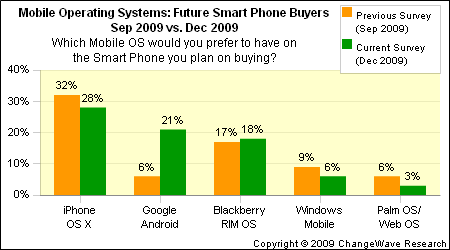
This week, ChangeWave released results from a December 9-14 survey of 4,068 U.S. consumers. Among those planing to buy a smartphone within 3 months, 21 percent said it would be an Android phone, up from 6 percent in September. Between the same two surveys, the number planning to buy an iPhone dropped from 32 percent to 28 percent.
Google has a huge user base. Other than perhaps Microsoft employees, who doesn't use Google search? Smartphones are about as much about data as voice. Now Google promises to use voice to make data services -- search being one of the most important -- a whole lot better.
Google's approach, obviously leveraging off its strengths, pits its informational and cloud services platform against Apple's mobile applications platform. Do you want the apps or the information? (Please answer the question in comments.) The answer won't be the same for everyone. There's a presumption among vocal Mac-loving bloggers that everybody wants mobile applications. But there is something appealing about the simplicity of using one service or facility to get needed information. Some people want the apps, others won't care as much as long as they can easily get what they need on the go.
Apple has a weakness, even as it today touts 3 billion downloads from the App Store. Google and its developers can always add more applications to the Android Marketplace. Where is Apple going to get search and supporting services like mapping? Google can much more easily encroach on Apple's mobile applications platform than Apple could challenge Google's informational and other cloud services platforms.
Perhaps this coming platform competition justifies Google dumping the smartphone designation. Today, the information giant called the Nexus One the first in a category of superphones. There's nothing exceptionally different about Nexus One that warrants calling superphone what is typically categorized as a smartphone. But the name change puts Google's ownership on a new mobile category, even if only from a marketing perspective. It's simply brilliant and very Applesque.
Google's superphone is both superman and alter-ego Clark Kent. It's the humble, glasses-wearing handset that simply makes phone calls. But voice search and voice-to-text superpowers -- leveraged off those Google cloud services -- make the Android 2.1 handset so much more. Those superpowers are easily spread by upgrading existing handsets to Android 2.1.
I ordered my Nexus One soon after Google put up the superphone's Website. I've long wanted to dump the keyboard for voice notes that would be searchable in audio or text form. Google's Android 2.1 handset might not go that far yet, but it promises to leap a tall building in a single bound. I'm too creative. All the great ideas come when I'm out and about. Voice to everything, dictation, twitter, etc. is what I need most. The voice-to-search services tied to GPS only make the capabilities sweeter.
What about you? What do you want from your next phone?

Survey my ba**s, let's just sit and watch this game, shall we!?
Score: 0
|I think it is going to be a closed battle between Google and Apple .... hope Apple can beat this giant otherwise another "Microsoft" online version.
Score: 0
|Dreamer.. Android = Linux based. iPhone = future MacOS based. Now, do you REALLY wanna say you belong to the 99% r-tards that believe Microsoft won't come to this battle with the BIGGER GUNS which will VIRTUALLY GUARANTEE VICTORY? Enjoy the huge r-tards camp... ;)
Score: -5
|Hahaha yeah right...tard.
Score: 0
|"Voice should have been it, but Microsoft failed to bring the technology to Windows Mobile in a big way."
Actually, Microsoft did it quite well, and I use it all the time. It's just that nobody hyped it because it wasn't from the gig A or the big G. It all depends on how you define "in a big way", and it's pretty easy to guess that your definition has more to do with me-too mindshare than it does actual usability.
As for the Nexus One, it's nice, but not a 'superphone'. If I make the switch to Android, it'll be when HTC comes out with the Sense UI version of the Nexus One (aka HTC Passion). It'll be WAY more useable then. HTC gets user interface way more than anyone else in the space, at least to anybody who actually uses multiple smartphones.
Score: 1
|MS use voice very well with Unified messaging/Exchange and Mobile. I've deployed Exchange UM servers with mobile and the execs love it, organise meetings or delegated so by pa, and work with messages etc. This is more business class though, this article like others of late does hit the mark that intuitive and fun devices made for the "consumer masses" that use the cloud may be more likely to succeed...
Score: 1
|Amen, brother. Now it doesn't take a genius, but it DOES take a non-retard to see the billion of light years ahead technology in the REAL OS Windows Mobile platform compared to some castrated flashy eye candy on top of a seriously restricted fake OS (iPhone) and dev-disgusted OS (Android=Linux). As the needs to "WOW" those idiotic masses (and not-less idiotic tech writers) increases, the company in position to actually DO SOMETHING TRULY WORTHY in the future is the one with the best engineered OS, which will give the most power to developers to CREATE and to CREATIVE HARDWARE MANUFS (HTC) to MAXIMALLY POTENTIALIZE. That ain't Android/ChromeOS and it ain't iPhone -- so sorry... The smarter/more creative a developer is, and a hardware manuf is, the more he'll find Windows Mobile his home, due to SOLID FOUNDATION. Anyone in biz knows this. Retarded consumers and consumer media? They'll just have to be "introduced" to it slowly in the future. Can't teach a dog to play piano in one day hehehe
Score: -3
|@ extremely well: So hilarious to see people trying so hard to make their point across...so childish too.
Score: 0
|Glad you enjoyed the style ;)
And yes, you are correct...you'll always hear this classic statement coming from great geniuses: "it sometimes offends average people to see how we, geniuses, can do so easily without preparation what it takes them (average people) hours to prepare for and they still do a WORSE JOB" hehehehehe
Sorry, my man, but my words are so powerful and the vision so clear, that the future has no choice but to form itself in my image of it. ;)
Score: 0
|I have yet to see Voice recognition work in an acceptable way on any device, that is actually recognizing the voice and not make the wrong selection 50% of the times...
Score: 1
|Voice recognition for numbers has been around for a long time, and no one uses it. Why do you believe that voice recognition for other functions will be any more popular?
Score: 0
|"Do you want the apps or the information?"
How about an affordable data plan.
"What do you want from your next phone?"
I want to extend it like I can Firefox. I don't want to go through an NDA & licensing nightmare so I can tinker.
Score: 2
|@melkor Agreed -- and how about reliable data service, too?
Score: 1
|I wonder, if you say "belladonna" will the phone find the nearest adult video store?!
Score: 0
|a 3000 word epic on the meaning of being open... declaring it's new phone to be alone in a new category of "superphones"... Yep, I smell hubris!
btw, what happened to Nokia? Has Google soared past Nokia as well? I thought Nokia is the true leader that all these US-focused apple-obsessed idiot-bloggers ignore..
Don't tell me you have forgotten them already??
Score: 0
|Good article. I'm going to have to look into FINALLY replacing my crummy commodity phone.
Small correction: "The search box is the user interface for the Web and one of the best meeting my six tenants of good technology design."
That should read "tenets" rather than "tenants". Nobody's paying rent, here. ;)
Score: 0
|@Prospero424 I must have been thinking about paying my rent. Fixed. Thanks.
Score: 0
|I mean it's still a phone barely better than the Droid running the same OS/software as every other Android phone out there. I fail to see why this particular phone is a "game changer". Want to call Android a game changer? Sure, I might even agree with you. But this phone isn't leaps and bounds better than anything else out there.
Score: 1
|It's a game changer because Mr. Wilcox wants more people to read what he writes, whether it's accurate or not. Hype is his game.
What else I've read about the phone is that it's somewhat different from the others, but not so different from HTC Hero or HD2. The big deal is that Google have chosen to show a new version of Android before anyone else gets it. That's gets them points for having a showcase and upsetting their partners.
Score: 3
|"I mean it's still a phone barely better than the Droid running the same OS/software as every other Android phone out there":
The Nexus One is running Android 2.1 and is a HTC phone (read: easily rooted and customizable). The Droid is running Android 2.0.1 and is Motorola-locked down. Sprint's HTC Hero is running Android 1.5 and the T-Mobile MyTouch3G is running Android 1.6. So, in terms of "barely" better than the Droid, I disagree. In terms of being leaps and bounds ahead of any other phone, there is one point that NO other phone can claim right now... it is non-subsidized and not carrier specific. Very, very rarely do we ever see a good phone that is not tied to a single carrier. That in and of itself makes it a huge game changer.
Score: 0
|Given that it's HTC hardware, of course it is not going to be different from the Hero or any other HTC phone. What makes it different is that it is the first Android phone released with the 1ghz SnapDragon processor and a dedicate GPU.
But hey, those are small differences, right?
Score: 0
|I'd say the HD2 is more of a game changer. Every single review has called it either the best or one of the best smartphones on the market. That's largely due to the Sense UI, not the underlying OS. I'd take a slower, lower rez HTC Hero over the Nexus One, because it's more usable on a day to day basis for the same reason: Sense UI.
Those who don't appreciate the efforts HTC has made (on both platforms too), don't really get what makes a smartphone "smart", and should stick to buying games and fart apps for their iPod phones.
Score: 0
|With all the hoopla from Google, where was Microsoft?
Ballmer gave his keynote address at CES, but the news media has ignored it. He had nothing to say about Windows Mobile 7, or how he would answer the Google juggernaut. He had no answer.
If the illusive Windows Mobile 7 was at alpha or beta stage, you'd think Ballmer would have demonstrated a bit of it, a feature or two, or showed us a glimpse of the interface, just to prove something is happening and it's still alive. But that was not possible. WM7 must be very behind in development, to such an extent that there's nothing that's complete enough to show (or nothing that's progressed enough that we wouldn't laugh at it).
From past experience, when a Windows Mobile OS goes out to OEMs, it's pretty well the finished product, and then there's a further 9 months of OEM testing before we see it on the street. It's going to be a long long time, probably much more than a year, before we see Windows Mobile 7.
Compare the WinMo fiasco and Ballmer's non-announcements to what Google brought us today. The updates are coming fast and swift, and they are not minor cosmetic lipsticking that we see with Windows Mobile. The Android upgrades are all substantial, and Android 2.1 is no exception.
Score: -3
|Isn't Ballmer's keynote supposed to be on Wednesday?
Score: 2
|WTF are you talking about you f0k0ng baboon? Steve Ballmer's keynote is on Wednesday!
Score: 1
|Windows Mobile's failure/future was excluded from Ballmer's keynote, so I think the criticism was justified.
Score: 0
|You should have something end-of-year that covers things you got wrong, over/under-stated, etc. It would be much more lengthy than blogging about what you got right... ;)
Score: 3
|"Today's Google Nexus One launch is as game changing as Apple's June 2007 release of the iPhone."
You must be kidding. B4 the iphone smartphones where just a nitch item that didnt do that much and wasnt that popular. The iPhone is the reason everyone is trying to make a iphone killer.
And there isn't much this Nexus phone can do that a iphone can't do.
And that survey is a joke. Most people pick the OS that they will actually buy. Which means if you have been with Verizon forever then you know you aint getting a iphone.
The Nexus is sure to be a goood phone. I'm not down playing what appears to be a very good phone. But lets get a grip for a minute. They havent even sold one phone yet. Nor has the device been reviewed.
Score: 1
|"You must be kidding. B4 the iphone smartphones where just a nitch item that didnt do that much and wasnt that popular."
Really? Wow!
Score: -1
|Niche, not nitch. Oops.
Score: 0
|"You must be kidding. B4 the iphone smartphones where just a nitch item that didnt do that much and wasnt that popular."
...in America. The rest of the world was using them already.
Score: 0
|"Nor has the device been reviewed"
Really? BGR and Engadget have both posted extensive reviews of the phone and given it high marks.
"And there isn't much this Nexus phone can do that a iphone can't do."
Agreed, but that is the point; up until now, no phone has really been able to compete with the iPhone. At least now, there is a bar that has been set for non-Apple devices to reach.
Score: 1
|@ ianbetteridge and OneToOne: Other than the nitch typo, I think bigsexy022870 is bringing an interesting view. You guys are so full of yourselves and narrow-minded morons.
Score: 0
|Hmm, weird thing is that the stats forgot to mention Nokia at all...
It is well known that in the US, Nokia failed to push their marketing, but it is the first seller in the rest of the world. And even in US they should score better than Palm and Microsoft together...
Maybe Changewave made (at least) an incorrect poll omitting one major player? Biased polls may lead to wrong conclusions...
IMHO, Nokia deserves to be on the spot...
Score: 2
|"For example, Jack Consumer can speak "Pizza Hut" and the phone will use GPS to find the nearest restaurant and then offer turn-by-turn vocal navigation on how to get there."
Umm, I can do exactly that on my WinMo phone using Bing. What is so revolutionary here? Just another "me-too" by Google.
Score: 0
|@OneToOne True enough, some of that capability is available in Bing for Windows Mobile or iPhone. But Google's search services and cloud platform reach is much greater than Microsoft's. It's a huge advantage for Google.
Score: 0
|Actually, you *technically* can with Bing on WinMo... However, Bing does not yet offer true navigation.
Google Maps for Android does offer true turn-by-turn, voice guided navigation. Also, Bing is limited in that it cannot search the local device. When you search on an Android 2.x device, it searches everything and gives you the relevant results. For instance, I want to drive to my friend's house. All I need to do is search for his name, and in the contact results, I have an option to navigate. 2 clicks is all it takes. I can't do that yet on my WinMo 6.5 phone and probably won't be able to for quite awhile.
After having both my MyTouch 3G and my HTC Touch Pro2, I have to say, Android is leaps and bounds ahead of WinMo. What I really took for granted on my Android device is sorely missing from my WinMo device (free navigation being one of those items. Trust me, after using Google Navigation for awhile and then trying to find ANYTHING close to it on WinMo is really disappointing). I really, really want to support WinMo, but it is still just too far behind the curve in terms of what the other mobile OSes are doing right now.
Score: 2
|The Google phone only catches up to the iPhone, it does not pass it. That means Apple still has the advantage, with more apps available - and they never stay still, always the moving target.
"Where is Apple going to get search and supporting services like mapping?"
You don't pay attention to tech news. Apple bought a company almost a year ago with mapping. Today they bought a mobile wireless ad firm. They can still work with Google for iPhone apps, but they have a choice to do these things on their own.
I do feel sorry for Droid. It is the big loser here. Fact is, the Android market is so splintered, there will never be a single android based phone to topple iPhone as king.
I am interested in the Nexus - I might get one if I can talk the wife into splurging $530 for me - I need a replacement phone for what I have with AT&T, and I do not need a data plan. I am happy with the iPod touch and probably will get the Apple tablet (no matter what the wife says about that!!).
Score: -1
|"Google's search services and cloud platform reach is much greater than Microsoft's. It's a huge advantage for Google."
Why, Joe? You can't get away with just stating that and not explaining why - after all, the examples you used are all, as OneToOne pointed out, available now on WinMo (and maybe even the Bing app on iPhone - I'm not going to load it to find out :) )
Score: 0
|@ianbetteridge That's best answered in a follow-up post, which is best delivered after all the CES clutter clears. Short version: Google search share is huge, Microsoft's is not. And the features offered in the Bing app don't come anywhere close to what Google promises with Nexus One/Android 2.1. I've got one coming today (paid for by me and 30-day return policy here in California). I'll have more to say after using Nexus One for a week or so. Competition will be stiff for personal approval. I really like the Nokia N900.
Score: 0
|