Office Home and Student accounts for 85% of US Office retail share

By Joe Wilcox | Published August 7, 2009, 4:54 PM

Which Microsoft Office version is most popular at US retail stores -- brick and mortar or online? Office Home and Student 2007, which inherited the position from XP and 2003 versions of Office Student and Teacher. Home and Student accounts for "85 percent of Office sales, either Mac or PC," said Stephen Baker, NPD's vice president of industry analysis.

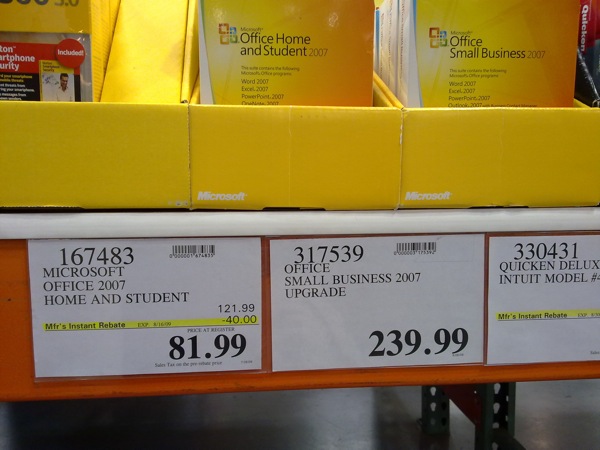
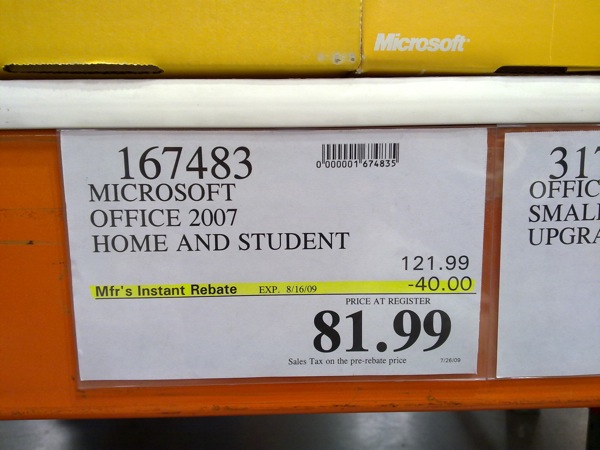
I asked Baker for the percentage because it's that time of year when students are preparing to go back to school and Microsoft and retailers practically give away Office Home and Student. Last week, I spotted the software, which normally sells for $149.95, at Microsoft Store for $99.99. That's a good deal, right? Wrong. This week, I saw the software at my local Costco selling for $81.99, after mail-in rebate. That's an even better deal, right? Wrong. Amazon sells the software for $79.99, no rebate.

That 80 bucks doesn't buy one but three Office Home and Student licenses. Three installations for $80. By comparison, Amazon sells Office Standard 2007 full version for $299.95, and that's for a single license; one activation. Microsoft Store sells the same software for $399.95.

So, I wonder: Who buys Office Home and Student? It's not like Microsoft or retailers check student IDs. That "Home" could apply to pretty much anyone. If someone runs a business out of the home, doesn't he or she technically qualify for a cheap copy of Office?

Microsoft doesn't talk about Office Home and Student or Student and Teacher editions piracy rates, but they have to be fairly high at retail if either version accounts for the bulk of sales. The company considers the purchase of software meant for one channel bought from another as piracy. Example: OEM Windows versions sold separately from new PCs.

According to current US Census Bureau statistics, there are about 25.4 million business firms in the United States -- 26.9 million when adding operations with single locations. Among both categories, there are 19.5 million non-employer businesses, with the majority being sole-proprietorships. Out of the 5.9 million employer firms, 3.8 million have 1-9 employees. So, in the United States, out of 25.4 million firms, 23.3 million have fewer than 10 employees. Where do these smaller businesses buy software? For the majority, it's brick-and-mortar or online retail stores.
costco-office2.jpg

Office versions for sale at Mission Valley Costco, San Diego

How many of these small or home-based businesses buy Office Standard 2007 or another version, when only 15 percent of US retail sales go to any edition other than Home and Student? Surprisingly few, if I rightly interpret NPD's US retail sales data.

While Microsoft doesn't talk about cross-channel piracy, the company doesn't ignore it, either. With Office 2007, Microsoft swapped out Outlook for OneNote in the consumer version. Before that, XP and 2003 Student and Teacher editions were feature identical to Office Standard, but with three licensees/activations for $250 less (even bigger difference during back-to-school buying season).

But is Outlook really that necessary for home-based or small businesses, when there are alternatives like Gmail or Windows Live Hotmail? It has been sometime since I checked in with the Hotmail team; but the last time, globally, small businesses accounted for more than 50 percent of users. Most people I know who aren't Windows geeks or use Outlook at work don't use Outlook. How about the people you know?

I first wrote about Student and Teacher edition in 2002, about 10 months after Microsoft started offering the version. At the time, analysts speculated Microsoft introduced the SKU to cut Office's price for consumers without jeopardizing business pricing. I have to ask: Is Microsoft victim of its own success, because of cross-channel piracy? The version 2007 SKU change strongly suggests so. Three licenses are tempting for the price.

What about future pricing and also retail market share? The heavy discounts won't last. "They always get aggressive on price in August, because that's when people are buying for back to school," Baker said. "This is time of year that you go nuts. That's when the volume's there; you don't want to let that stuff slip through your fingers."

What about that low pricing? "You saw $99 last year," Baker said. But 80 bucks? He said that Amazon typically is lower than other retailers, but the $79.99 price is about $5 less than what he remembers from last year.
costco-office1.jpg

Back-to-school pricing for Office 2007 Home and Student

About retail share, Baker said: "I don't think it's anything dramatically different form last year." He's right. Share was 80 percent in January 2007 and about the same three years earlier, according to older NPD data I looked up. I suspect 85 percent is about as high as the share will go.

But could the market share go down? That's the $64,000 question of the day. Microsoft has acquired domain Office.com, presumably for the forthcoming Office Web Apps. I've read lots of punditry about Microsoft trying to fend off perceived Google Apps competition. But what about Office Web Apps competing with Office Home and Student among consumers and small businesses?

I contend that Microsoft already has lost Office revenue because of home-based and small businesses buying Office Home and Student. That $80 is a great deal -- about $26.60 per license or $50 at full price -- but how much more attractive is free?

Last week, Stephen Elop, president of Microsoft's Business division, explained the Office Web Apps strategy during the company's annual Financial Analysts Meeting:

Office Web applications will be available in three ways. First, through Windows Live, where more than 400 million uses will have access to Office Web applications at no cost. Second, we will provide business customers with the opportunity to subscribe to Web applications as a service hosted by Microsoft similar to other offerings in Microsoft online services. And, third, all 90 million existing business customers with annuity agreements, plus all of the new Office 2010 volume license customers, will have rights to run Web applications on premises enabling them to deploy and manage these applications like they would any other service.

The software will be free for consumers, and the consumer Office version accounts for 85 percent of sales in the United States. That's not complex math to figure out. There has to be some cannibalization, unless Microsoft requires Office on the desktop as adjunct to Web Apps.

Something else: How exactly will Microsoft separate consumers from home-based or small business customers for Office Web Apps, when it can't for Office Home and Student? Perhaps there will be answers when or soon after Office Web Apps begins its Technical Preview later this month.

Comments

View comments by with a score of at least

Our company will not move past 2003 or XP until there are REAL reasons.

Score: 0

|

People still buying Office 2007 when 2010 is just around the corner?

Score: 0

|

"The company considers the purchase of software meant for one channel bought from another as piracy. Example: OEM Windows versions sold separately from new PCs."

Not 100% accurate info about the OEM Windows. You can buy the OEM System Builder version of Windows without a new PC, even without hardware. Just look at Newegg for example. If Microsoft thought that was not legal, they (Newegg) would have been shut down eons ago.

Now, if you are referring to the [Royalty OEM] versions of Windows from the large companies like Dell, HP, etc., then yes selling that Windows away from the branded machine it came with *is* a no-no.

Score: 0

|

Incorrect. System Builder OEM packs are, strictly speaking, only intended to be sold with new hardware. We all know that anyone with sense to look for them instead of buying retail can find them in many places. Why MS choose not to take that up with places that do sell to end-users is up to them.

Score: 1

|

They must be sold with new hardware TO THE END USER. The loophole is that Newegg can be presumed to be selling to someone who is building a system for an end user. Although Newegg clearly sells lots of products directly to end users, in this case, Newegg is perceived to be acting as distributor and Newegg's customer is considered to be a "system builder," even if the other (hardware) components of the system being built are not being purchased from Newegg in the same order. Sure, it's obviously a very gray area. Certainly Microsoft COULD choose not to be so lax, but if you follow the periodic press releases of piracy busts, it's clear that Microsoft keeps so busy chasing the big pirates (huge manufacturing operations which churn out truckloads of counterfeit shrink-wrapped boxes) that any single-digit, double-digit, or even triple-digit quantity of OEM 3-packs is irrelevant to them at this point. It may add up, but they'll take the market share for now.

Score: 1

|

And you just reaffirmed my comment with your own statement. I am a OEM System builder, I have talked to Microsoft at long lengths over this issue. The answer I got was: Y-E-S, we can sell a OEM copy of Windows to an end user. They can legally be considered a "System Builder" per the agreement.

Direct from the OEM System Builder site (relevant parts mentioned, *** used for the important part):

"Authorized Distribution and Acceptance:

Distribution of individual software licenses or hardware units contained in this Microsoft System Builder Pack (“package”) is not authorized unless you accept this license. You accept this license when you open this package. By accepting this license, you agree that you are a system builder. ***If you do not open this package, you may deliver it to another system builder. “System builder” means an original equipment manufacturer, an assembler, refurbisher, or pre-installer of software on computer systems.***"

End user can technically and legally be considered to fall under this definition. Trust me, I have gone at great lengths with Microsoft over the phone over this, if this were not true, then Newegg and the scores of other sites wouldn't be selling the product that way, as Microsoft would have put the screws to them already.

Score: 0

|

$80 is still too much for me. OpenOffice.org does all that I want (and probably all that *most* people need), plus it's free. Then again, I rarely use it, since most of my work would be with Word-like programs, and LaTeX is even better. :)

Score: 0

|

Robert Don't be such a pantsy... Open Office Sucks, heck if i want office apps you could use MS works which is the cheap version of sort but no one wants to use works... so save your meh comments.

Score: -1

|

Well, I have purchased the Student & Teacher version of MS Office 2007 for my partner (teacher) since she needs it (she does PowerPoint presentations, had compatibility issues with OpenOffice when processing various documents from her students, etc) but I don't use it - even when I work from home - because technically the license probably doesn't allow me to use it for business purposes.

In fact, we've had a single license of MS Office 2003 OEM in our company (others have been using OpenOffice for years), and instead of upgrading with the PC, last year we've replaced that one with OpenOffice too. For the documents and spreadsheets we need, OpenOffice will just do the job, and a single license of MS Office for 360 € (wholesale price, excl. VAT)? Not worth it.

Score: 0

|

The OO.o interface could use a little polishing (then again, it's not that different from pre-2007 Office), but functionality-wise, it can do almost anything Office can. Besides the UI, some good templates (especially for Present) wouldn't hurt, but that's not really related to the application itself. For *most* people, OO.o really is enough.

(In any case, I still stand by my statement that LaTeX trumps Word and OO.o Writer, although either of them could be decent if people used them properly.)

Score: 0

|

Since these figures have been pretty close for years, and they went ahead and widened the definition from "Student and Teacher" to "Home and Student", they are clearly aware of the issue and choose to pursue this course of action.

I think that they were worried that many small businesses would turn to Open Office or pure piracy. For $299, quite a few would have switched, but $80-100 seems like a small amount to pay to be "legal" and not have to worry about using something other than "the standard".

Outlook loses most of its advantages without Exchange, so I'm sure very few small business people cared about losing it. That move may have been targeted at academic institutions, and ensuring they have to pay for clients, once they were already locked into Exchange.

Is there anything in the Home & Student EULA that states you can't use it for doing any business? Say someone uses their personal computer for their small-company job? Or, someone outright uses one of the licenses on a work computer. Freeware vendors have specified things like that for years, but have any ever taken businesses to court?

Score: 0

|

they wouldn't turn to open office because its garbage as many have come to find out, what MS offers is farrr superior

Score: -1

|

Superior--yes, far--no.

Office may be their finest product but it's still full of bugs, including security holes. To their advantage, OpenOffice is overweight for no good reason.

Joe: it's nice that you're learning to shop for value. Is the economic crisis making you pinch pennies?

Score: 0

|

... did i miss the point of this article or something? was the point at the end or did you just feel like wasting an hour/hours of your life and a few minutes of my own with that market stuff that nobody, well, at least not myself cares about...

you learned how to shop around recently? found a 79$ deal, congrats, i guess

how will they know whos using 'office web apps' ? as long as folks are using it i'm sure MS will be happy, perhaps depending on your version of office 2010, when you sync/validate your copy of office 2010 with the cloud office services using your passport, it will know what you're using and offer various flavors of 2010 special features/options... folks with older versions get some basic form of web apps

Score: -1

|

if MS can get folks using the software, then they can worry about generating some cash flow from it, i didn't quite answer the 'how will they know' question fully, guess big picture is they won't be able to tell for the majority but maybe those enjoying the ease of use of apps and bolstering your brand will work to their advantage in the longer run and i think office 2010 will work well with the apps, depending on price many will use both and if there is anyone who knows office software its Microsoft

they might lose some $ but not users or share really, if anything their Office share will increase overall if the apps are decent

Score: 0

|

good find!

Score: 0

|

The Ultimate Deal is for secondary education only. Microsoft does check the student ID for this deal. But it's still no steal. Students attending colleges or universities with campus agreements can get the software for even less. Call it the $40,000/year Office deal. ;-)

Score: -1

|

what do you want them to sell office for? $10... ohhhhh k

Score: 0

|

Joe, I think you mean post-secondary. Plus, college or university must be registered, approved, and have a valid .edu email address. For those that do qualify, however, it's not a bad deal.

http://store.digitalrive...nPage&SiteID=msshus

Score: 0

|

Security firm: Windows patches not responsible for 'Black Screen of Death'

On second thought, maybe that access control list thingie with the lockdown something-or-rather didn't trigger an alleged, perhaps non-existent, pandemic.

Windows desktops and notebooks reach near price-performance parity for Holiday 2009

Gone are the days when average Windows desktop offered more for less than laptops.

Latest Firefox 3.6 beta fixes 133 bugs, promises faster page load times

A once-sluggish beta testing process has kicked into overdrive, with astonishing success at finding serious bugs. Will Mozilla be able to fix all the others in time?

Confirmed: Office 2010 to ship in June

Two weeks after Microsoft had been expected to draw a clearer roadmap for its principal applications suite, it's finally ready to commit to the end of H1.

Apple settles with Psystar except for 'circumvention devices'

The fracas with the Florida clone computer maker might have ended today had Apple not have muddled the issue over a cheap piece of Psystar software.

Microsoft denies latest 'Black Screen of Death' claims

After an anti-malware producer announced a fix to what it says is a swarm of recent KSoD problems, evidence of the swarm itself has yet to turn up.

New EU antitrust commissioner will oversee Microsoft, Oracle+Sun, Intel issues

As one of Europe's most prominent politicians shifts positions in January, her replacement remains a question mark over technology's biggest issues.

Without its own 'iTablet' yet, is Apple missing the boat?

Steve Jobs is on record as dissing "single-purpose" devices like e-readers. But given their recent popularity, was that a mistake?

Not-so-mobile battery life: Time to force the issue

Carmi Levy | Wide Angle Zoom: If power efficiency is important when you buy a car or even a motorcycle, why shouldn't it matter for a smartphone?

Apple invokes DMCA, claims Psystar is 'trafficking in circumvention devices'

In trying to close the book on possibly the last attempt at a Mac clone, Apple cites from its own landmark case...but may actually be misinterpreting it.

The fallacy of Facebook privacy

Carmi Levy | Wide Angle Zoom: If an insurance company learns something interesting about its client through the Internet, is that snooping?

Shareaza 2.5.1

December 1 - 8:55 PM ET

avast! Home 5.0.259 Beta

December 1 - 8:34 PM ET

ooVoo for Windows 2.2.3.24

December 1 - 8:13 PM ET

Sandboxie 3.42

December 1 - 7:52 PM ET

Soundbase 2009.12.01

December 1 - 7:31 PM ET

StatWin Pro 8.0 Beta

December 1 - 7:10 PM ET

Awasu 2.4.2 Alpha 1

December 1 - 6:49 PM ET